Suppose you know that as approaches 5, approaches 4 and approaches . Then must approach , and must approach : when two quantities each settle near a number, their sum and product settle near the sum and product of those numbers. The limit laws make that intuition into rules you can apply line by line, and they are why you can find most limits by plugging in, and why you sometimes can't.
The limit laws
Each law takes limits you already know and builds the limit of a combination.
The laws are true for the reason in the opening paragraph. If is within a tiny distance of and is within a tiny distance of , then is within twice that tiny distance of , and you can make that as small as you like by taking close enough to . The product and quotient laws come from the same kind of estimate, with one exception built in: if is approaching 0, dividing by it can blow up, so the quotient law needs . Topic 1.6 covers what to do when both and approach 0, and topic 1.14 covers a nonzero number divided by something approaching 0.
The final sentence of the box matters in both directions. You can't use the laws on pieces whose limits don't exist, and a combination can have a limit even when its pieces don't. Take and . Neither has a limit as , but for every , so . "The pieces don't have limits" never proves "the combination has no limit."
The laws also work with one-sided limits, or , as long as you use the same side for every piece.
Direct substitution, and why it works
Two limits are obvious: for a constant, and . Every polynomial is built from constants and with sums, products and powers, so the laws give its limit by substitution. For example,
Nobody writes all of that out on the exam, but it is the reason for every polynomial . A rational function is a quotient of polynomials, so the quotient law gives provided . For instance, .
The same holds for roots, trig, exponential and logarithmic functions at any point inside their domains: , . Functions with this property are called continuous, and topics 1.11 and 1.12 make that word precise. For these functions, substitution fails or needs care in three situations: a denominator that becomes 0, a point outside the domain, and a point where a piecewise function switches formulas.
Limits of compositions
For , the inside approaches some value , and the question is what does to inputs near .
Inputs close to give outputs close to when is continuous there, so as closes in on , closes in on . That is why : the inside approaches 25, and the square root is continuous at 25.
When is not continuous at , the limit of depends on how approaches :
- if approaches from above (values greater than ), the answer is ;
- if approaches from below, the answer is ;
- if equals for all near , then there, and the answer is .
This matters most with graphs, where has a jump and you have to look at the graph of to see which side its values come from. Example 3 does this twice.
One-sided limits by formula and by graph
A function defined in pieces, like
uses a different formula on each side of . A one-sided limit only sees one side, so you compute it with that side's formula: and . The two-sided limit exists exactly when both one-sided limits exist and are equal, so . The value plays no part in either limit.
A one-sided limit can also be forced by the domain. The function is defined only for , so , and the right-hand limit at 3 doesn't exist because there are no inputs on that side.
From a graph, a one-sided limit is the height the graph approaches as you trace toward from that side, regardless of any dot at itself (topic 1.3 covers reading limits from graphs). To combine two graphs with the limit laws, find each function's one-sided limits from its graph, combine them side by side, then compare the two sides.
Worked examples
Suppose , and . Find each limit, or explain why the limit laws can't give it.
(a)
(b)
(c)
(d)
Show solution
(a) Constant multiple, power and difference laws: .
(b) The root law applies because , and the denominator approaches , so the quotient law applies too:
(c) The denominator's limit is , so this is . A numerator approaching 0 is no problem.
(d) The denominator's limit is 0, so the quotient law does not apply. The numerator stays near 4 while the denominator shrinks toward 0, so the quotient's size grows without bound and there is no finite limit. Whether it heads to , to , or to neither depends on the sign of near 5, which isn't given.
Let where is a constant. Find the value of for which exists, and give the limit.
Show solution
The formula changes at , so compute each one-sided limit with its own formula. Both formulas are continuous where they are used, so substitution works on each side:
The two-sided limit exists only if these are equal: , so , and then .
The graphs of the functions and on are shown below. Each is made of line segments.
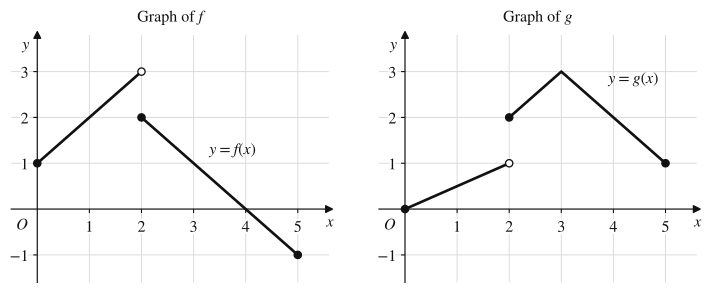
(a) Find .
(b) Find , or show that it does not exist.
(c) Find .
(d) Find , or show that it does not exist.
Show solution
Neither nor has a two-sided limit at , so work one side at a time. From the graphs: , , , .
(a) Left: . Right: . The one-sided limits agree, so , even though neither function has a limit at 2.
(b) Left: . Right: . Since , the limit does not exist.
(c) Ask what does on each side, then what does to those values.
- As , approaches 1. The graph of is unbroken at 1, so .
- As , approaches 2 with values greater than 2. So approaches the right-hand limit of at 2, which is 2.
Both sides give 2, so .
(d) Here , which is exactly where jumps, so the composition rule for a continuous outside doesn't apply. For , is greater than 2, and it approaches 2 from above as ; then . For , is less than 2 and approaches 2 from below, so . The one-sided limits are 2 and 3, so does not exist.
Parts (c) and (d) look alike, since in both the inside approaches the jump at 2, but the side it approaches from decides the answer.
Where students lose points
On the exam
Limit-law questions can be multiple choice without a calculator, built on given limit values like Example 1 or on two graphs like Example 3. When a free-response part asks whether a limit exists, the expected work is the two one-sided limits, each shown, and a sentence comparing them.
Check yourself
Question 1
If and , what is ?
- A
- B
- C
- D
The limit does not exist.
Show answer
A
The denominator's limit is , so the quotient law applies: . Choice B comes from losing the sign of and computing .
- A
Question 2
Suppose and for every near 3. Let for and for . Find .
Show answer
The inside approaches 2 from below, so the outside only receives inputs less than 2, where . The answer is . Substituting to get ignores that jumps at 2.
Question 3
Neither nor exists. What can you conclude about ?
- A
It does not exist.
- B
It exists and equals .
- C
It may or may not exist; you need more information.
- D
It exists only if and are both defined.
Show answer
C
The sum law needs both limits to exist, so it says nothing here. The sum can still have a limit: and each have no limit at 0, but their sum is 0. Or it can fail to: plus itself has no limit. Choice A is the tempting overreach.
- A
Question 4
If , find . (You may not assume in advance that this limit exists.)
Show answer
Write . Both pieces inside have limits, 5 and 4, so the sum and constant multiple laws give , and they also show the limit exists.