Lean on a wall and the wall pushes back on your hands; let go of a pencil and Earth pulls it down. Every force has a source, some other object doing the pushing or pulling. A free-body diagram is the drawing that lists those forces for one chosen object, and every Newton's-law equation you write in this course is read off one.
A force is an interaction between two objects
A force is a push or a pull that one object exerts on another. It is a vector: it has a magnitude, measured in newtons (), and a direction. A push to the left and a push to the right do opposite things.
Because a force is an interaction, you can always name it in the form "force on A by B". Before you draw an arrow, name the object that exerts it. If you can't name one, the force doesn't exist. "The force of the throw" on a ball that has left your hand fails this test: nothing is touching the ball anymore, so nothing is throwing it.
The same idea explains why an object can't exert a net force on itself. Sitting in a stalled car and pushing hard on the dashboard does not move the car: your hands push the dashboard forward, the dashboard pushes your hands backward, and the seat back pushes you forward to keep you in place. Every push between parts of the car-plus-you system is matched by an equal push the other way (Topic 2.3 makes this precise). To change the motion of a system, something outside it has to act on it. A car accelerates because the road pushes forward on its tires, not because the engine pushes on the car; the engine is part of the car.
Contact forces are electric forces seen from far away
Forces come in two kinds. Long-range forces act across empty space; in mechanics the one you meet is gravity (Topic 2.6). Contact forces act only when two objects touch: normal forces, friction, tension, spring forces and air resistance.
Contact forces aren't a separate kind of physics. When the atoms at two surfaces get very close, the electrons around them repel each other. A book resting on a table squeezes the table's surface atoms slightly closer together, like compressing trillions of tiny stiff springs, and those atoms push back. The sum of all those microscopic electric forces is what you call the normal force. This picture explains a fact students often miss: the normal force has no fixed size. Press down on the book and the surface compresses a bit more and pushes back harder. The normal force is whatever it needs to be to keep the book from sinking into the table.
| Force | Symbol | Exerted by | Direction | More in |
|---|---|---|---|---|
| Gravitational (weight) | Earth (or another mass) | toward Earth's center | Topic 2.6 | |
| Normal | a surface | perpendicular to the surface, pushing away from it | this topic | |
| Friction | a surface | parallel to the surface, opposing slipping or the tendency to slip | Topic 2.7 | |
| Tension | a rope, string or cable | along the rope, pulling away from the object | Topic 2.3 | |
| Spring | a spring | along the spring, back toward its relaxed length | Topic 2.8 | |
| Drag | air or a fluid | opposite the object's velocity relative to the fluid | Topic 2.9 |
A useful search procedure: an object feels gravity, plus up to two forces (a normal force and friction) from each surface it touches, plus one force from each rope, spring or hand attached to it, plus drag if it moves through air or a liquid fast enough for that to matter. Nothing else.
Drawing a free-body diagram
A free-body diagram shows every force the environment exerts on one object or system, and nothing else. Draw it this way:
- Pick the object or system and draw it as a dot. The dot stands for the center of mass (Topic 2.1): the model treats the object as if all its mass sat at that point.
- Find every force on it with the search procedure above, naming the object that exerts each one.
- Draw each force as one straight arrow that starts at the dot and points in the direction of the force. Label it with a symbol, and preferably with what exerts it.
- Make the lengths honest when you know how the sizes compare. If the forces balance, opposite arrows should be the same length.
When an AP free-response question asks for a free-body diagram, it asks for the forces, not their components: each force is its own straight arrow starting on the dot and pointing away from it. Splitting a force into components on the diagram draws the same force twice. Two forces that point the same way would lie on top of each other, so draw them side by side, both starting at the dot, so a reader can see that there are two.
Equally important is what stays off the diagram: forces that the object exerts on other things, the net force, , and the velocity. They are not forces on the object by something else, so they fail the "on A by B" test.
From the diagram to equations: choosing axes
Newton's laws (Topics 2.4 and 2.5) are applied one axis at a time, so you need axes. Any pair of perpendicular axes gives correct answers, but one choice makes the algebra easy: put one axis along the direction of the acceleration. Then the acceleration has only one component, and the other axis gets the equation "forces balance".
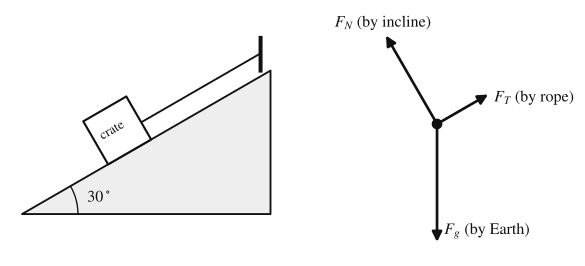
On an incline, an object that slides or is pulled moves along the surface, so tilt the axes: parallel to the incline and perpendicular to it. In the crate's diagram above, the normal force and the tension then lie along the axes, and only gravity has to be split. The axis is perpendicular to the incline and is perpendicular to the ground. The incline is tilted from the ground, so those two perpendicular lines are tilted from each other, and
Check it at the extremes: with the ground is flat and nothing pulls the crate along it (); with the "incline" is a wall and gravity is entirely along it.
These components go into your equations, not onto the diagram. For the crate in the figure, take and . It is at rest, so the forces along each axis balance:
The normal force is less than the crate's weight, , because the incline supports only the part of gravity that presses into it.
Worked examples
A ball is tossed straight up. Air resistance is negligible. Draw the free-body diagram of the ball (a) while it is still rising, after it has left your hand, and (b) at the top of its path.
Show solution
(a) Run the search: nothing touches the ball, so there is no normal force, friction or push. The only force is gravity. The diagram is a dot with one arrow, by Earth, pointing down.
(b) The same diagram: one downward arrow of the same length. The ball's velocity is zero for an instant, but velocity doesn't appear on a free-body diagram, and Earth keeps pulling.
The tempting extra arrow is an upward "force of the throw" in (a). Your hand's force acted only while it touched the ball. After release, the ball keeps rising because it already has upward velocity, and the downward force is what slows it.
A crate rests on a level floor with friction. You pull on a rope attached to the crate with a force directed above the horizontal, and the crate slides along the floor. Take . Draw the crate's free-body diagram and find the normal force on it.
Show solution
The crate touches the floor and the rope, and Earth pulls on it. So the diagram has four arrows from the dot: by Earth (down), by the floor (up), by the floor (horizontal, opposite the sliding), and by the rope ( above the horizontal, in the direction of the pull).
The crate slides horizontally, so put along the floor and straight up. It doesn't leave the floor or sink into it, so its vertical velocity stays zero. That makes its vertical acceleration zero, and by the second law the vertical forces balance:
The upward component of the rope's pull carries of the crate's weight, so the floor needs to push up only , not . This is why the normal force must come from the equations and not from habit.
Block A, of mass , rests on top of block B, of mass , which sits on a frictionless horizontal table. A horizontal force to the right is applied to block B. The blocks move together, without slipping, with an acceleration of to the right. Take .
(a) On separate dots, draw and label the forces (not components) exerted on block A and on block B.
(b) Justify the direction of the friction force exerted on block A.
(c) Calculate the magnitude of the friction force on block A and the magnitude of .
Show solution
(a) Go object by object and ask what touches each one.
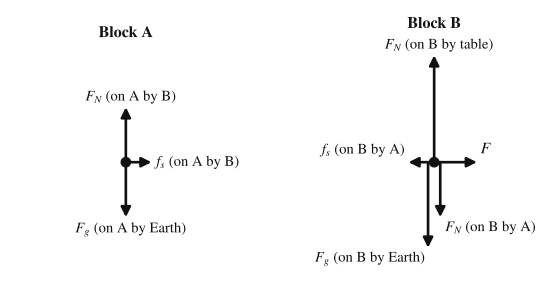
Block A touches only block B, so it feels gravity, a normal force from B, and friction from B. Block B touches the table (a normal force only, since the table is frictionless), touches block A (a normal force and friction), and has the applied force , plus gravity. The force A exerts on B is a normal force pushing down on B's top surface, not "the weight of A": A's weight is a force on A by Earth, so it belongs only on A's diagram.
(b) Block A accelerates to the right, so a net force to the right must act on it. Its vertical forces must balance, since it has no vertical acceleration. The only horizontal force on A is friction from B, so that friction must point to the right. It is static friction, because the surfaces don't slide relative to each other.
(c) With to the right (the direction of acceleration), Newton's second law (Topic 2.5) for block A alone gives
For , choose the two blocks together as the system. The friction forces between A and B are now internal, and the only external horizontal force is :
Check with block B alone: , as it must be. Choosing a different system for each unknown is the move that keeps every equation to one unknown.
Where students lose points
Check yourself
Question 1
A hockey puck slides to the right across level, frictionless ice. Air resistance is negligible. Which forces belong on the puck's free-body diagram?
- A
Gravity (down) and a normal force (up) only
- B
Gravity (down), a normal force (up), and a force to the right
- C
Gravity (down), a normal force (up), and friction to the left
- D
A force to the right only
Show answer
A
Nothing touches the puck except the ice, and frictionless ice can only push perpendicular to its surface. Earth pulls down. Choice B adds a force in the direction of motion that nothing exerts: the puck keeps sliding because it already has velocity.
- A
Question 2
At the microscopic level, the normal force that a tabletop exerts on a resting book is
- A
the gravitational attraction between the atoms of the book and the table
- B
the sum of electric forces between atoms at the two surfaces, which push back as the table's surface is compressed
- C
a fixed property of the table equal to the book's weight
- D
a reaction that appears only after the book stops moving
Show answer
B
Contact forces come from electric repulsion between the atoms of surfaces that are pressed together. That is why the normal force adjusts to the situation. Choice C fails because pressing down on the book makes the normal force larger than the book's weight.
- A
Question 3
A box rests on a level floor. You push straight down on its top with a force. Taking , what is the normal force the floor exerts on the box?
Show answer
About upward ().
The box stays at rest, so the vertical forces balance: . The floor pushes back harder because the extra push compresses its surface more.
Question 4
A person stands inside a large basket and pulls straight up on the basket's handles as hard as possible. The basket does not leave the ground. Which statement best explains why?
- A
The person's pull is smaller than the combined weight of person and basket.
- B
For the person-plus-basket system, the pull is an internal force, and a system cannot exert a net force on itself.
- C
The basket's handles cancel the pull by exerting friction on the person's hands.
- D
The ground's normal force increases to cancel the pull.
Show answer
B
The hands pull up on the handles, the handles pull down on the hands, and the feet press harder on the basket floor: every one of these forces is between parts of the person-plus-basket system, so together they add to zero. Only external forces (gravity and the ground) can change the system's motion. Choice A suggests that a strong enough pull would work, but no internal pull can.
- A