In 1750, Virginia and Massachusetts had similar populations, about 231,000 and 188,000. But 101,000 of Virginia's people were of African descent, almost all enslaved, against about 4,000 in Massachusetts. Both were English colonies under the same king, settled within a generation of each other. The difference came from what each place could grow, which decided what labor it needed, and from who chose to go there and why.
The Chesapeake and North Carolina: tobacco and servants
Virginia's first settlers looked for gold and found none. Around 1612 John Rolfe planted a sweet West Indian tobacco, and the first shipment went to England in 1614. Demand in England exploded, and by the 1630s Virginia was exporting more than a million pounds a year. Maryland (1634) followed the same path. The land suited the crop: a long, warm growing season, and deep tidal rivers (the James, York, Potomac) that let oceangoing ships load hogsheads (large wooden casks, each packed with several hundred to about 1,000 pounds of tobacco) at a planter's own wharf, which is why the region grew few towns.
Tobacco is labor-intensive. Seedlings must be transplanted by hand, each plant topped and cleared of worms and side shoots, then cut, hung to cure, and packed. It also wears out soil in a few years, so planters were always clearing new land. Profit therefore depended on how many workers a planter controlled. The headright system (50 acres for each person whose passage you paid) rewarded importing them. For most of the 1600s the workers were indentured servants, mostly young, single Englishmen who sold four to seven years of labor for passage, food and "freedom dues" at the end: a payment on release, usually corn, clothing and tools (early Maryland also promised 50 acres). About 100,000 servants came to the Chesapeake in the 1600s, roughly three of every four migrants. Malaria, typhoid and dysentery killed many before their terms ended, and men outnumbered women for decades, so families formed slowly.
From the 1680s planters shifted to enslaved Africans. Fewer English servants came as wages rose in England, more enslaved people were available once the Royal African Company (1672) and private traders expanded the trade, and Bacon's Rebellion (1676) had shown planters how dangerous a mass of armed, landless former servants could be. Enslaved people cost more up front but served for life and their children were enslaved too. By 1750, 44 percent of Virginians and 31 percent of Marylanders were of African descent. Topic 2.6 covers how laws turned this into a racial caste system. A small gentry of great planters, such as the Byrds and Carters, came to dominate the House of Burgesses and the established Anglican Church.
North Carolina's Albemarle region was settled from the 1650s mostly by Virginians moving south. Its coast had few good harbors behind the Outer Banks, so it grew more slowly, as a colony of smaller tobacco farms and of naval stores (tar, pitch and turpentine from its pine forests) for the Royal Navy.
New England: towns, families and commerce
Puritans came to build a godly community, and they came as families with their ministers. About 20,000 arrived in the 1630s; after that, migration nearly stopped, but New England's population still reached about 93,000 by 1700, almost entirely by births. Cold winters and clean water kept away much of the disease that ravaged the Chesapeake, so New Englanders lived longer than people in England, married young, and raised large families.
Settlement was organized by town. The colony's General Court granted land to a group of families, who laid out a village around a meetinghouse that served as both church and town hall, with farm lots and common pasture around it. Adult male church members ran local affairs in town meetings. The Congregational church was supported by taxes, and because Puritans believed every person should read the Bible, Massachusetts required towns of 50 families to hire a teacher (1647) and founded Harvard College (1636) to train ministers.
Thin, rocky soil and a short growing season ruled out a plantation staple. Families farmed corn, wheat, rye and livestock mostly for their own use and local sale. The wealth came from the sea and the forest: cod from the Grand Banks, timber and masts, and ships built cheaply from New England oak. Boston, Salem and Newport merchants carried fish, grain, livestock and lumber to the sugar islands of the West Indies and returned with molasses, which New England distilled into rum. That mixed economy of farming and commerce made New England less dependent on slavery (about 3 percent of its people in 1750), but its merchants profited from feeding the plantation colonies. Rhode Island's Narragansett country was a partial exception: a few large estates there used enslaved workers to raise cattle, sheep, cheese and horses for export to the West Indies.
The middle colonies: grain and diversity
New York and New Jersey (taken from the Dutch in 1664), Pennsylvania (1681) and Delaware had fertile soil, a longer growing season than New England, and broad rivers, the Hudson and the Delaware, leading to good ports. Farmers grew wheat and other grains, millers ground it into flour, and merchants in Philadelphia and New York shipped flour, bread and salted meat to the West Indies and southern Europe. These "bread colonies" were prosperous, and Philadelphia was among the largest cities in British America by the mid-1700s.
The people were the most varied in English America. New York kept its Dutch families, Dutch Reformed churches and great Hudson Valley estates, and added Huguenots (French Protestants, who founded New Rochelle in 1688) and a small Jewish congregation. Pennsylvania was a Quaker colony: William Penn, a Quaker persecuted in England, offered cheap land on generous terms and freedom of worship, and advertised across Europe. German-speaking Protestants (Mennonites, Lutherans, Reformed, later Moravians) came from 1683, when Francis Daniel Pastorius led the founding of Germantown, and arrived by the tens of thousands after 1717. Scots-Irish Presbyterians from Ulster poured into the backcountry from the same years. Penn guaranteed religious liberty in his 1701 Charter of Privileges:
BECAUSE no People can be truly happy, though under the greatest Enjoyment of Civil Liberties, if abridged of the Freedom of their Consciences, as to their Religious Profession and Worship . . . I do hereby grant and declare, That no Person or Persons, inhabiting in this Province or Territories, who shall confess and acknowledge One almighty God . . . shall be in any Case molested or prejudiced, in his or their Person or Estate, because of his or their conscientious Persuasion or Practice . . .
William Penn, Charter of Privileges, 1701
The tolerance had limits. The same charter allowed only those who professed belief in Jesus Christ to hold office. Its promise of tolerance was also practical: diversity made it hard for any one church to dominate, and religious freedom drew the settlers who made Penn's land valuable. Slavery existed here too, especially in New York, where 14 percent of the people were of African descent in 1750.
The southern Atlantic coast and the West Indies: plantations with Black majorities
The most valuable English colonies were not on the mainland. In the 1640s Barbados planters turned to sugar, the most profitable and deadliest crop of the era, and imported enslaved Africans in huge numbers; by the early 1700s they outnumbered whites there by about three to one. Barbados wrote a comprehensive slave code in 1661, and Jamaica, taken from Spain in 1655, followed the same model. Sugar work killed so many that the islands needed constant new imports of captives.
Carolina was planted from Barbados. Planters from the island founded Charles Town in 1670 and brought slavery with them from the start; Carolina's founding constitution of 1669, drafted with help from John Locke for its eight Lords Proprietors (the English nobles to whom Charles II had granted Carolina in 1663), declared that every free colonist "shall have absolute power and authority over his negro slaves." After early profits from deerskins and the Indian slave trade, planters found their staple in the 1690s: rice, grown in the swampy low country, which had a long growing season of more than eight months. Many enslaved West Africans came from rice-growing regions and knew the crop. Enslaved people were 43 percent of South Carolina's population in 1700 and about 70 percent by 1720. In the 1740s Eliza Lucas (later Pinckney) developed indigo, a blue dye, as a second crop, and Parliament paid a bounty on it from 1748. Georgia, chartered in 1732 as a buffer against Spanish Florida and a fresh start for poor Britons, banned slavery in 1735 under James Oglethorpe's trustees, but pressure from colonists who wanted rice plantations ended the ban in 1751.
With Black majorities on the rice coast, enslaved people built a culture with more independence than Chesapeake slaves had. Rice plantations used the task system: each worker got a daily task, such as hoeing a set area, and once it was done the rest of the day was theirs to tend gardens, raise poultry or sell goods. Chesapeake tobacco used the gang system, in which workers labored together under an overseer from sunrise to sundown. On the low-country coast, the Gullah language mixed English with West African languages, and African traditions survived in names, sweetgrass baskets, and worship such as the ring shout, a counterclockwise devotional dance that joined African movement with Christian song. Topic 2.6 covers resistance, including the Stono Rebellion of 1739.
Historians argue about these regions. Peter Wood's Black Majority (1974) and Judith Carney's Black Rice (2001) argued that enslaved Africans' expertise built the rice economy. David Eltis, Philip Morgan and David Richardson replied in 2007 that planters and markets drove it and that captives came from many parts of Africa, not mainly from rice regions. More broadly, Jack Greene (Pursuits of Happiness, 1988) argued that the Chesapeake, not Puritan New England, was the typical British colony, and that the regions grew more alike in the 1700s.
Worked examples
Read the excerpt from Penn's Charter of Privileges above. Identify and describe Penn's claim.
Show solution
Claim: Political liberty is incomplete without freedom of conscience, so the government should protect from harm anyone who believes in God and obeys the law, whatever church they belong to.
How to find it. The sentence is built as "BECAUSE . . . I do hereby grant." The "because" clause is the reason (people cannot be happy without religious freedom, even with civil liberties), and the grant is the conclusion (no one who acknowledges one God may be harmed for their beliefs). A claim is the position plus its reason, so state both.
Describing it. Penn was a Quaker, and Quakers had been jailed in England for refusing to attend the Church of England, so the claim comes from experience. The claim also has a boundary worth noticing: protection extends to those who acknowledge "One almighty God," and the next clause limits office to Christians. That boundary is what makes a precise description better than "Penn supported religious freedom."
Explain how environmental factors caused the economies of New England and the Chesapeake to develop differently in the 1600s.
Show solution
Answer. The Chesapeake's long, warm growing season and fertile soil suited tobacco, a labor-intensive export crop, and its deep tidal rivers let ships load directly at plantations. Planters therefore built dispersed plantations and imported as many laborers as they could, first indentured servants and then enslaved Africans. New England's short growing season and rocky soil could not support a profitable export crop, so families farmed for their own needs, while its harbors, forests and nearby fisheries turned the economy toward fishing, shipbuilding and trade with the West Indies. Settlement in compact towns followed from family-based farming and Puritan community goals.
Why this works. Each environmental fact is joined to an economic result by a "so" or "therefore," which is what "explain how" requires. Naming the specific crop, labor force and trade keeps it from being a generic "the South was warm."
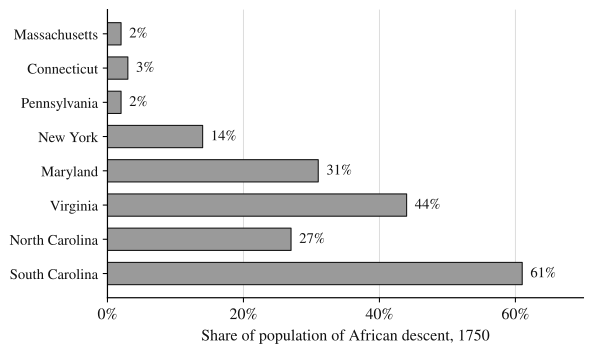
Data from U.S. Bureau of the Census, Historical Statistics of the United States, Colonial Times to 1970 (1975)
a. Briefly describe ONE pattern shown in the chart.
b. Briefly explain ONE cause of the pattern in South Carolina shown in the chart.
c. Briefly explain ONE way enslaved people in the region of South Carolina shaped their own lives despite enslavement.
Show solution
a. The share of people of African descent rose sharply from north to south: 2 to 3 percent in Massachusetts, Connecticut and Pennsylvania, 31 to 44 percent in Maryland and Virginia, and 61 percent in South Carolina, the only colony shown with a Black majority.
b. South Carolina's planters, many of them from Barbados, built plantations around rice, a labor-intensive export crop suited to the low country's swamps and long growing season. They imported enslaved Africans in large numbers from the 1690s, some from West African rice-growing regions, so that enslaved people were already about 70 percent of the population by 1720.
c. Under the task system on rice plantations, enslaved workers who finished their daily task controlled the rest of their time, and many used it to keep gardens and livestock and sell produce. In the low country they also developed the Gullah language and religious practices such as the ring shout that kept West African traditions alive.
Why these earn the points. Part (a) describes a pattern with numbers from the chart instead of listing one colony. Part (b) gives a cause (rice and the planters' Barbados model) rather than restating the 61 percent. Part (c) names specific practices and connects them to autonomy, which is what "shaped their own lives" asks for.
Where students lose points
On the exam
This topic's skill is identifying a claim in a source, so expect a charter, promotional tract, or traveler's account with questions about what the author argued and why. Data questions use population or trade figures like the chart above. In essays, regional comparisons (Topic 2.8) work best when each region gets its environment, crop, labor system and settlers.
Check yourself
Question 1
Which development best explains why the Chesapeake colonies shifted from indentured servants to enslaved Africans in the late 1600s?
- A
Parliament outlawed indentured servitude in the colonies after 1660.
- B
Fewer English servants were available, the supply of enslaved Africans grew, and planters feared unrest among landless former servants after Bacon's Rebellion.
- C
Tobacco required less labor than rice, so planters could manage with fewer workers held for life.
- D
Puritan ministers in the Chesapeake encouraged slavery as a way to convert Africans.
Show answer
B
Rising wages in England reduced the flow of servants, the Royal African Company and private traders expanded the slave trade, and the 1676 rebellion showed the danger of armed former servants. Choice C reverses the logic: tobacco was labor-intensive, and labor demand is why planters wanted lifelong workers. Indentured servitude was never outlawed, and the Chesapeake was Anglican, not Puritan.
- A
Question 2
In two sentences, contrast the task system and the gang system, and say where each was used.
Show answer
Under the task system, used on low-country rice plantations in South Carolina and Georgia, each enslaved worker had a set daily task and controlled the remaining time once it was done. Under the gang system, used on Chesapeake tobacco plantations, enslaved people worked together under an overseer for the whole day.
The task system gave enslaved people more control over their time, which they used for gardens, livestock and trade, and it is one reason low-country slaves built more autonomous communities, along with their majority in the population.
Question 3
Which statement best describes the middle colonies around 1700 to 1750?
- A
They exported grain and flour and had the greatest ethnic and religious diversity in British North America.
- B
They depended on rice and indigo grown by enslaved majorities.
- C
They were settled almost entirely by Puritan families organized in towns with one established church.
- D
They prohibited slavery and allowed people of any religion to hold office.
Show answer
A
Fertile soil and ports like Philadelphia and New York made grain the export, and Quaker toleration, Dutch heritage and German and Scots-Irish migration made the region diverse. Choice D overstates their tolerance: slavery was legal, and Pennsylvania limited office to Christians.
- A
Question 4
In 1750, Rhode Island had about 33,000 people, of whom about 3,300 were of African descent, while Massachusetts had 188,000 with about 4,100. Which explanation best fits Rhode Island's higher share?
- A
Rhode Island grew rice in its coastal swamps.
- B
Newport merchants were deeply involved in Atlantic trade, including the slave trade, and some Narragansett-area estates used enslaved labor.
- C
Rhode Island was founded by Quakers who invited enslaved people to settle as free farmers.
- D
Rhode Island was a royal colony required by Parliament to import a quota of enslaved Africans.
Show answer
B
About 10 percent of Rhode Island's people were of African descent, far above Massachusetts's 2 percent, because Newport was a center of Atlantic commerce and the slave trade and the colony's larger farms used enslaved workers. It shows that New England was tied to slavery through commerce even without a plantation staple. Rhode Island grew no rice (its Narragansett estates raised livestock, cheese and horses), no colony had a Parliamentary slave quota, and Roger Williams, not Quakers, founded it.
- A