A function is continuous at when the value it heads toward near is the value it actually takes at : in symbols, , with both sides existing. A discontinuity is a point where that fails, and the graph breaks there. The breaks come in three kinds, and you tell them apart by asking what the one-sided limits do. Topic 1.11 takes the definition of continuity apart condition by condition; this topic is about recognizing and naming the ways it fails.
Three ways a graph can break
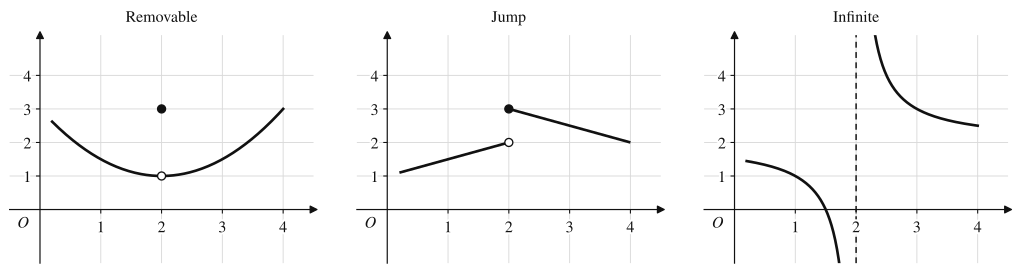
Removable. The two one-sided limits exist and are equal, so exists and is a finite number . The trouble is only at the single point: either is undefined (a hole in the graph) or (a hole with the point displaced above or below it). It is called removable because changing or supplying one value, , repairs it; topic 1.13 does exactly that.
Jump. Both one-sided limits exist as finite numbers but are different. The graph arrives at one height from the left and leaves from another height on the right, so no choice of can make it continuous. The value , if it exists, may match one side, the other, or neither.
Infinite. At least one one-sided limit is or , and the line is a vertical asymptote. One side is enough: approaches 0 as but grows without bound as , and that single infinite side makes an infinite discontinuity. Topic 1.14 covers infinite limits and asymptotes in more detail.
Whether exists does not decide the type. The graph of has a removable discontinuity at 1, has a jump at 0, and has an infinite discontinuity at 0, and none of the three is defined at its point. The limits decide the type; the value only matters for deciding whether there is a discontinuity at all.
Not every discontinuity fits these three. oscillates between and infinitely often near 0, so neither one-sided limit exists, finite or infinite. AP questions classify only the three named types, but this example is why the classification starts by computing the one-sided limits rather than guessing from a formula.
Where each type comes from
You can predict where to look from the way a function is built.
Rational functions (a polynomial over a polynomial) break only where the denominator is 0, and the numerator decides how. If the numerator is also 0 there, is a factor of both; cancel it and look again. If the cancelled form has a nonzero denominator at , the limit is finite and the discontinuity is removable. If the numerator is not 0 at , the fraction is a nonzero number over something approaching 0, and its size grows without bound, so the discontinuity is infinite. A rational function never has a jump: near the same formula applies on both sides, so if both one-sided limits are finite they are the same number.
Piecewise functions can break at the points where the rule changes, and that is where jumps come from. Each one-sided limit at a boundary is computed with the piece that applies on that side. A piece's own formula can also break inside its interval, for instance a fraction whose denominator is 0 there.
Absolute values produce jumps when they appear in a quotient: equals for and for .
Worked examples
Let . Find every value of where is discontinuous and classify each discontinuity, with justification.
Show solution
The denominator is 0 at and , so those are the only candidates; elsewhere is a quotient of polynomials with a nonzero denominator. Factor both parts:
At : the numerator is also 0, and after cancelling,
The limit exists but is undefined, so has a removable discontinuity at .
At : the factor did not cancel, and the numerator approaches . As , is a small positive number, so ; as , it is a small negative number, so the quotient . Since a one-sided limit is infinite, has an infinite discontinuity (a vertical asymptote) at .
Let
Classify each discontinuity of .
Show solution
Each formula is a polynomial or a quotient of polynomials, so the only places can break are the boundaries and and the point , where the last piece's denominator is 0 (and , so that piece is in use there).
At : from the left use , giving ; from the right use , giving . The limit exists and equals 2, but . That is a removable discontinuity.
At : from the left use , giving ; from the right use , giving . Both are finite and they differ, so this is a jump discontinuity. (Here , matching the left side, but that doesn't change the type.)
At : the numerator is 7 while . As the quotient , and as it . That is an infinite discontinuity.
Let , where is a constant.
(a) For what value of does have a removable discontinuity at ? For that value, find .
(b) For every other value of , what type of discontinuity does have at ? Explain.
(c) Is there any value of for which has a jump discontinuity at ? Explain.
Show solution
(a) The denominator approaches 0, so the limit can be finite only if the numerator also approaches 0; otherwise the quotient grows without bound. Set the numerator equal to 0 at :
With the numerator factors as , so for , and . Since is undefined, the discontinuity is removable.
(b) If , the numerator approaches while the denominator approaches 0, so the quotient's absolute value grows without bound from each side. The discontinuity is infinite, with a vertical asymptote at . For example, with the numerator approaches 2, and as and as .
(c) No. A jump needs two different finite one-sided limits. Near the same formula applies on both sides, and parts (a) and (b) cover every : either both one-sided limits equal 7, or at least one is infinite.
Where students lose points
On the exam
Classification questions come as multiple choice (a formula, a piecewise rule or a graph, and a choice of types or of the points where one type occurs) and as free-response parts asking whether a function is continuous at a point, with justification. The justification the exam rewards names the limits: for a jump, the two different one-sided limits; for a removable discontinuity, the existing limit and the missing or different value; for an infinite one, the infinite one-sided limit. "The limit does not exist" on its own is not a justification; give the one-sided behavior that shows it.
Check yourself
Question 1
Let . At which value of does have a removable discontinuity?
- A
- B
- C
- D
has no removable discontinuity
Show answer
C
The denominator factors as , so for . At the limit is , finite, so that discontinuity is removable. At and the numerator is not 0 while the denominator is, so those are infinite discontinuities; choices A and B treat every zero of the denominator the same way.
- A
Question 2
Let . Find and , and classify the discontinuity at .
Show answer
The left-hand limit is and the right-hand limit is , so has a jump discontinuity at .
For , , so . For , . Both one-sided limits are finite and they differ, which is a jump.
Question 3
A function is defined for all near except at itself. Which of the following must be true?
- A
has a vertical asymptote at
- B
does not exist
- C
is not continuous at
- D
has a removable discontinuity at
Show answer
C
Continuity at requires to exist, so a missing value always means a discontinuity. Which type it is depends on the one-sided limits, so A, B and D can each be false: at 1 has a limit (so B and A fail), and at 0 is not removable (so D fails).
- A
Question 4
Classify the discontinuity of at , giving both one-sided limits.
Show answer
and , so is an infinite discontinuity.
As , and ; as , and . One infinite one-sided limit is enough for an infinite discontinuity, even though the other side is finite. It is not a jump, because a jump needs both sides finite.