A limit question on the exam can hand you a formula, a graph, a table of values, or a sentence such as "as approaches 2, approaches 3." These are four views of one object, and a question often gives you two of them at once, say as a graph and as a formula, and asks about .
One limit, four views
The statement says that the outputs get as close to as you want once the inputs are close enough to , with . The value plays no part: it can equal , differ from , or not exist. The one-sided limits and use only inputs below or only inputs above , and the two-sided limit exists exactly when both one-sided limits exist and are equal.
Take near , where it is undefined because the denominator is 0.
| View | What it shows near |
|---|---|
| Table | , , , |
| Graph | A smooth curve rising through the point , with an open circle there |
| Formula | Factor: for , so the limit is |
| Words | As approaches 2 from either side, approaches 3 |
Each row says the same thing. Translating between them is mechanical once you know what to look for: a limit on a graph is a height the curve heads toward, in a table it is the value the outputs settle on from both directions, in a formula it is what the algebra of topics 1.5 and 1.6 produces, and in words it is the sentence the notation abbreviates.
What each view can prove
The views are not equally strong. A formula, worked with the limit laws, algebra, or the squeeze theorem (topic 1.8), proves a limit's value. A graph whose key heights are labeled or sit on grid lines, or a sentence stating a limit, hands you an exact value to use as given, the way a theorem's hypothesis is given. A table, alone, only suggests a value.
A table samples, it doesn't prove. A table shows finitely many inputs, and a function can do anything between them. Let . At the inputs to the cosine are , all even multiples of , so every entry of the table is exactly 1. Yet does not exist: at , which also crowd toward 0, the cosine's input is an odd multiple of and . The table chose inputs that hid the oscillation. That is why exam questions ask you to estimate a limit from a table, and why a table is evidence you weigh against other information (for instance, being told the function is continuous) rather than a proof.
A graph is read, not computed. On a graph the limit from the left is the height the curve approaches as you trace it toward from the left, and likewise from the right. An open circle marks a point missing from the graph, and a filled dot marks the actual value . The limit ignores both, because it is about the heights near . A drawing is only as precise as its labels: take heights from labeled points and grid lines, and when a figure is marked not drawn to scale, trust the labels over the picture. A limit read that way is exact, which is why Example 2 below combines graph-read limits with the limit laws.
Infinite behavior in every view. If the outputs grow without bound as , you write . On a graph this is a curve climbing along a vertical asymptote; in a table, outputs like as gets closer to ; in a formula, typically a nonzero numerator over a denominator approaching 0. Writing describes how the limit fails to exist; it does not make the limit a number. Topic 1.14 covers infinite limits in full.
Combining limits from different views
The limit laws do not care where a limit came from. If is read off a graph and comes from a formula, then . The laws need each piece's limit to exist, though, and when one doesn't, the combination can still have a limit. You find it by going back to one-sided limits, combining each side separately, and comparing.
Compositions need the direction of approach. To find , first find what approaches and from which side, then ask what does as its input approaches that value from that side. With the graph of in Example 2 below, which jumps at 3 (heights near 4 just left of 3, heights near 3 just right of 3), compare two limits at :
- In , the input approaches 3 and is always less than 3 for , so .
- In , the input approaches 3 from above, so .
The inside approaches the same number in both, and the answers differ only because of the side. If the inside approaches a value while never equaling it, itself is irrelevant; you need the limit of at , not its value.
Worked examples
Let , the function from the first section. A student makes a table with and , sees that 3 lies between them, and claims . Explain what the table supports, then establish the limit.
Show solution
Two entries at distance 0.1 from 2 only show that takes values near 3 on either side; they say nothing about which number the outputs settle on as gets closer. Adding and gives and , which close in on 3 from below and from above. That is good evidence, but still a sample.
To prove it, use the formula. Direct substitution gives , which means is a factor of both the numerator and the denominator. Factor the difference of cubes and the difference of squares:
The limit only looks at , so it equals the limit of the simplified expression, which is continuous at 2:
The table also matches the formula's shape: the outputs increase through 3, consistent with being increasing near 2.
The graph of on is shown below. Let .
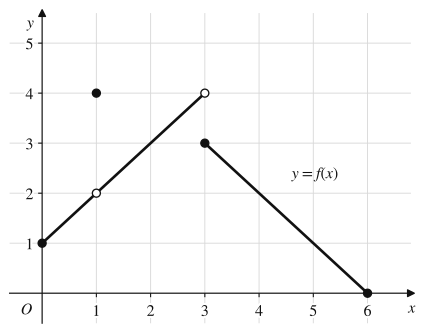
(a) Find and .
(b) Find , , and if it exists.
(c) Find .
Show solution
(a) As approaches 1 from either side, the curve's height approaches the open circle at 2, so . The filled dot gives . The two numbers differ, and that is allowed: the limit describes the heights near 1, the value is the height at 1.
(b) Tracing the left segment toward , the heights approach 4, so . Tracing the right segment toward 3, they approach 3, so . The one-sided limits are different, so does not exist.
(c) Neither nor has a limit at 3, so the sum law doesn't apply; work each side. For , , so ; for , . Then
The one-sided limits agree, so . The jump of in is cancelled by the jump of in .
For the function graphed in Example 2, which of the following limits does not exist?
(A)
(B)
(C)
(D)
Show solution
Check each one, tracking which side the inner function approaches from.
(A) Near , , which approaches 1 and is not equal to 1 for . So the limit is . It exists. (The value is a different number, and a tempting wrong answer if you substitute instead of taking a limit.)
(B) Near , , which approaches 3. Because is increasing, the inner values are below 3 when and above 3 when . So
The one-sided limits differ, so this limit does not exist.
(C) From the left, and , so the product approaches ; from the right it approaches . Both sides give 0, so the limit is 0.
(D) The inner approaches 1 from both sides without equaling it for , so the limit is .
The answer is (B).
Where students lose points
On the exam
A question on this topic gives you a graph or a table of , sometimes with a formula for another function, and asks about a sum, product, quotient or composition. Answer choices can include the function's value at the point and "does not exist," so decide on a two-sided limit only after you have both one-sided limits. When a question gives a table and says the function is continuous at a tabulated input , continuity makes the entry equal to (topic 1.11); the entries at other inputs near still only suggest a limit.
Check yourself
Question 1
The functions and satisfy , , and . Which of the following is true?
- A
and does not exist
- B
Both and do not exist, because does not exist
- C
does not exist and
- D
and
Show answer
A
Work each side. The sum approaches from the left and from the right, so its limit is 4. The product approaches from the left and from the right, so its limit does not exist. Choice B assumes a combination can't have a limit when its pieces don't; choice D uses only the right-hand values for the product.
- A
Question 2
A function satisfies , and . Find .
Show answer
As , the inside approaches 1 and is less than 1 for every , so the outer function's input approaches 1 from the left. The limit is therefore . The value never enters, because the inside never equals 1 for .
Question 3
Suppose is read from a graph with labeled points, and is known to be continuous at , with a table giving . What is ?
Show answer
Continuity at 1 makes . Both limits exist, so the limit laws apply no matter where the limits came from: the numerator approaches and the denominator approaches , which is not 0. The quotient's limit is .
Question 4
A table gives at , and nothing else is known about . Which statement must be true?
- A
- B
- C
is continuous at
- D
None of the other three statements is guaranteed by the table
Show answer
D
A table samples finitely many inputs. The function matches every entry, since each in the table is an even multiple of , yet it has no limit at 0 and is undefined there. Choice A is the tempting one: the table suggests 6 but cannot prove it.
- A