Evaluate at and you get ; at you get . As closes in on 1 the values pass every number you could name, so they do not approach any number, and the limit at 1 does not exist. "Does not exist" hides a lot, though: these values all grow in one direction without bound, which is very different from values that jump or oscillate. Infinite limit notation records exactly that behavior, and on a graph it shows up as a vertical asymptote.
What an infinite limit says
Writing
means that can be made larger than any number you choose, by taking close enough to (with ). Pick , and there is a window around where every value of exceeds ; pick a million, and a narrower window works. means the same with "smaller than any negative number." The one-sided versions, (inputs to the left of ) and (inputs to the right), restrict attention to one side.
The symbol is not a number, and an infinite limit is a way of saying how a limit fails to exist. Writing is correct and more informative than writing "does not exist," but it does not mean the limit exists. For the same reason, you can't do arithmetic with it as if it were a value: two expressions that each go to can have a difference that goes to anything.
A two-sided infinite limit needs both sides to agree. If from both sides of , write . If one side goes to and the other to , as does at 3, state the two one-sided limits and say the two-sided limit does not exist; writing it as is wrong.
One unbounded side is enough. The graph then runs up or down along the line , getting closer to it without reaching it, and that is what an asymptote is.
Nonzero divided by almost zero
Most vertical asymptotes come from a quotient whose denominator approaches 0 while its numerator does not. Dividing a fixed number by smaller and smaller numbers gives larger and larger results: and . So the size of the quotient blows up, and only its sign is left to decide. The sign comes from the signs of the numerator and the denominator on the side you are approaching from.
To analyze a quotient at a point where :
- Check the numerator. If , the quotient is unbounded near and is a vertical asymptote. If too, the form is and you must simplify first; the limit may be a finite number, giving a hole instead of an asymptote (topic 1.13).
- Find the sign on each side. Factor the denominator and decide the sign of each factor for slightly less than , then slightly more. Only the factor that is 0 at changes sign; every other factor keeps the sign it has at .
- Write the one-sided limits. Positive over a small positive or negative over a small negative gives ; mixed signs give .
The power of the zero factor decides whether the two sides agree. An odd power such as or changes sign at , so the two one-sided limits have opposite signs. An even power such as is positive on both sides, so the two sides match. For instance, with , the numerator is near and the denominator is a small positive number on both sides, so
a genuine two-sided infinite limit.
Asymptotes beyond rational functions
The same reasoning applies to any function that has a quotient or a logarithm inside it.
- Logarithms. As , , because reaching a very negative output only needs a tiny positive input (). The line is a vertical asymptote of , and only the right-hand limit makes sense, since is undefined for .
- Tangent. . As , and is a small positive number, so ; from the right, is a small negative number and . That happens at every odd multiple of .
- One side only. For , as the exponent and , but as the exponent goes to and . The right side alone makes a vertical asymptote.
- A zero denominator without an asymptote. is undefined at 0, but its limit there is 1 (topic 1.8), so its graph has a hole at , not an asymptote.
A function that is continuous at has the finite limit there, so it cannot have a vertical asymptote at . Vertical asymptotes can only occur where a function is not continuous, and they are the infinite discontinuities of topic 1.10. To find all of them, list the inputs where the function is undefined or its formula breaks (zero denominators, a logarithm's argument reaching 0, odd multiples of for ) and test each one.
Worked examples
Let . Find the vertical asymptotes of the graph of , and find both one-sided limits at each.
Show solution
The denominator factors as , which is 0 at and . Check the numerator at each: and . Neither is 0, so both are vertical asymptotes, and only the signs remain.
Near , the numerator is near 1 (positive) and is near (negative). The factor carries the sign change.
- : , so the denominator is , small. Positive over small positive: .
- : , so the denominator is , small. Positive over small negative: .
Near , the numerator is near 9 and is near 4, both positive. The factor carries the sign change.
- : , so .
- : , so .
The graph below shows all four behaviors: up along on the left and down on the right, down along on the left and up on the right.
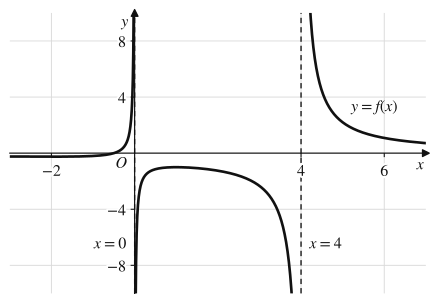
Let . Find every vertical asymptote of the graph of and justify each one with a limit.
Show solution
is defined for with . The places to test are the edge of the domain, , and the zero of the denominator, .
At , only is possible. Here the numerator while the denominator . An unbounded negative quantity divided by a quantity near is unbounded and positive:
so is a vertical asymptote. This one is not "nonzero over zero"; the numerator is what blows up.
At , the numerator is , a positive number, and the denominator goes to 0. For the denominator is positive and for it is negative, so
and is a vertical asymptote.
The numerator is 0 at , but that only makes ; it has nothing to do with asymptotes, which come from the function becoming unbounded.
Let , where is a constant.
(a) Find all values of for which the graph of has exactly one vertical asymptote. For each, give an equation of the asymptote.
(b) Let . Find , and .
(c) Is it possible to choose so that the graph of has no vertical asymptotes? Explain.
Show solution
(a) The denominator factors as , so the candidates are and . Each is an asymptote unless the numerator is also 0 there, in which case the shared factor cancels and leaves a hole. For exactly one asymptote, the numerator must be 0 at exactly one of them.
Numerator 0 at : , so . Then the numerator is , and for , . At the numerator is , so the only vertical asymptote is .
Numerator 0 at : , so . Then the numerator is , and for , . At the numerator is , so the only vertical asymptote is .
For any other , the numerator is nonzero at both points and there are two asymptotes. So (asymptote ) or (asymptote ).
(b) With , for . Near the numerator is near 2, which is positive.
At the simplified form is continuous, so
The limit at 2 is finite, which is why is not an asymptote: the graph has a hole at .
(c) No. Removing both would need the numerator to be 0 at both and , which would make it a multiple of . A numerator of the form with leading coefficient 1 would have to equal exactly, and its constant term is , not . So at least one asymptote remains for every .
Where students lose points
On the exam
To justify that is a vertical asymptote, give one one-sided limit at that is or ; a statement about the denominator being 0 is not enough on its own. On calculator-active questions, a graphing calculator can draw a near-vertical segment across an asymptote or skip a narrow spike, so decide asymptotes from the formula, using the graph only to confirm.
Check yourself
Question 1
What is ?
- A
- B
- C
- D
Show answer
A
The numerator approaches 4. The denominator is : for slightly less than 3, is a small negative number and is near 6, so the denominator is a small negative number. Positive over small negative gives . Choice B comes from checking only the size and not the sign.
- A
Question 2
Find every vertical asymptote of the graph of .
Show answer
Only .
The denominator is and the numerator is , so for the function equals . At and the limits are and (holes), while at the numerator of is nonzero, so .
Question 3
A function satisfies and . Which of the following must be true?
- A
The line is a vertical asymptote of the graph of .
- B
- C
is undefined.
- D
The line is a horizontal asymptote of the graph of .
Show answer
A
One unbounded one-sided limit is enough for a vertical asymptote. B is false because the left side approaches 5, so the two-sided limit does not exist. C need not hold: could be defined, for example as 5. D confuses a limit as with end behavior.
- A
Question 4
Find .
Show answer
As , while approaches 0 through positive values (sine is positive just below ). A number near divided by a small positive number is unbounded and negative.