Connecting Limits at Infinity and Horizontal Asymptotes
Find limits as x grows without bound, read them as end behavior and horizontal asymptotes, and compare how fast functions grow using a limit of their ratio.
Topic 1.15 · 9 min read
Evaluate x2+13x2 at x=10 and you get about 2.970; at x=100, about 2.9997. As x grows, the +1 in the denominator matters less and less, and the values settle toward 3. Topic 1.14 asked what happens as x approaches a number; this topic asks what happens as x itself grows without bound, which is the question of a function's end behavior: what its graph does at the far right and far left.
Limits at infinity
Writing
x→∞limf(x)=L
means that f(x) stays as close to L as you want once x is large enough. Choose a tolerance like 0.001, and from some point on, every value of f(x) is within 0.001 of L. The limit as x→−∞ means the same for inputs that are very negative. A function can also grow without bound at the ends, written x→∞limf(x)=∞ (as x2 does), or have no limit at all because it keeps oscillating (as sinx does, swinging between −1 and 1 forever).
A few limits are the building blocks for everything else:
Function
As x→∞
As x→−∞
xp1, p>0
0
0 (when xp is defined for x<0)
ex
∞
0
e−x
0
∞
lnx
∞
not defined
arctanx
2π
−2π
The first row is the workhorse: a fixed number divided by something growing without bound shrinks to 0. The last row is a function with two different horizontal asymptotes, y=2π on the right and y=−2π on the left.
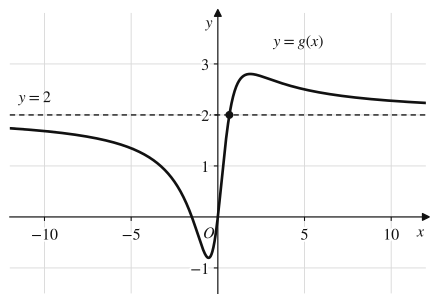
A horizontal asymptote only describes what happens far out. Unlike a vertical asymptote, it can be crossed, any number of times. The function g(x)=x2+12x2+3x has x→±∞limg(x)=2, yet g(x)=2 when 3x=2, so the graph crosses y=2 at x=32, rises above it, and then falls back toward it.
Rational functions: the leading terms decide
For large x, the highest power in a polynomial dwarfs everything else. At x=1000, the term 5x is about 0.17% of 3x2. So the end behavior of a rational function comes down to the leading term of the numerator over the leading term of the denominator. To show it with limits, divide every term by the highest power of x in the denominator, then use xpc→0:
x→∞limx2+13x2=x→∞lim1+x213=1+03=3.
A rational function always has the same limit at both ends (when the limit is finite), so it has at most one horizontal asymptote.
Radicals, and why x→−∞ needs care
With a square root, the dominant term is still the one with the highest power, but x2=∣x∣, not x. For negative x, ∣x∣=−x, and that sign flip is where two different asymptotes come from. Take x−34x2+1. Inside the root, factor out x2: 4x2+1=∣x∣4+x21. Then
The graph has two horizontal asymptotes, y=2 and y=−2. The sign check is reasonable: for very negative x, the numerator is positive and the denominator is negative.
Comparing how fast functions grow
When f and g both grow without bound, the limit of their ratio says which one grows faster:
"Faster" is about the long run, not about which function is bigger at a particular x. At x=10, x10=1010 is far bigger than e10≈22,026. But ex overtakes x10 near x≈35.8 and stays ahead, and by x=100 it is about 2.7×1043 against x10=1020. Each step from x to x+1 multiplies ex by e≈2.718, while it multiplies x10 by (xx+1)10, a factor that sinks toward 1 as x grows. A constant multiplier always beats one that shrinks toward 1. The proof that the ratio goes to 0 uses L'Hospital's Rule (topic 4.7); until then, use the ordering as a known fact.
"Same rate" can hide a large difference. x2+100x is always bigger than x2 for x>0, by 100x, which itself grows without bound. Still, x2x2+100x=1+x100→1, so the two grow at the same rate: the extra 100x is a vanishing fraction of the total.
Taking the limit of a ratio works the same way for any two quantities that both go to infinity, or both go to 0, including two rates of change. If two tanks drain at rates that both approach 0, the limit of the ratio of the rates tells you which tank's flow becomes negligible next to the other's. Example 4 does this.
Worked examples
Worked exampleExample 1: rational end behavior
Find x→∞lim and x→−∞lim for each function, and give any horizontal asymptotes.
(a) f(x)=3−2x26x2−x
(b) g(x)=5x2+1x3−2x
Show solution
(a) The degrees are equal, so divide every term by x2:
f(x)=x23−26−x1⟶0−26−0=−3
as x→∞, and the same computation works as x→−∞. The horizontal asymptote is y=−3. The negative sign comes from the denominator's leading coefficient, −2, which is why reading the leading coefficients (not the first-written terms) matters.
(b) The numerator has the higher degree. Divide by x2:
g(x)=5+x21x−x2.
The denominator goes to 5, and the numerator behaves like x. So x→∞limg(x)=∞ and x→−∞limg(x)=−∞. There is no horizontal asymptote; for large ∣x∣ the graph behaves like the line y=5x.
Worked exampleExample 2: exponentials, two asymptotes
Let k(x)=2ex+36ex+1. Find the horizontal asymptotes of the graph of k.
Show solution
The two ends behave differently because ex grows on the right and shrinks on the left, so take each limit separately.
As x→∞, ex dominates. Divide every term by ex:
k(x)=2+3e−x6+e−x⟶2+06+0=3.
As x→−∞, ex→0, so no division is needed:
k(x)⟶0+30+1=31.
The graph has two horizontal asymptotes: y=3 (on the right) and y=31 (on the left).
Worked exampleExample 3: a difference that looks like ∞−∞
Find x→∞lim(x2+6x−x).
Show solution
Both terms go to ∞, and the form ∞−∞ gives no answer by itself: the first term is a little bigger than the second, and the question is how much. Multiply and divide by the conjugate to turn the difference into a quotient:
x2+6x−x=x2+6x+x(x2+6x)−x2=x2+6x+x6x.
Now divide the top and bottom by x, using x2+6x=x1+x6 for x>0:
1+x6+16⟶1+16=3.
So the line y=3 is a horizontal asymptote on the right. The answer makes sense: x2+6x is close to (x+3)2=x+3 for large x, which is 3 more than x.
Worked exampleExample 4: two drinks cooling (exam style, no calculator)
A cup of coffee and a cup of tea are both poured at 85 degrees Celsius into a room at 20 degrees Celsius. The temperature of the coffee is C(t)=20+65e−0.08t and the temperature of the tea is T(t)=20+t+201300, both in degrees Celsius, where t is minutes after pouring. Their rates of change are
C′(t)=−5.2e−0.08t,T′(t)=−(t+20)21300
degrees Celsius per minute.
(a) Find t→∞limC(t) and interpret it in context.
(b) Both drinks approach the same temperature. Use a limit to decide which drink is eventually much closer to that temperature.
(c) Find t→∞limT′(t)C′(t) and explain what it says about how the two drinks are cooling after a long time.
Show solution
(a) As t→∞, −0.08t→−∞, so e−0.08t→0 and
t→∞limC(t)=20+65⋅0=20.
In the long run the coffee's temperature approaches 20 degrees Celsius, the room's temperature. The line y=20 is a horizontal asymptote of the graph of C.
(b) The tea also approaches 20, since t+201300→0. Compare the distances from room temperature, C(t)−20=65e−0.08t and T(t)−20=t+201300, with the limit of their ratio:
because an exponential with a positive exponent grows faster than any polynomial. The coffee's distance from 20 degrees becomes negligible compared with the tea's, so the coffee is eventually much closer to room temperature. At t=60, for instance, the coffee is about 0.535 degree above room temperature and the tea is 16.25 degrees above.
again because the exponential in the denominator outgrows the polynomial (t+20)2. After a long time the coffee's temperature is changing at a rate that is negligible compared with the tea's, in degrees Celsius per minute. Both drinks keep cooling, but the coffee's cooling dies out much faster, which matches part (b): the coffee has almost no temperature difference left to lose.
Where students lose points
On the exam
A horizontal asymptote is justified by a limit statement, such as x→∞limC(t)=20, for each direction you claim. When a question gives a function in context, it can ask for the limit as t→∞ with an interpretation; the interpretation names the quantity, its units, and the long-run value, as in Example 4(a).
Check yourself
Question 1
What is x→−∞lim4−3x9x2+2?
A
1
B
−1
C
3
D
0
Show answer
A
For x<0, 9x2+2=∣x∣9+x22=−x9+x22. Dividing the top and bottom by −x gives −4/x+39+2/x2→33=1. Choice B comes from replacing x2 by x, which is wrong for negative x.
Question 2
Find x→∞lim2⋅3x+x4x5+3x.
Show answer
21
The exponential 3x outgrows every power of x, so divide every term by 3x: 2+x4/3xx5/3x+1. Both 3xx5 and 3xx4 go to 0, leaving 21.
Question 3
As x→∞, which of these functions grows fastest?
A
x100
B
(1.01)x
C
(lnx)50
D
100x99
Show answer
B
An exponential with base greater than 1 eventually outgrows every power of x, however large the power, and every power of x outgrows every power of lnx. The base 1.01 makes the exponential slow to start, which is what makes A tempting, but x→∞lim(1.01)xx100=0.
Question 4
Find every horizontal asymptote of the graph of y=2arctanx+1.
Show answer
y=π+1 and y=1−π.
As x→∞, arctanx→2π, so y→2⋅2π+1=π+1. As x→−∞, arctanx→−2π, so y→1−π. The two directions give two different asymptotes.
Question 5
Let f(x)=x2+100x and g(x)=3x2. Do f and g grow at the same rate as x→∞? Justify with a limit.
Show answer
Yes. x→∞limg(x)f(x)=31, a positive number, so they grow at the same rate.
3x2x2+100x=31+3x100→31. For large x, f(x)≈31g(x): the term 100x grows without bound but becomes a vanishing fraction of x2, and the constant factor 3 does not change the rate class.