Find a limit by trapping a function between two simpler ones, check the theorem's conditions, and use the limits of sin(x)/x and (1 - cos x)/x that it proves.
Topic 1.8 · 6 min read
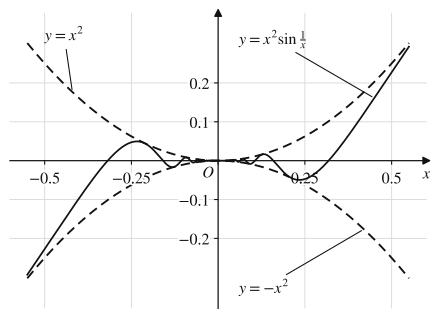
As x→0, the factor sinx1 swings between −1 and 1 infinitely many times and never settles, so it has no limit, and the product law can't handle x2sinx1. But the swinging factor can never make the product bigger than x2 or smaller than −x2, and both of those go to 0. A function pinned between two others that meet at the same height has nowhere else to go. That is the squeeze theorem, and it also proves the two trig limits behind every derivative of sine and cosine.
The squeeze theorem
The graph shows the idea. The solid curve wiggles without end near 0, but it lives in the narrowing gap between the dashed parabolas, and that gap closes to the single point (0,0).
Why it's true: pick any distance, however small. Close enough to c, both g(x) and h(x) are within that distance of L. Since f(x) sits between them, it is too. That is exactly what x→climf(x)=L means.
Each condition earns its place. The bounds must squeeze toward the same number: if 1≤f(x)≤3 near c, you only learn that a limit, if one exists, lies between 1 and 3. For a two-sided limit, the inequality must hold close to c on both sides; what happens far from c, or at c itself, doesn't matter.
Building the bounds
The bounds usually come from the fact that sine and cosine never leave [−1,1], whatever their input:
−1≤sin(anything)≤1,−1≤cos(anything)≤1.
Multiply through by a factor that is never negative, and the inequality survives. For x=0, x2>0, so
−x2≤x2sinx1≤x2.
Both bounds approach 0 as x→0, so x→0limx2sinx1=0.
If the factor can be negative, multiplying flips the inequality wherever it is negative. The clean fix is to bound the absolute value: if ∣f(x)∣≤B(x) near c and B(x)→0, then −B(x)≤f(x)≤B(x), and the squeeze theorem gives f(x)→0. Example 1 uses this.
Why xsinx approaches 1
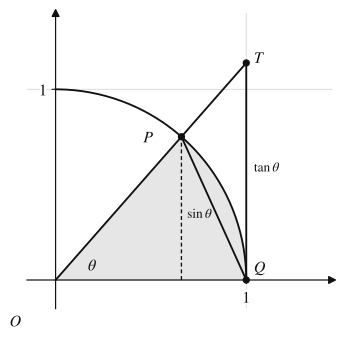
Substituting x=0 into xsinx gives 00, and no identity removes a common factor. The squeeze theorem settles it, using a picture of the unit circle.
Take 0<θ<2π, measured in radians. In the figure, three regions are nested: triangle OPQ fits inside the sector OPQ, which fits inside triangle OQT. Their areas are:
triangle OPQ: base OQ=1, height sinθ, area 21sinθ;
sector OPQ: a fraction 2πθ of a circle of area π, so area 2θ;
triangle OQT: base 1, height QT=tanθ, area 21tanθ.
Nested regions have increasing areas, so 21sinθ<21θ<21tanθ, which gives
sinθ<θ<cosθsinθ.
Divide through by sinθ, which is positive here: 1<sinθθ<cosθ1. Taking reciprocals of positive numbers reverses both inequalities:
cosθ<θsinθ<1.
As θ→0+, cosθ→1 and the constant 1 stays 1, so the squeeze theorem gives θ→0+limθsinθ=1. For negative θ, −θsin(−θ)=−θ−sinθ=θsinθ, so the expression takes the same values on both sides of 0, and the left-hand limit is also 1.
The sector area 2θ is where radians matter. In degrees the sector's area is 360πθ, and the same argument gives xsinx∘→180π instead of 1. Calculus uses radians so that this limit is 1.
Why x1−cosx approaches 0
This one also starts as 00. For 0<x<2π, use 1−cos2x=sin2x:
1−cosx=1+cosx(1−cosx)(1+cosx)=1+cosxsin2x.
Since 1+cosx>1 here, 0<1−cosx<sin2x. Divide by x>0 and use xsinx<1 from the previous section:
0<x1−cosx<sinx⋅xsinx<sinx.
Both 0 and sinx approach 0, so x→0+limx1−cosx=0. For negative x, replacing x by −x changes only the sign of the denominator, so the values on the left are the negatives of those on the right, and they approach −0=0 as well.
So arrange the expression to match before using either one. For example, 2xsin5x=25⋅5xsin5x→25, and xtanx=xsinx⋅cosx1→1⋅1=1.
Worked examples
Worked exampleExample 1: a bound with an odd power
Find x→0limx3cosx5.
Show solution
The factor cosx5 has no limit at 0, so the product law can't be used. Bound it instead: cosx5≤1 for every x=0, so
The absolute values matter: for negative x, x3 is negative, and multiplying −1≤cosx5≤1 by it would flip the inequality. Since x→0lim(−∣x∣3)=x→0lim∣x∣3=0, the squeeze theorem gives x→0limx3cosx5=0.
Worked exampleExample 2: bounds given as an inequality
The function f satisfies 4x−9≤f(x)≤x2−2x for all real x. Find x→3limf(x). What does the inequality tell you about x→0limf(x)?
Show solution
Both bounds are polynomials, so their limits come from substitution: x→3lim(4x−9)=3 and x→3lim(x2−2x)=9−6=3. The bounds hold for all x and approach the same value, so by the squeeze theorem x→3limf(x)=3.
The lower bound never exceeds the upper one, because their difference is (x2−2x)−(4x−9)=x2−6x+9=(x−3)2≥0, so the two bounds touch only at x=3. That is why x=3 is the one place they squeeze. At x=0 the bounds approach −9 and 0, which are different, so the inequality says only that f(x) stays between them near 0. It doesn't determine x→0limf(x), or even guarantee it exists.
Worked exampleExample 3: using the trig limits
Find (a) x→0limtan5xsin3x and (b) x→0limx21−cos2x.
Show solution
(a) Write tan5x=cos5xsin5x, then give each sine the denominator it needs:
The middle two factors each approach 1 and cos5x→1, so the limit is 53.
(b) The double-angle identity cos2x=1−2sin2x turns the numerator into 2sin2x:
x21−cos2x=x22sin2x=2(xsinx)2→2(1)2=2.
Worked exampleExample 4: an exam-style squeeze (no calculator)
The function f satisfies cosx≤f(x)≤1+x2 for all x in the interval −1<x<1.
(a) Find x→0limf(x). Justify your answer.
(b) Find f(0).
(c) Find x→0limxf(x)−1. Justify your answer.
Show solution
(a) Both bounds are continuous at 0: x→0limcosx=1 and x→0lim(1+x2)=1. Since cosx≤f(x)≤1+x2 on an open interval containing 0 and both bounds have limit 1, the squeeze theorem gives x→0limf(x)=1.
(b) The inequality holds at x=0 too: cos0≤f(0)≤1+0, so 1≤f(0)≤1 and f(0)=1.
(c) Subtract 1 throughout: cosx−1≤f(x)−1≤x2. Now divide by x, one side at a time, because dividing by a negative number reverses inequalities.
For 0<x<1:
xcosx−1≤xf(x)−1≤x.
As x→0+, the left bound is −x1−cosx→0 and the right bound x→0, so the right-hand limit is 0.
For −1<x<0, the inequalities reverse:
x≤xf(x)−1≤xcosx−1.
As x→0−, both bounds again approach 0, so the left-hand limit is 0. Both one-sided limits are 0, so x→0limxf(x)−1=0.
Where students lose points
On the exam
The two trig limits come inside quotients that you rearrange first, as in Example 3. The squeeze theorem itself is a justification: when a question gives you an inequality like the one in Example 4, a complete answer states the inequality, shows that both bounds have the same limit, and names the squeeze theorem. Topic 2.7 uses both trig limits to find the derivatives of sinx and cosx.
Check yourself
Question 1
What is x→0limsin2xsin7x?
A
27
B
1
C
72
D
The limit does not exist.
Show answer
A
Rewrite as 27⋅7xsin7x⋅sin2x2x. Both fractions approach 1, leaving 27. Choice B applies the known limit without matching each sine's angle to its own denominator.
Question 2
The function g satisfies 2−x2≤g(x)≤2cosx for all x near 0. Find x→0limg(x).
Show answer
x→0limg(x)=2
Both bounds are continuous at 0, and 2−0=2 and 2cos0=2. The bounds hold near 0 and approach the same value, so by the squeeze theorem g(x)→2.
Question 3
The function h satisfies 1≤h(x)≤3 for all x. What can you conclude about x→0limh(x)?
A
It exists and is between 1 and 3.
B
It equals 2.
C
It might not exist.
D
It equals 1.
Show answer
C
The bounds approach different values (1 and 3), so the squeeze theorem doesn't apply. A function like 2+sinx1 stays between 1 and 3 and has no limit at 0. Choice A assumes the limit exists, which is the one thing the theorem would have had to prove.
Question 4
Find x→0lim1−cosxx2.
Show answer
2
Multiply top and bottom by 1+cosx: the expression becomes sin2xx2(1+cosx)=(sinxx)2(1+cosx), which approaches 12⋅2=2.