The curve passes through the point , since . To find its slope there the way you have so far, you would first solve for , and that means solving a cubic equation in for every . Implicit differentiation skips that step. You differentiate the equation as it stands, treating as an unknown function of , and the chain rule from topic 3.1 tells you what to do with every you meet.
One equation, several functions
A function is defined explicitly when is written alone on one side: . It is defined implicitly when an equation ties and together without isolating : .
An implicit equation can describe a curve that is not the graph of any single function. The circle fails the vertical line test, since the line meets it at and . But near any one point other than and , where the tangent is vertical, a small piece of the circle is the graph of a function. The top half is and the bottom half is , and both satisfy the equation. When you differentiate implicitly, you are differentiating whichever of these functions passes through the point you care about, and the coordinates you plug in pick it out for you.
That is why implicit derivatives usually contain both and . At the circle has two different slopes, one at and one at , so a formula that depended on alone could not give both.
Why every term picks up
Since stands for a function of , any expression in is a composition: the inside is and the outside is whatever is done to it. So is , and by the chain rule
This is the row from topic 3.1's table, with . Compare : there the inside is itself, whose derivative is 1, so no extra factor appears. The factor is the inside derivative, and you cannot write it as a number or a formula yet because you don't know . You carry it as an unknown and solve for it at the end.
| Expression | Derivative with respect to |
|---|---|
The last three rows need more than the chain rule. A term such as is a product of two functions of , so it needs the product rule, and the factor inside it still brings its own . In , the inside is the product , so the inside derivative is the whole product-rule result.
Try it on the circle. Differentiating both sides of gives
At the slope is , and at it is , one formula giving both. You can confirm the first one explicitly: on the top half, , so , which at is . There is also a geometric check. The radius to has slope , and a tangent to a circle is perpendicular to the radius, so its slope is the negative reciprocal, .
Solving for
After you differentiate, appears in one or more terms, and the equation is linear in it: it is never squared or inside a function. So you can always isolate it with algebra.
Back to the opening curve, . The first term is a product, so
Collecting and factoring,
At , the slope is .
When you only need the slope at one point, you can substitute the coordinates right after step 1 and then solve. At the differentiated equation becomes , so with almost no algebra. Substitute only after differentiating; the last trap below shows what goes wrong otherwise.
Reading horizontal and vertical tangents from the formula
Write the implicit derivative as a fraction, , where and are expressions in and .
- The tangent is horizontal at a point of the curve where and , since the slope is 0 there.
- The tangent is vertical at a point of the curve where and . The slope is undefined there, and the curve, viewed with as a function of , has .
- Where and are both 0, the formula gives and decides nothing. The curve might cross itself there or have a cusp, and you would need another method.
Setting gives one equation in two unknowns, so it describes many points, almost all of them off the curve. You find the actual points by solving it together with the original equation. On the circle, , so a horizontal tangent needs ; the circle then gives , so the horizontal tangents are at and , where .
Differentiating an implicit equation a second time gives as a relation in , and . Topic 3.6 shows the computation, and topic 5.12 uses it to find and classify critical points of implicit curves.
Worked examples
Find for the curve , and find the slope of the curve at .
Show solution
First confirm the point is on the curve: .
Write the roots as powers, , and differentiate both sides. The term is a composition with inside , so it gets the factor ; the constant 5 has derivative 0:
Only one term contains , so isolate it directly:
At , the slope is . A negative slope fits the curve: as grows, grows, so must shrink to keep the sum at 5.
Write an equation for the line tangent to the curve at the point .
Show solution
Check the point: .
Differentiate both sides. The derivative of is by the chain rule, needs the product rule, and is a constant:
Collect the terms and solve:
At , the slope is . The tangent line through is
Solving for first was never an option here: cannot be solved for with algebra and the functions in this course.
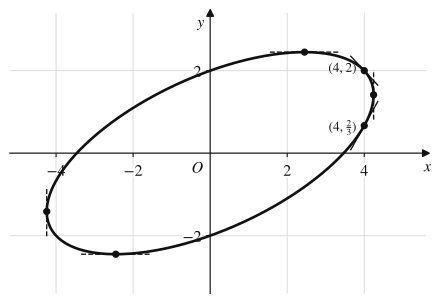
Consider the curve given by .
(a) Show that .
(b) Find all points on the curve at which the tangent line is horizontal.
(c) Find all points on the curve at which the tangent line is vertical.
(d) There are two points on the curve with -coordinate 4. Find them, and find the slope of the curve at each.
Show solution
(a) Differentiate both sides with respect to . The middle term is a product, so it needs the product rule:
Collect the terms on the left and the rest on the right:
A "show that" part is earned by the differentiation line and the algebra that reaches the given expression, so both belong on the page.
(b) A horizontal tangent needs the numerator to be 0, so . Points with must also lie on the curve, so substitute into the original equation:
The points are and . At each, the denominator is , so the slope really is 0.
(c) A vertical tangent needs the denominator to be 0, so . Substitute into the curve:
The points are and . At each, the numerator is , so these are vertical tangents, not points.
(d) Put into the curve: , so , which factors as . The points are and .
One -value, two slopes: the curve is the tilted ellipse below, and the line crosses it twice, once on the upper arc and once on the lower.
Where students lose points
On the exam
A free-response question on an implicit curve may open with "show that ". The given expression lets you do the later parts even if your own differentiation goes wrong, so use it. The later parts can ask for a tangent line at a point, points with horizontal or vertical tangents, or the second derivative (topics 3.6 and 5.12). An answer may be left in terms of and unless a point is given. A multiple-choice question can ask for the slope at a given point, where substituting the point right after differentiating is the fastest route, or for the points where the tangent is horizontal or vertical, which means solving the slope condition together with the curve's equation.
Check yourself
Question 1
What is the slope of the curve at the point ?
- A
- B
- C
- D
Show answer
A
The product rule gives , so . Choice B comes from dropping the factor when differentiating , which gives ; choice C is the reciprocal, .
- A
Question 2
The curve passes through . Find there, and explain why is positive at every point of the curve.
Show answer
, which is at and positive everywhere because .
Differentiating gives , so . The denominator is at least 1 for every , so the slope is always positive, and at it is . You learn the curve is always rising without ever solving the cubic for .
Question 3
At which points does the curve have a vertical tangent line?
- A
and
- B
and
- C
only
- D
and
Show answer
B
Implicit differentiation gives . A vertical tangent needs with ; putting into the curve gives , so or . Choice A is where the numerator is 0, the horizontal tangents. Choice C, the center , makes both parts 0 but is not on the curve. Choice D has the right -value but measures 5 units left and right of ; completing the square gives , a circle with center and radius 5, so the vertical tangents are 5 units left and right of .
- A
Question 4
Find the slope of the curve at the point .
Show answer
Differentiating gives . Substituting right away gives , so . The point is on the curve because .