A car's speedometer shows one number at one moment: 50 km/h right now. But speed is distance divided by time, and in a single instant the car covers no distance in no time. Around 450 BCE the Greek philosopher Zeno of Elea pushed this into a paradox: at any one instant a flying arrow occupies a space exactly its own size, so at that instant it is not moving, and yet it gets to the target.
Average rate of change
When a quantity changes as goes from to , its average rate of change on is the change in output divided by the change in input:
Its units are output units per input unit: meters per second, gallons per minute, dollars per year. On a graph it is the slope of the secant line, the straight line through the two points and .
Take a ball tossed straight up from the ground. Rounding gravity to 10 m/s², its height after seconds is meters, so , and . Its average velocity on is
On the average velocity is m/s, even though the ball was never sitting still: it rose for one second and fell back for one second. An average rate describes the interval as a whole and erases what happened inside it. The longer the interval, the more it erases.
Why an instant breaks the formula
To get the velocity at exactly , the obvious move is to make both endpoints equal to 1:
This is not 0 and it is not a very large number. It is undefined, because division by zero has no answer. And is undefined in a particularly unhelpful way: the equation holds for every number , so no single number deserves to be called the quotient. The average-rate formula needs the input to change. At a single instant it doesn't, so the formula has nothing to say there, and this is Zeno's arrow in algebra.
Instantaneous rate as a limit of average rates
The way out is to use intervals that contain the instant and shrink toward it. Each one has a perfectly good average rate, and you watch where those averages head. For the ball at , use the interval from 1 to , where is a small number, positive (the interval extends to the right of 1) or negative (to the left).
| Interval | Average velocity (m/s) | |
|---|---|---|
From both sides the averages close in on 10. Algebra shows why. For any ,
Cancelling is legal precisely because ; the average is never computed over an interval of length zero. But the expression makes it plain that when is close to 0, the average velocity is close to 10, and it can be brought as close to 10 as you like by taking small enough. That target value is the instantaneous velocity: 10 m/s upward at . The averages from the right are below 10 and those from the left are above 10 because the ball is slowing down, so a later interval catches it moving more slowly.
On the graph, each average rate is the slope of a secant line through . As the second point slides toward , the secant lines turn and settle on one line, the tangent line, whose slope is the instantaneous rate.
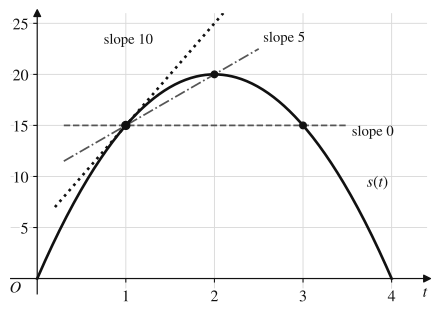
The notation reads "the limit as approaches 0" and asks where the values head as gets close to 0, never what happens at itself. Topic 1.2 makes the notation precise, and in Unit 2 this same limit becomes the derivative.
When there is no single rate
The averages don't always agree. For at , the average rate on is . For every this equals , and for every it equals . Intervals to the right all say the rate is 1, intervals to the left all say it is , and shrinking them never brings the two answers together. So has no instantaneous rate of change at 0; its graph has a sharp corner there, and no single tangent line. The instantaneous rate exists only when the average rates on both sides approach the same number, which is why the definition checks both.
Worked examples
Let . Write the average rate of change of on the interval between and as a simplified expression in , and use it to find the instantaneous rate of change of at .
Show solution
Combine the fractions in the numerator over the common denominator , then divide by :
The point of simplifying is to get rid of the in the denominator, the factor that makes the original quotient at . As a check, gives and gives , on either side of .
As approaches 0, approaches 4, so the averages approach . The instantaneous rate of change of at is . The negative sign fits the graph: is decreasing for .
Let . Estimate the instantaneous rate of change of at to three decimal places.
Show solution
The average rate on the interval between 0 and is , and no algebra cancels the here, so compute averages on both sides with a calculator:
The averages from the left increase and those from the right decrease, so the instantaneous rate is trapped between and . Both round to , so the rate is about . Using intervals on both sides is what makes the estimate trustworthy: a single side gives a number that is off in the third decimal place unless is very small. Topic 3.1 shows the exact value is .
Water flows into a tank. The amount of water in the tank, gallons, is measured at selected times minutes, as shown in the table below.
(a) Find the average rate of change of over the interval . Indicate units of measure.
(b) Use the data in the table to estimate the rate at which the amount of water in the tank is changing at time minutes. Show the computation that leads to your answer, and indicate units.
(c) Can the data in the table determine the rate at exactly? Explain.
Show solution
(a) Divide the change in water by the change in time:
(b) Use the smallest interval in the table that contains , which is , because the shorter the interval around the instant, the less it averages away:
The amount of water is increasing at about 7.5 gallons per minute at . Note how different this is from the 10.2 of part (a): the tank filled faster early on, and the long interval mixes that in.
(c) No. The rate at is the limit of average rates over intervals shrinking to , so it depends on values of at times arbitrarily close to 6, and the table gives values only at 5 and 7. Plugging in for both endpoints gives , which is undefined. The table supports an estimate, not an exact value.
Where students lose points
Check yourself
Question 1
A ball's height is meters at time seconds. Which expression gives the ball's instantaneous velocity at ?
- A
- B
- C
evaluated at
- D
Show answer
B
The instantaneous velocity is the limit of average velocities over intervals shrinking to . Choice C tries to use an interval of length zero, which gives the undefined ; choice A is an average over three whole seconds, and choice D is where the height heads, not the velocity.
- A
Question 2
Water drains from a tank. is the volume of water in the tank, in liters, at time minutes. Suppose . Explain what this statement means in the context of the problem, with units.
Show answer
At time minutes, the volume of water in the tank is decreasing at a rate of 3 liters per minute.
The limit of average rates over intervals shrinking to is the instantaneous rate of change of at that moment, in liters per minute, and the negative sign means decreasing. It does not say the tank holds 3 liters at , and it does not say exactly 3 liters drain during the next minute: that would be an average rate over , which can differ from the rate at the instant.
Question 3
For a function , the average rate of change on the interval between and is , and for , and , and for . What is the best estimate of the instantaneous rate of change of at ?
- A
- B
- C
- D
Show answer
A
The averages from the right decrease toward 3 and those from the left increase toward 3, so the rate is trapped between and and appears to be 3. Choice B is just the closest average from one side, which still contains the error from using a nonzero .
- A
Question 4
Let . Does have an instantaneous rate of change at ? Use average rates of change to explain.
Show answer
No. Average rates on intervals to the right of 2 all equal , and on intervals to the left of 2 all equal , so they don't approach a single number.
On the interval between 2 and the average rate is , which is for every and for every . Shrinking the intervals never brings the two sides together, so there is no instantaneous rate (the graph has a corner at ).