In topic 1.1 the ball's velocity at was the number that its average velocities, , head toward as shrinks to 0. "Head toward" needs a precise meaning before it can carry the weight of calculus, and it needs a notation, because every derivative and integral in this course is written as a limit.
What a limit says
Take the function
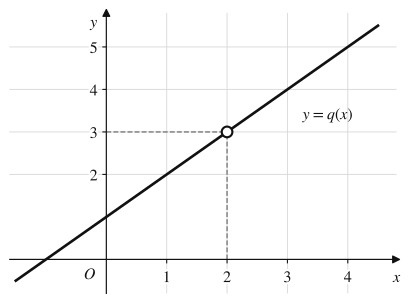
It is undefined at , where it would be . Everywhere else, the numerator factors as , so for every . Its graph is the line with one point missing.
Near the outputs are near 3, and you can say how near. If you want within of 3, keep within of 2 (and not equal to 2): then is within of 3. If you want within of 3, keep within of 2. Whatever tolerance you name, some neighborhood of 2 delivers it. That is what it means for 3 to be the limit.
Three parts of that statement do real work.
- The point itself is left out. Since , the limit describes the function near , not at . That is why has a limit at 2 even though doesn't exist, and why the instantaneous velocity in topic 1.1 could be a limit of average velocities that are undefined at .
- Any tolerance, not just "closer and closer". As decreases from 2 toward 1, the values of decrease toward 1, so each one is closer to than the one before. But they never come within of , because they all stay above 1. Getting closer to a number is not enough; the outputs have to get as close as you demand. The limit as is 1, not .
- One real number. If the outputs head toward two different numbers, or grow without bound, or never settle, there is no such and the limit does not exist. Topic 1.3 shows each of these.
Reading and writing limit notation
In , the arrow under "lim" says which variable moves and where it is going; the expression after "lim" is the function whose outputs you watch; is where they head. Read it aloud as "the limit of as approaches equals ." The letter for the variable doesn't matter: and are the same number, 3.
| In words | In notation |
|---|---|
| As approaches 5, approaches . | |
| As approaches 0 from the right (), approaches 12. | |
| As approaches 4 from the left (), approaches 7. | |
| As approaches 1, grows without bound. |
The superscripts in the middle rows mark one-sided limits: means approaches 4 through values less than 4, and through values greater than 0. The sign belongs to the direction comes from; it says nothing about whether the outputs are positive or negative. Topic 1.3 develops one-sided limits.
The last row is a convention, not a number: writing records how the limit fails to exist (the outputs grow past every bound), so it still counts as "does not exist" when a question asks whether the limit exists.
When you evaluate a limit in steps, every expression that still has in it keeps its "lim". The correct chain is
The "lim" disappears only at the step where the number appears. Topics 1.5 and 1.6 build the algebra that justifies steps like these.
A limit statement about a real quantity also reads as a sentence about that quantity. If is a temperature in degrees Fahrenheit at time hours, then says that as the time approaches 4 hours, the temperature approaches 68 degrees Fahrenheit. It says nothing about the reading at exactly .
One limit, three representations
The same limit can be shown as a graph, as a table of values, or as a formula, and on the exam it arrives in all three forms. Here is in each.
Graphically. The graph of is the line with an open circle at . Follow the line toward from either side and the heights head to 3, the height of the hole.
Numerically.
| undefined |
From both sides the outputs close in on 3.
Analytically. For , , and is close to 3 whenever is close to 2.
The three views have different strengths. A graph shows the overall behavior at a glance but can hide detail at the wrong scale (topic 1.3). A table gives actual values but only at the inputs someone chose (topic 1.4). Algebra settles the question exactly, when the formula is available (topics 1.5 and 1.6).
Worked examples
Write each statement in limit notation.
(a) As approaches , the values of approach .
(b) As gets close to 6 through times before 6, gets close to 40.
(c) The values of decrease without bound as approaches 5 through values less than 5.
Show solution
(a) .
(b) "Times before 6" means , so this is a left-hand limit: .
(c) "Less than 5" again means from the left, and "decrease without bound" is : . This one makes sense on its own: for just below 5, is a tiny negative number, and 1 divided by a tiny negative number is a large negative number.
The depth of snow on the ground is inches, where is the number of hours after midnight. Interpret each statement in context.
(a)
(b)
Show solution
(a) As the time approaches 3:00 a.m., the depth of snow approaches 8 inches. (The statement says nothing about the measurement at exactly 3:00 a.m.)
(b) The quotient is the average rate of change of the depth over the interval between 3 and hours, in inches per hour. Its limit as is the instantaneous rate (topic 1.1), so at 3:00 a.m. the depth of snow is increasing at a rate of 1.5 inches per hour. An interpretation needs the quantity, the time, the value, and units; leaving any one out leaves the sentence incomplete.
Suppose . Which of the following must be true?
(A)
(B) is defined.
(C) for some near 3.
(D) can be made as close to 7 as you like by keeping close enough to 3, with .
Show solution
The answer is (D), because it is what the statement means. Notice what (D) leaves out: it says nothing about itself, and nothing about ever landing exactly on 7.
The others can fail, and a single example shows it. For (A) and (B): the limit ignores , so could be 2, or undefined, as with a function equal to everywhere except at . For (C): , with the point removed from its domain, has limit 7 at 3 but never equals 7 anywhere. Approaching a value does not require reaching it.
Where students lose points
Check yourself
Question 1
Suppose and . Which statement is true?
- A
is actually 5, because .
- B
For close enough to 4, with , is close to .
- C
This is impossible: a function's limit at 4 must equal .
- D
The limit does not exist, because the limit and the value disagree.
Show answer
B
The limit describes outputs near 4 and ignores itself, so a limit of and a value of 5 can coexist (the graph has a hole at height and a dot at height 5). Choices C and D treat the value at 4 as if it controlled the limit.
- A
Question 2
A function has , , , , , , and . What do these values suggest is, and what role does play?
Show answer
The limit appears to be 6. The value plays no part in the limit.
From both sides of 3 the outputs close in on 6, so the values suggest . The limit ignores itself, so doesn't change it (the graph would have a hole at height 6 and a dot at height 1). A table only suggests a limit, since it shows outputs at a few chosen inputs; topic 1.4 covers what a table can and can't settle.
Question 3
Which notation says "as approaches through values greater than , approaches 6"?
- A
- B
- C
- D
Show answer
B
Values greater than are to the right of , so the approach is from the right, marked with a plus sign on . Choice A is the left-hand limit; the minus sign there marks direction, not the sign of the outputs.
- A
Question 4
As decreases from 3 toward 2, every value of is closer to than the one before. Why is not ?
Show answer
Because the values of never get within, for example, of : for they all stay above 4. They can't be made as close to as you like. The limit is 4.
A limit needs the outputs to come within every tolerance of the number, not merely to move toward it. Near the outputs can be kept as close to 4 as you like, so the limit is 4.