Fill the gap of a charged, isolated capacitor with a sheet of glass and a voltmeter across the plates drops: no charge left the plates, yet the potential difference fell. The glass is a dielectric, an insulator placed in an electric field, and it weakens the field between the plates without cancelling it. That is how real capacitors pack microfarads into a component the size of a grain of rice.
How an insulator polarizes
In a conductor (topic 10.1), electrons roam the whole object and pile up on its surface until the field inside is exactly zero. In an insulator, every electron stays bound to its own atom or molecule. An external field can only shift charge a tiny distance within each molecule, in one of two ways:
- Induced dipoles. In a nonpolar molecule (like the long chains in Teflon or polystyrene), the field pushes the electron cloud one way and the nuclei the other, stretching the molecule into a small dipole aligned with the field.
- Aligned permanent dipoles. A polar molecule, such as water, is already a dipole. The field pulls its positive end one way and its negative end the other, which twists the molecule partly into line. Thermal jostling keeps the alignment from being complete.
Either way the material becomes polarized: its molecules point their negative ends toward the positive plate and their positive ends toward the negative plate. Deep inside, each molecule's positive end sits next to its neighbor's negative end, and the charges cancel on average. At the two faces they do not: the face next to the positive plate is left with a layer of negative charge, and the face next to the negative plate a layer of positive charge. These bound charges can't leave their molecules, unlike the free charges on the plates, which can flow through wires. The dielectric as a whole stays neutral.
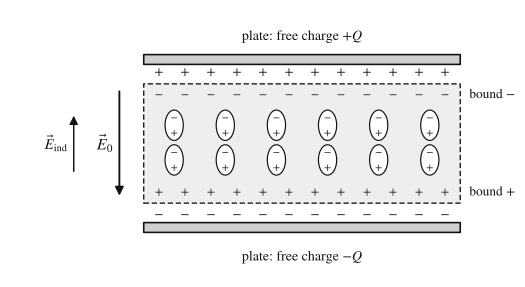
The dielectric's field opposes the applied field
The layer of bound charge acts like a second, weaker pair of plates inside the first, with the signs reversed. Its field, , points from the bound positive face to the bound negative face, which is opposite to the applied field, the field of the free charge on the plates. The net field in the dielectric is smaller than but in the same direction, because the bound charge is always less than the free charge (the molecules only partly cancel the field that is polarizing them).
The dielectric constant (kappa) measures how much a material weakens the field. For a dielectric filling the gap of an isolated capacitor,
The free surface charge density on the plates and the bound density on the dielectric's faces add like two pairs of sheets, so . Setting this equal to gives : with , the bound charge is three quarters of the free charge and the field is a quarter as strong.
Some values of at room temperature:
| Material | |
|---|---|
| Vacuum | 1 (exactly) |
| Dry air | 1.0006 |
| Teflon | 2.1 |
| Paper | 3.7 |
| Water | 80 |
Every material has , because polarization can only oppose the applied field. Air is so close to vacuum that the exam treats air-filled capacitors as having . Water's large value comes from its strongly polar molecules, which turn readily into line.
The dielectric constant also defines the material's permittivity, . Inside a dielectric, every formula you derived with carries over with in its place.
What changes when a dielectric goes in
The capacitance follows directly from the weaker field. With the plates' charge fixed, , so . The capacitance is a property of the device (topic 10.3), so it rises by in every case. What happens to the other quantities depends on whether the capacitor is isolated or stays connected to a battery:
| Filled with | |||||
|---|---|---|---|---|---|
| Isolated (battery removed first) | same | ||||
| Connected to battery | same | same |
Isolated: the charge has nowhere to go, so the dielectric's field weakens the net field and the potential difference falls by . The energy falls by as well. The missing energy went into the dielectric: the plates' field pulls a dielectric slab into the gap (the bound charges near the edge are attracted toward the plates of opposite sign), so you must hold it back as it goes in, and the field does positive work on it.
Connected: the battery fixes , so the field between the plates can't change. As the dielectric starts to weaken the field, the battery pushes more charge onto the plates until the field is back to ; the free charge ends at . The energy rises by , supplied by the battery.
The general statement is that inserting a dielectric may change each quantity. Decide first what is held fixed, as in topic 10.3's Example 2.
Worked examples
An air-filled parallel-plate capacitor with and plate separation is charged to and disconnected from the battery. A glass slab with is slid in, filling the gap. Find the new capacitance, charge, potential difference, field and stored energy, and the bound charge on the face of the glass.
Show solution
Disconnected, so the plates' charge is fixed. Start there:
The glass fills the gap, so , and
The field was and is now , one quarter as large, still pointing from the positive plate to the negative plate.
Energy before: . After, using the form with the fixed quantity: . The difference is the work the field did pulling the glass in.
The bound charge on each face of the glass is : negative on the face next to the positive plate.
A parallel-plate capacitor has plates of area separated by and stays connected to a battery. A plastic slab with , thick and the same area as the plates, is placed flat against one plate. Find the field in the air and in the plastic, the charge on the plates, and the new capacitance. Use .
Show solution
The formula is for a filled gap, so go back to the field. The free charge density on the plates is the same all the way across, so the field in the air gap is and in the plastic it is reduced by : . The battery fixes the total potential difference, which is the sum across the two layers:
Then . Both point from the positive plate to the negative plate.
The charge comes from the air-gap field: .
The capacitance is . Without the slab, , so the half-thickness slab raised by a factor of , not . A metal slab of the same thickness would raise it by a factor of 2, since it removes the field from its whole thickness (topic 10.1, Example 3); a dielectric with a very large behaves almost like that metal.
Students want to find the dielectric constant of a plastic that comes in sheets thick. They have two square metal plates of area , a stack of the sheets, and a capacitance meter.
(a) Describe a procedure that would let them determine from a graph. Say what they vary, what they measure and what they keep the same.
(b) Their data are below. What should they graph to get a straight line, and how is found from it?
| Sheets | (mm) | (nF) |
|---|---|---|
| 1 | 0.50 | 2.30 |
| 2 | 1.00 | 1.12 |
| 3 | 1.50 | 0.76 |
| 4 | 2.00 | 0.56 |
| 5 | 2.50 | 0.46 |
(c) Use the data to calculate . Use .
(d) In one trial, thin air gaps were left between the sheets. Would that make the measured value of too high or too low? Explain.
Show solution
(a) Stack 1, 2, 3, 4 and 5 sheets between the plates, pressing the plates flat so the plastic fills the gap with no air. For each stack, record the plate separation (number of sheets times , or measured with calipers) and the capacitance from the meter. Keep the plates and the plastic the same throughout, and keep the plates square to each other so the area of overlap stays . Take several readings per stack and average them.
(b) The model is , so is proportional to . Graph against : the points should fall on a line through the origin with slope , so . A graph of against would be a curve, which is much harder to read a constant from.
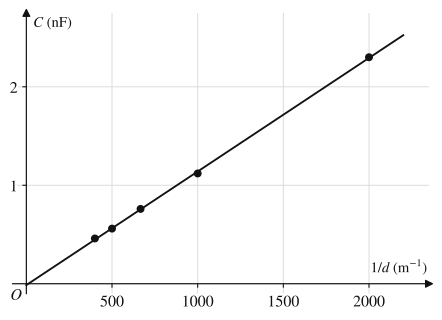
(c) The values are , , , and . Draw the best-fit line through the plotted points and read two well-separated points on the line (not data points), such as and :
Then
(Units: is in Fm, so is dimensionless, as it must be.) Taking the slope from the line, rather than from two of the data points, averages out the scatter in the measurements.
(d) Too low. In an air gap the field is not reduced by the plastic, so, as in Example 2, a gap partly filled with plastic has less capacitance than one completely filled. The measured for that stack comes out smaller than , which pulls the slope, and the calculated , down.
Where students lose points
On the exam
Dielectric questions ask you to predict changes in , , , and when a dielectric is inserted or removed, to explain polarization and the direction of the induced field, and to design or analyze an experiment that measures (linearize the data, take the slope from a best-fit line, carry units). A calculator is allowed throughout.
Check yourself
Question 1
An air-filled parallel-plate capacitor is charged and disconnected from the battery. A slab with is then slid in, filling the gap. Which describes the result?
- A
doubles, and is unchanged.
- B
is unchanged, and the field between the plates is halved.
- C
is unchanged, and the field between the plates is unchanged.
- D
is halved, and is halved.
Show answer
B
Disconnected, the free charge can't change. The polarized slab's bound charge sets up a field opposite the plates' field, so the net field drops to and drops with it. Choice A describes the connected case, where the battery holds fixed.
- A
Question 2
A parallel-plate capacitor stays connected to a battery while a dielectric with is inserted to fill the gap. By what factors do the charge on the plates, the field between the plates and the stored energy change?
Show answer
The charge increases by a factor of 5, the field is unchanged, and the stored energy increases by a factor of 5.
The battery fixes , so can't change. becomes , so becomes and becomes ; the battery supplies the extra charge and energy.
Question 3
A dielectric slab fills the gap between a positively charged upper plate and a negatively charged lower plate. Which statement about the slab is correct?
- A
Its top face carries negative bound charge, and the field of its bound charge points up.
- B
Its top face carries positive bound charge, and the field of its bound charge points down.
- C
Its top face carries negative bound charge, and the field of its bound charge points down.
- D
It carries no surface charge, because its charges cannot move.
Show answer
A
The molecules turn or stretch so their negative ends face the positive plate, leaving negative bound charge on the top face and positive on the bottom. The field of that bound charge points from the bottom (positive) face to the top (negative) face, up, opposite the plates' downward field. Choice D is wrong because bound charges shift slightly within each molecule, and that shift leaves charge at the faces.
- A
Question 4
A parallel-plate capacitor has plates of area separated by of a material with that fills the gap. Find its capacitance. Use .
Show answer
(about ).
. The material raises the capacitance of the same plates in air by a factor of 2.5.