A camera flash needs a burst of energy far faster than its battery can deliver it. The fix is to spend a few seconds pulling electrons off one metal plate and piling them onto another, then let them rush back in a millisecond. Two conductors holding equal and opposite charge make a capacitor, and the energy is stored in the field between them.
Capacitance
A capacitor is any pair of conductors, separated by an insulator, that carry charges and . The simplest is a parallel-plate capacitor: two flat metal plates of area facing each other a distance apart. Connecting the plates to a battery moves electrons from one plate to the other through the battery, so the two plates always end up with equal amounts of opposite charge. When people say a capacitor "holds charge ," they mean on one plate and on the other. The capacitor's net charge is zero.
Separated charge creates a potential difference between the conductors. Double the charge on each plate and the field everywhere doubles (superposition), so doubles too. Charge and potential difference are proportional, and the constant of proportionality is the capacitance.
looks like it says "more charge means less capacitance," but it does not: adding charge raises in the same proportion, and the ratio stays fixed. Capacitance measures how much charge the device stores per volt. A farad is enormous: plates apart in air would need an area of about to reach . Lab capacitors are measured in microfarads () and picofarads ().
The field between parallel plates
Treat each plate as a large sheet with surface charge density . Gauss's law (topic 8.6) gives each sheet's own field as , pointing away from the positive plate and toward the negative plate. Between the plates both fields point from to , so they add; outside, they point opposite ways and cancel:
The same answer comes from the conductor result of topic 10.1: the plates' charges attract each other onto the inner faces, and the field just outside a conductor's surface is . The field between the plates is uniform, the same magnitude and direction everywhere, and it is proportional to the surface charge density. Near the edges it bulges outward and weakens. This fringing is negligible when is much smaller than the plates' width, which is the condition for all the formulas here.
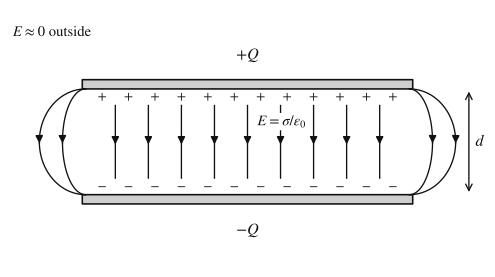
Now derive the capacitance. A uniform field gives , so
Larger plates hold more charge at the same field, so . Wider spacing makes the same field produce a larger , so . For example, square plates on a side () apart in air have .
Charges moving between the plates
A uniform field exerts a constant force on a charged particle between the plates, so the particle has constant acceleration . That is the same situation as a ball thrown near the Earth's surface: a particle that enters moving parallel to the plates follows a parabola, with constant velocity along the plates and uniformly accelerated motion across them. Every projectile equation from mechanics applies, with in place of . A positive charge accelerates toward the negative plate, a negative charge toward the positive plate. Gravity on an electron or proton is negligible next to the electric force, by many orders of magnitude in any realistic capacitor.
Energy offers a shortcut when you only need speeds. A charge moving from one plate to the other changes its potential energy by (Unit 9), so a proton released from rest at the positive plate reaches the negative plate with kinetic energy , whatever the plate spacing.
Spherical and cylindrical capacitors
Beyond parallel plates, the AP Physics C course covers two other shapes quantitatively (and no others): a spherical capacitor (a metal sphere inside a concentric spherical shell) and a coaxial cylindrical capacitor (a wire or rod inside a coaxial tube, the geometry of a coaxial cable). The method is the same for every shape:
- Put on one conductor and on the other.
- Use Gauss's law to find in the gap.
- Integrate across the gap to get .
- Divide: . The charge always cancels.
For a sphere of radius inside a shell of inner radius , a Gaussian sphere of radius in the gap encloses , so and
Check the limit: when the gap is tiny, , which is with . A thin spherical gap is a parallel-plate capacitor wrapped into a ball. The cylindrical case is worked in Example 4.
Energy stored in a capacitor
Charging a capacitor means moving charge from the negative plate to the positive plate against the field that the charge already there creates. The energy stored equals the work done to separate the charge. When the plates hold , the potential difference is , and moving the next small charge across takes work . Charging from zero to :
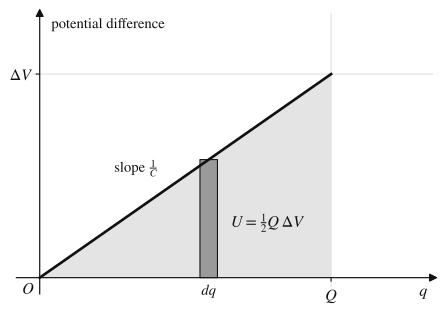
The graph shows where the comes from. The first bits of charge cross almost no potential difference; only the last bits cross the full . On average the charge crosses half the final potential difference, so the work is half of . Using , the three equivalent forms are
Worked examples
A parallel-plate capacitor has plates of area separated by of air and is connected to a battery. Use . Find (a) the capacitance, (b) the charge on each plate, (c) the field between the plates, and (d) the energy stored.
Show solution
(a) (295 pF).
(b) : on the plate connected to the positive terminal, on the other.
(c) The field is uniform, so , from the positive plate toward the negative plate. As a check, , and .
(d) .
A parallel-plate capacitor with capacitance is charged to potential difference . The plate separation is then doubled. Find how , , , and change (a) if the capacitor was disconnected from the battery first and (b) if it stays connected.
Show solution
In both cases , so doubling halves the capacitance: . What else changes depends on which quantity is held fixed.
(a) Disconnected, the charge has nowhere to go, so . Then . The field is and has not changed, so is unchanged (twice the distance at the same field gives twice the potential difference, consistent). The energy is . The extra energy comes from you: the plates attract each other, and pulling them apart takes positive work.
(b) Connected, the battery holds . Then : half the charge flows back through the battery. The field is , so it halves. The energy is .
| Disconnected | same | same | |||
| Connected | same |
The first move in any "what changes" question is to decide whether or is fixed.
Two horizontal plates long and apart have a potential difference of , with the upper plate positive. An electron enters midway between the plates moving horizontally at . Use and ; ignore gravity and fringing.
(a) Find the electron's acceleration.
(b) Does the electron leave the plates without hitting one? Justify your answer.
(c) At what angle to the horizontal is it moving when it leaves?
Show solution
(a) The field is , pointing down (from the positive upper plate). The electron's charge is negative, so the force is up, toward the positive plate:
(That is about times , so ignoring gravity is safe.)
(b) Treat it as projectile motion. Horizontally there is no force, so the time between the plates is . Vertically it starts at rest, so in that time it rises
It started below the upper plate, and , so it leaves without hitting the plate.
(c) The vertical velocity at exit is . The angle above the horizontal is .
A coaxial cable of length has a solid inner conductor of radius and a thin outer conducting tube of radius , with air between them. The inner conductor carries charge and the outer tube . Ignore end effects.
(a) Using Gauss's law, derive an expression for the electric field between the conductors at distance from the axis.
(b) Derive an expression for the capacitance of the cable.
(c) For , and , calculate the capacitance and the energy stored when the potential difference is . Use .
(d) A second cable is identical except that . Does it have more or less capacitance than the first? By what factor?
Show solution
(a) By cylindrical symmetry, the field in the gap points radially outward and depends only on . A coaxial Gaussian cylinder of radius () and length encloses the inner conductor's charge ; flux passes only through its curved side:
(b) Integrate across the gap from the inner conductor to the outer tube:
As it must, cancels; the result depends only on the dimensions.
(c) , so
(d) Less. The new ratio is , and , so . A wider gap means the same charge produces a larger potential difference, so less charge is stored per volt.
Where students lose points
On the exam
The course limits quantitative capacitor work to three shapes (parallel plates, concentric spheres, coaxial cylinders), so expect derivations of from Gauss's law for any of them, factor-of-change questions on , , , and , and charged-particle motion between plates solved as projectile motion. Sketches of against should be a straight line through the origin with slope ; the area under it is the stored energy. A calculator is allowed throughout.
Check yourself
Question 1
The plates of an air-filled parallel-plate capacitor are replaced with plates of twice the area, and the separation is halved. By what factor does the capacitance change?
- A
It is unchanged.
- B
It doubles.
- C
It increases by a factor of 4.
- D
It depends on the charge on the plates.
Show answer
C
, so doubling doubles and halving doubles it again, a factor of 4. Choice D treats as if depended on ; it depends only on the geometry and the material.
- A
Question 2
A capacitor holds on each plate when the potential difference across it is . Find its capacitance and the energy it stores.
Show answer
() and .
. With and both given, . Leaving out the doubles the answer.
Question 3
A proton is released from rest next to the positive plate of a parallel-plate capacitor held at a fixed potential difference by a battery. The plate separation is then doubled and the experiment is repeated. Compared with the first trial, the proton reaches the negative plate with
- A
the same kinetic energy, after a longer time
- B
half the kinetic energy, after the same time
- C
the same kinetic energy, after the same time
- D
twice the kinetic energy, after a longer time
Show answer
A
The kinetic energy gained is , and is fixed by the battery, so it is unchanged. But the field halves, so the acceleration halves while the distance doubles; from , the time grows by a factor of 2. Choice C misses that the trip takes longer.
- A
Question 4
A spherical capacitor is a metal ball of radius inside a concentric metal shell of inner radius , with air between. Find its capacitance. Use .
Show answer
(about ).
. It comes from integrating across the gap to get and dividing by it.
Question 5
Why is the electric field outside a large, charged parallel-plate capacitor (away from the edges) nearly zero?
- A
Each plate's charge is shielded by the other plate's metal.
- B
The fields of the two oppositely charged plates are equal in magnitude and opposite in direction there.
- C
All the charge is inside the plates, so no field reaches outside.
- D
The field outside points along the plates and has no component away from them.
Show answer
B
Each plate alone makes a field on both sides. Outside the pair, the positive plate's field points away and the negative plate's field points toward the plates, so they cancel; between the plates they add to . Choice C is wrong because a conductor's charge sits on its surface, not inside it.
- A