Two protons apart in a nucleus push on each other with about , roughly the weight of a large dog, acting on particles whose mass is . That push is the electric force, and its strength is set by one property of the particles, their electric charge, and by how far apart they are.
What charge is
Electric charge is a property of matter, like mass, that determines how strongly an object takes part in electric interactions. It is a scalar: it has a size and a sign but no direction. There are two signs, called positive and negative only by convention (Benjamin Franklin's choice in the 1740s). The SI unit is the coulomb (C).
Ordinary matter gets its charge from three particles:
| Particle | Charge | Mass |
|---|---|---|
| Proton | ||
| Electron | ||
| Neutron | about the proton's |
Here is the elementary charge. In AP Physics it is the smallest amount of charge that exists on its own, so any object's net charge is a whole-number multiple of it: . (Quarks carry thirds of , but they are never found alone, so the rule holds for every object you will meet.) A bead with has exactly more electrons than protons; a charge of , which is , cannot exist.
A neutral atom has as many electrons as protons. Objects become charged almost always by gaining or losing electrons, because electrons sit on the outside of atoms and the protons are locked in nuclei (topic 8.2 covers how this happens).
A point charge is a model, not a kind of particle: you treat a charged object as if all its charge sat at one point, which is fair when the object's size is small compared with the distances in the problem. Two beads apart are point charges; two metal balls apart are not, because the charge on each crowds toward or away from the other and the "distance between the charges" is no longer one number.
Coulomb's law
In 1785 Charles-Augustin de Coulomb hung a charged pith ball on a thin twisting fiber and measured how hard a second charged ball pushed it at different distances. The force between two point charges turns out to depend on the product of the charges and on the inverse square of the distance between them.
Use absolute values for the magnitude and get the direction from the signs; plugging signed charges into the formula and reading the sign of the result as "attractive or repulsive" works for two charges but becomes a source of errors once there are three.
The inverse square has a geometric reason you will see in topic 8.6: the charge's influence spreads over spheres whose area grows as . It makes the law a tool for factor-of-change questions. Doubling one charge doubles the force; doubling the distance divides it by ; tripling the distance divides it by .
Several charges. Each pair of charges interacts exactly as if the others were absent. The net force on one charge is the vector sum of the forces from each of the others:
This is the principle of superposition. Because the forces are vectors, you add them by components, never by adding magnitudes, unless every force lies along one line. Superposition holds for any number of charges, but the course framework's boundary statement caps exam force calculations at four or fewer charges, allowing more only when symmetry makes most components cancel. For charge spread continuously over an object, topic 8.4 does the sum as an integral.
Electric force compared with gravity
Charged objects also have mass, so two charged objects attract gravitationally too. The two forces look alike, both inverse-square, but they differ in two ways that shape the whole physical world.
First, gravity only attracts, because mass has one sign. The electric force can attract or repel.
Second, the electric force is enormously stronger. For two protons, with ,
The distance cancels, so the ratio is the same at every separation. Between any two particles or small charged objects, gravity is negligible next to the electric force.
So why does gravity, not electricity, hold the Moon in orbit? Because large objects are almost perfectly neutral. Each atom has equal numbers of protons and electrons, so a planet's positive and negative charges nearly cancel, and the electric force between two planets is close to zero. Gravity has no cancellation: every kilogram attracts every other. How close to neutral are they? For Earth () and the Moon () to repel electrically as hard as they attract gravitationally, each would need a charge with , so
That is about extra electrons. Earth holds roughly electrons, so an imbalance of about one electron in would cancel lunar gravity entirely. Matter in bulk stays neutral far better than that, because any excess charge attracts the opposite charge from its surroundings.
The electric force is also behind most of the forces in Mechanics. When a book rests on a table, the electron clouds of the surface atoms repel each other; that repulsion, summed over the enormous number of atoms in contact, is the normal force. Friction comes from electric attraction between atoms at contact points, and tension is the electric bonding between neighboring atoms in a rope, stretched slightly. Tracking that many interactions one by one is hopeless, so you model their total as a normal force, friction or tension. These are called contact forces, and they are not new fundamental forces.
Permittivity: how materials respond to charge
Inside an atom, the electron cloud is held to the nucleus but can be shifted. Put a material near a positive charge and in every atom the electrons are pulled slightly toward that charge and the nucleus slightly away. Each atom becomes a tiny separation of and . This is polarization, and the material is now polarized. The shifted charges make their own field, which points against the one that caused it, so charges embedded in a material push and pull on each other less than they would in vacuum.
Electric permittivity, , measures how strongly a material polarizes in response to an electric field. Empty space has nothing to polarize, and its permittivity is the constant . It appears in Coulomb's law through and in many relationships later in the course (Gauss's law, capacitance). Air polarizes so little that you treat it as vacuum.
Matter has a permittivity larger than , and how much larger depends on its composition and structure: how easily its electrons can shift into new arrangements. Water's permittivity is about , so the attraction between a sodium ion and a chloride ion dissolved in water is about times weaker than in vacuum, a large part of why salt dissolves in water. Topic 10.4 uses permittivity in capacitors.
The same idea sorts materials into two classes:
- Conductors are materials in which charge carriers move freely through the whole object. In metals some electrons belong to no single atom and wander the whole sample; in salt water, ions carry the charge.
- Insulators (nonconductors) are materials in which charge carriers can't move through the material. Their electrons only shift slightly within their own atoms or molecules. Glass, rubber, plastic and dry wood are insulators.
Topic 8.2 uses this difference to explain how objects get charged.
Worked examples
A bead with charge is from a bead with charge . Treat both as point charges, with .
(a) Find the magnitude and direction of the force exerts on .
(b) The charge of the first bead is doubled and the beads are moved to apart. Find the new force magnitude.
Show solution
(a) Coulomb's law with absolute values:
Units: . The charges have opposite signs, so the force on is attractive: it points from toward . Convert centimeters and nanocoulombs to meters and coulombs before substituting; leaving makes the answer times too small.
(b) Use the factor of change instead of recomputing. The product of the charges is multiplied by and by , so the force is multiplied by :
The force is still attractive, and the force on is the same size in the opposite direction.
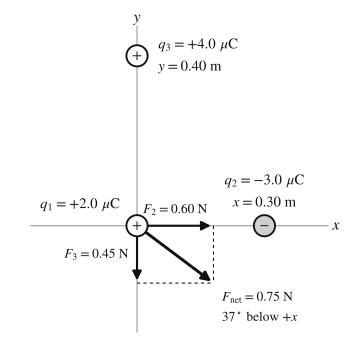
Charge is at the origin. Charge is at on the -axis, and is at on the -axis. Find the net electric force on .
Show solution
Find each force separately, with its direction from the signs, then add components.
Force from : opposite signs attract, so it points from toward , in the direction.
Force from : like signs repel, so it points from through and beyond, in the direction.
The components of the net force are and , so
below the axis. Adding the magnitudes, , would be wrong: the two forces are perpendicular. Notice too that and exert forces on each other, but those forces act on and , not on , so they play no part here.
A point charge is fixed at and a point charge is fixed at , where .
(a) Take and . Calculate the net force on a charge placed at .
(b) A small positive charge is to be placed on the -axis where the net electric force on it is zero. Explain why no such point exists between the two fixed charges or to the right of .
(c) Derive the location of the point where the net force on is zero, in terms of .
(d) The charge at that point is nudged a small distance along the -axis and released. Does it return toward the point? Justify your answer.
Show solution
(a) At the midpoint each fixed charge is away. The charge repels the charge toward :
The charge attracts it, also toward , with times the force at the same distance: . Both point the same way, so in the direction.
(b) Between the charges, pushes a positive charge toward and pulls it toward , so the forces add and can't cancel, as part (a) shows. To the right of , the forces point in opposite directions, but every point there is closer to than to , and also has the larger charge, so its force is always larger. Cancellation needs the point to be closer to the smaller charge, which leaves only .
(c) Let the point be a distance to the left of , so it is from . For zero net force the magnitudes must be equal:
(Taking the positive square root is correct because both and are distances.) The point is at . Neither nor appears in the answer, so the location is the same for any test charge, positive or negative.
(d) Yes, it returns. If moves slightly left, so , then , so : the rightward pull of now exceeds the leftward push of , and the net force points right, back toward . If moves slightly right (), the inequality reverses and the net force points left, again back toward . The point is stable for motion along the axis. (For a negative both forces reverse, so it would be pushed away: unstable.)
Where students lose points
On the exam
Coulomb's law appears both as a calculation (with a calculator) and as a factor-of-change prediction, where the charges may be given symbolically, like and , at distances like and . A justification about the direction of a force should name the signs ("opposite charges attract, so the force on is toward "). A zero-net-force derivation, like Example 3(c), earns credit for setting the two Coulomb magnitudes equal and for choosing the region correctly with a reason.
Check yourself
Question 1
Small sphere A has charge and small sphere B has charge . Sphere A exerts a force of magnitude on sphere B. What force does B exert on A?
- A
, directed away from B
- B
, directed away from B
- C
, directed away from B
- D
, directed toward B
Show answer
B
The two forces are a Newton's third law pair: equal in magnitude, opposite in direction. Both charges are positive, so each pushes the other away. Choice C wrongly lets the larger charge exert the larger force; Coulomb's law depends on the product , which is the same from either side.
- A
Question 2
In an oil-drop experiment, a student reports that one drop carries a charge of . Could this measurement be exactly right? Explain.
Show answer
No. , and a net charge must be a whole-number multiple of .
A drop gains or loses whole electrons, so its charge is with an integer. Nearby allowed values are and , so the reported value contains a measurement error.
Question 3
Three point charges, each , sit at the corners of an equilateral triangle of side . What are the magnitude and direction of the net electric force on one of them?
Show answer
, directed away from the midpoint of the opposite side (straight out from the triangle's center through that corner).
Each of the other two charges repels it with , along the two sides that meet at that corner, which are apart. The components across the bisector cancel and the components along it add: . Adding magnitudes would give .
Question 4
Two identical small spheres, each with charge , are a distance apart and repel with force . Then charge is moved from one sphere to the other, and the spheres are returned to separation . What is the new force?
- A
- B
- C
- D
Show answer
A
The charges are now and , whose product is , so the force is . Choice B assumes that because the total charge is unchanged, the force is too, but Coulomb's law depends on the product of the charges, not their sum.
- A
Question 5
The electric force between two protons is about times their gravitational attraction. Why, then, is the Moon held in orbit by gravity rather than by electric force?
- A
The electric force falls off faster with distance than gravity does.
- B
Earth and the Moon are very nearly electrically neutral, so the electric forces from their positive and negative charges almost cancel, while gravitational forces never cancel.
- C
Electric forces act only between particles in contact.
- D
The Moon is made of insulating rock, which cannot feel electric forces.
Show answer
B
Both forces are inverse-square, so choice A is false. Each body has almost exactly as many electrons as protons, so their net charges, and the electric force between them, are tiny; mass has only one sign, so gravity adds up over every kilogram. Choice D is wrong because insulators feel electric forces too; they just don't let charge flow through them.
- A