Walk 3 m east, then 4 m north. Your feet covered 7 m, but you are only 5 m from where you started, and "5 m" alone doesn't say where you are: you need "5 m, 53° north of east". The first number is a scalar and the second is a vector, and nearly every quantity in mechanics is one or the other.
Magnitude only, or magnitude and direction
A scalar is a quantity that a single number with a unit describes completely: mass (), time (), temperature, energy. A vector needs a size, called its magnitude, and a direction. Pushing a stalled car with forward and pushing it with backward have the same magnitude and opposite effects, so force must be a vector.
The kinematics quantities split like this:
| Scalar (how much) | Vector (how much, and which way) |
|---|---|
| distance: total length of path covered | position: where the object is relative to an origin |
| speed: how fast, in any direction | displacement: change in position, start to finish |
| velocity: rate of change of position | |
| acceleration: rate of change of velocity |
Speed is the magnitude of velocity. Distance is not the magnitude of displacement, because distance counts every back-and-forth while displacement only compares the start and finish. In the opening walk, distance is and the magnitude of the displacement is .
You draw a vector as an arrow: it points in the vector's direction, and its length is proportional to its magnitude, using whatever scale the diagram states. A velocity arrow twice as long as another means twice the speed. In print, a vector gets an arrow over its symbol, , and its magnitude is written or . A magnitude is never negative.
In one dimension, there are only two directions, so a sign does the job of the arrow. Pick a positive direction (say, right or up); then the opposite direction is negative. A car that moves from to has displacement : in the negative direction. The minus sign is direction, not a "smaller" quantity. Reverse your choice of positive direction and every sign flips, but the physics is unchanged.
Components and unit-vector notation
In two or three dimensions, you describe a vector by how far it reaches along each axis. Those numbers are its components. To name the directions, use the unit vectors , and : arrows of magnitude 1 (no units) pointing along , and . Any vector is the sum of three vectors parallel to the axes:
The components , , carry the units and the signs. A displacement means in the direction and in the direction.
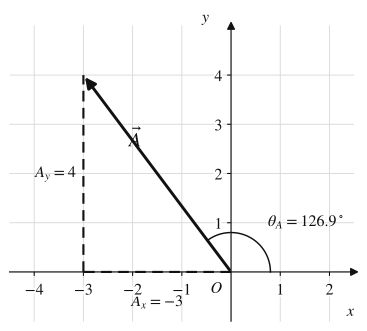
Going between the two descriptions is right-triangle trigonometry. If is the angle measured counterclockwise from the axis to the vector, the projections onto the axes, and the way back, are:
For the vector in the figure, . A calculator's inverse tangent gives , which points into the fourth quadrant, the wrong one. The inverse tangent can't tell from , so it always answers between and . When is negative, add : , or equivalently above the axis.
The position vector points from the origin to the object: . Its magnitude is the object's distance from the origin, and dividing by that magnitude gives the unit vector , which has length 1 and points the same way. For a particle at , the distance is and
You will use whenever a quantity points straight away from or toward a center, as gravity does in topic 2.6 (it points along , toward the center).
Adding vectors by components
The resultant of several vectors is their vector sum. Geometrically, you place them tip to tail, and the resultant runs from the first tail to the last tip. Algebraically, you add the components axis by axis:
This works because the parts of the arrows lie along one line, where adding is ordinary 1D addition with signs, and the same is true for and separately. What you can't do is add magnitudes. Two displacements of and have a resultant anywhere from (opposite directions) to (same direction); only when they are perpendicular is it . In general, , with equality only for parallel vectors.
Worked examples
A hockey puck slides at in the direction south of west. With east and north, write its velocity in unit-vector notation.
Show solution
Draw it first: west is , and south of west tips the arrow below the axis, into the third quadrant. So both components are negative. The is measured from the -axis, so the -component gets the cosine:
Check by going back: , and measured counterclockwise from the direction is . Putting the signs in from the sketch, instead of trusting to produce them, is the move that catches quadrant mistakes.
A sailboat leaves its dock and sails at north of east, then due north. (a) What single displacement takes it straight back to the dock? Give it in unit-vector notation and as a magnitude and direction. (b) Compare the total distance sailed with the displacement for the whole round trip.
Show solution
(a) Take east and north. Resolve each leg:
After two legs the boat is at from the dock. Returning means undoing that, so the return leg is its negative:
Its magnitude is . Both components are negative, so it points south of west, at south of west.
(b) The distance sailed is , a scalar that only grows. The displacement for the round trip is , because the boat ends where it began.
Two displacements each have magnitude . The first points along ; the second makes an angle with the first, measured counterclockwise.
(a) Derive an expression for the magnitude of their resultant in terms of and .
(b) Find the angle for which the resultant has the same magnitude as each displacement.
(c) A student claims that the resultant of two equal-length vectors is always longer than either one. Use your expression to evaluate the claim.
Show solution
(a) Write both in components: and . Add axis by axis:
using . So . Check the limits: gives (parallel, magnitudes add), gives (the Pythagorean case), and gives (they cancel).
(b) Set : , so and . Tip to tail, the three arrows form an equilateral triangle.
(c) The claim is false. requires , that is , or . For angles between and the resultant is shorter than either vector, because their components along largely cancel.
Where students lose points
On the exam
A vector answer needs both parts: unit-vector components with units, or a magnitude with a direction stated relative to an axis or a compass direction (", south of west"). When a question asks for a "magnitude", give a positive number and no direction. Answers in one dimension may use a sign for direction, as long as the positive direction is clear from the question or from your work.
Check yourself
Question 1
Which list contains only vector quantities?
- A
distance, displacement, velocity
- B
position, velocity, acceleration
- C
speed, velocity, acceleration
- D
displacement, speed, time
Show answer
B
Position, velocity and acceleration all need a direction to be complete. Choice A includes distance, and choice C includes speed: both are scalars, since they say how much without saying which way.
- A
Question 2
A displacement is . Give its magnitude and its direction measured counterclockwise from the axis.
Show answer
at from the axis (that is, above the axis).
. The inverse tangent of gives , but puts the vector in the second quadrant, so add to get .
Question 3
Two displacements have magnitudes and , in directions you can choose. Which magnitude could their resultant NOT have?
- A
- B
- C
- D
Show answer
D
The resultant ranges from (opposite directions) to (same direction), so is impossible. Choice B, , is what perpendicular vectors give, one possibility among many.
- A
Question 4
A particle is at . Write the unit vector that points from the origin toward the particle.
Show answer
(no units).
Divide the position vector by its magnitude, . The meters cancel, so has no units and a magnitude of exactly 1: .