Some highways use average-speed cameras: they photograph your car at two points apart and divide the distance by the time between the photos. A radar gun reads your speed at a single instant. You can pass the camera check at an average of and still be caught by radar at , because an average over an interval says nothing about what happened inside it. Mechanics needs both kinds of number, and calculus is what connects them.
Treating the object as a point
Kinematics describes motion without asking what causes it, and it starts by simplifying the thing that moves. In the object model, a car, a ball or a planet is treated as a single point. Its size, its shape and anything going on inside it (spinning wheels, sloshing fuel, a flexing tennis racket) are ignored. The point still carries the object's mass and charge, because later units need them. The model works whenever you only care where the object as a whole is and how that changes. It stops working when rotation or deformation matters, which is why Unit 5 replaces it with a rigid body that can turn.
The point's location is its position, measured from an origin you choose: in one dimension, or the position vector from topic 1.1 in two or three.
Displacement and the two averages
Displacement is the change in position, final minus initial:
It depends only on where the object starts and finishes. A delivery robot that drives down a hallway and back has covered a distance of but has a displacement of .
An average compares two moments, the start and the end of a time interval, and ignores everything between them:
Average speed is a different quantity: total distance divided by elapsed time. The robot above, taking for both legs, has an average speed of but an average velocity of . The two agree only when the object never reverses or turns.
Velocity changes, and so an object accelerates, whenever its speed changes or its direction changes. A tennis ball reaches a wall at and leaves at , in contact for . Take toward the wall as positive. The ball's speed dropped by only , but its velocity went from to :
that is, directed away from the wall. Reversing direction takes far more acceleration than the change in speed suggests. The same logic means a car rounding a curve at a steady is accelerating, since its direction keeps changing.
Instantaneous values are derivatives
The radar gun's number is the limit of an average. Take a cart whose position is and ask for its velocity at . Average over the interval from to :
| (s) | 1.0 | 0.5 | 0.1 | 0.01 | 0.001 |
|---|---|---|---|---|---|
| (m/s) | 14 | 9.5 | 6.62 | 6.0602 | 6.006002 |
As shrinks, the extra terms vanish and the average closes in on , the instantaneous velocity at . On a graph of against , each average is the slope of a secant line through two points of the curve, and the limit is the slope of the tangent line.
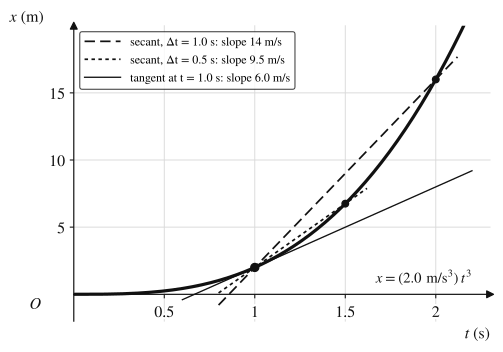
That limit is the definition of a derivative, and it gives the precise statements:
Here , which is at , matching the table.
Because the average over a very short interval is already close to the instantaneous value, a lab can measure instantaneous velocity without calculus. A photogate times how long a narrow flag on a cart blocks its light beam. A few milliseconds is too short for the velocity to change much, so the flag's width divided by that time is a good estimate of the velocity as the cart passes the gate.
The signs of and together tell you whether the object is speeding up. If they have the same sign, the acceleration points along the motion and the speed grows. If they have opposite signs, the speed shrinks. So "negative acceleration" alone does not mean slowing down: an object moving in the direction with is speeding up.
Undoing the derivative: integrals and initial conditions
Going the other way, from acceleration to velocity to position, takes integration. Since , integrating from time to time gives
The integral alone gives only the change: the acceleration tells you how velocity changes, not what it started at. The initial values and have to come from the problem, and they are where the constant of integration goes. Two carts with the same but different starting velocities follow different paths.
The integral of velocity is displacement, which counts motion in the direction as negative. Distance traveled is the integral of speed, ; in practice you find where , integrate each piece, and add the sizes. When the acceleration is constant, these integrals produce the three kinematic equations, which topic 1.3 develops along with reading slopes and areas off graphs.
Worked examples
A car drives along a curve at a constant speed of . At it is heading east; at it is heading north. Find the magnitude and direction of its average acceleration over those .
Show solution
The speed never changes, so it is tempting to say the acceleration is zero. But the velocity changes direction, and average acceleration is built from the change in the velocity vector. With east and north:
Its magnitude is . The components are equal in size with negative and positive, so it points northwest ( north of west), toward the inside of the turn.
A particle moves along the -axis with position .
(a) Find and . (b) When and where is the particle momentarily at rest? (c) For the interval to , find the displacement, the distance traveled, the average velocity, the average speed and the average acceleration. (d) During which time intervals is the particle speeding up?
Show solution
(a) Differentiate term by term (units in m, s):
(b) At rest means , not . So , where , and , where . The particle turns around at both.
(c) and , so the displacement is . The distance has to follow the turnarounds: (4.0 m), back to (4.0 m), out to (4.0 m), a total of . Then
For the average acceleration, and , so even though is nonzero at every instant except .
(d) Compare signs. is positive before , negative between and , positive after; is negative before and positive after.
| Interval (s) | sign of | sign of | speed |
|---|---|---|---|
| 0 to 1.0 | + | − | decreasing |
| 1.0 to 2.0 | − | − | increasing |
| 2.0 to 3.0 | − | + | decreasing |
| 3.0 to 4.0 | + | + | increasing |
The particle speeds up from to and from to , the intervals where velocity and acceleration share a sign.
A cart on a straight track is at and moving with velocity at . A motor then gives it an acceleration .
(a) Derive expressions for and . (b) Find the time and position at which the cart reverses direction. (c) Calculate the cart's average velocity from to . (d) A student says the average velocity is . Evaluate that claim.
Show solution
(a) Start from the definition and integrate from to , using the given starting velocity:
Then , so integrate again from the given starting position:
Units check: and .
(b) The cart reverses when changes sign: gives . Before that and after it , so it is a true reversal. The position there is .
(c) , so
directed in the direction.
(d) , so the student's formula gives , which disagrees with the from the definition. The claim is wrong. Averaging the endpoint velocities works only when the acceleration is constant, because then is linear in and its midpoint is its average. Here grows with time, so is a parabola that stays near its low values for most of the interval and climbs steeply only at the end, giving a smaller average. Average velocity is always .
Where students lose points
On the exam
Questions in this topic give one of , or as a function and ask for the others, a turnaround time, or an average over an interval. "Derive" means starting from or and showing the differentiation or the integration with its limits or constant. A calculator is allowed on both sections of the exam. "Momentarily at rest" or "changes direction" always points to with a sign change, never to .
Check yourself
Question 1
Which object has zero acceleration?
- A
A car going around a curve at a constant
- B
A ball at the highest point of a vertical toss, where it is momentarily at rest
- C
A puck sliding in a straight line at a constant on frictionless ice
- D
A cart at the instant it reverses direction on a track
Show answer
C
Acceleration is zero only when neither the speed nor the direction of the velocity changes, which is true only for the puck. The ball in B has zero velocity for an instant, but its velocity is changing from upward to downward, so it is accelerating; the same holds for the reversing cart in D. The car in A changes direction, so it accelerates even at constant speed.
- A
Question 2
A particle's position is . Find its velocity, its speed and its acceleration at .
Show answer
, speed , and (the same at every time).
Differentiate each component: , which at is , with magnitude . Differentiating again gives , which has no in it.
Question 3
At one instant an object on the -axis has and . What is it doing at that instant?
- A
Moving in the direction and speeding up
- B
Moving in the direction and slowing down
- C
Moving in the direction and speeding up
- D
Moving in the direction and slowing down
Show answer
D
The sign of gives the direction of motion, . Velocity and acceleration have opposite signs, so the acceleration opposes the motion and the speed is decreasing. Choice B takes the direction from the acceleration, which says how the velocity is changing, not which way the object moves.
- A
Question 4
A runner finishes one lap of a track in , ending where she started. Give her average velocity and her average speed for the lap.
Show answer
Average velocity ; average speed .
Her displacement is zero because she ends at her starting point, so . Average speed uses the distance: .
Question 5
A flag wide on a moving cart blocks a photogate's beam for . Which is the best estimate of the cart's speed as it passes the gate?
- A
- B
- C
- D
Show answer
C
The average velocity over the blocking time is , and over so short an interval it is very close to the instantaneous value. Choice D divides centimeters by seconds and then calls the result meters per second ( is ).
- A