Roll a ball off a table and, at the same instant, drop a second ball from the same height. The rolled ball lands farther away, yet the two hit the floor together. Its sideways motion did nothing to its fall, and that independence is what makes motion in a plane solvable: you treat it as two one-dimensional problems that share a clock.
Split the motion into components
Write the position as (add in three dimensions). Differentiating a vector differentiates each component, so
Nothing in the equations involves , and nothing in the equations involves . So every tool from topics 1.2 and 1.3 (derivatives, integrals, graphs, and the constant-acceleration equations when they apply) works on each axis by itself. The only thing the two axes share is the time , which is how you pass information between them: find the time from one axis, use it in the other.
The two components need not behave alike. A toy boat crossing a pool might have a constant while a motor gives it . Then and : one component has no acceleration and the other has an acceleration that changes with time. Each is still a 1D problem; the second just needs calculus rather than the constant-acceleration equations.
When the components are found, recombine them as in topic 1.1: speed and direction , with the quadrant read from the signs.
Perpendicular motions are independent
Changing the motion along one axis leaves the perpendicular motion alone. A puck sliding east on frictionless ice at that gets a quick kick due north picks up a north component of velocity, but its east component stays , because nothing acted along the east-west line. In Unit 2 this becomes a statement about forces: a force along produces acceleration only along .
The strobe picture below shows the opening experiment. Every , the launched ball and the dropped ball are at the same height, because both start with and have the same . The launched ball's horizontal spacing is even, since nothing changes its .
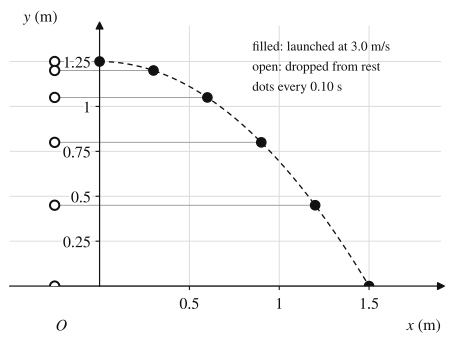
Projectile motion
A projectile is an object moving under gravity alone, with air resistance negligible. It is the special case with zero acceleration along one axis and a constant, nonzero acceleration along the perpendicular one. With horizontal and up, and a launch at speed at angle above the horizontal:
The path is a parabola. Solve the equation for (launch from the origin) and substitute into :
That is a downward-opening parabola in . The shape depends on being constant; if the vertical acceleration varies, the path is a different curve.
At the top, the velocity is horizontal, not zero. The peak is where , at . The horizontal component is unchanged, so the speed at the top is , the minimum speed of the flight. The acceleration there is still downward.
Range on level ground. If the projectile lands at its launch height, set : , so the flight time is . The horizontal distance covered is
The range is largest when , at , and two angles adding to (such as and ) give equal ranges. This formula is only for equal launch and landing heights. On a hill, off a cliff, or at a wall, go back to the component equations.
The velocity graphs make the same story visible: against is a horizontal line, and against is a straight line of slope that crosses zero at the peak. AP Physics C: Mechanics asks for quantitative work in two dimensions only; a third dimension adds a equation that behaves the same way.
Worked examples
A ball rolls off the edge of a high table at . Use . (a) How long is it in the air? (b) How far from the table's edge does it land? (c) Find its velocity just before it lands.
Show solution
Origin on the floor below the edge, up. The launch is horizontal, so and .
(a) The time comes from the vertical motion alone, which is a drop from rest:
(b) Horizontally the velocity is constant, so .
(c) is still ; . Recombine:
Rolling it faster would land it farther away in the same , since the fall time depends only on the height and .
A ball is kicked from the ground with initial velocity components horizontal and upward, toward a tall wall away. Use . (a) At what height does it hit the wall? (b) Is it rising or falling when it hits? (c) What is the highest point of its path, and does it reach it before the wall?
Show solution
(a) The horizontal motion gives the time to reach the wall: . Use it in the vertical equation:
(b) . Negative means falling.
(c) At the peak : , before the arrival. The peak height comes from the time-free equation, , so , at . The level-ground range formula would say nothing useful here, because the ball never returns to the ground before the wall.
A drone takes off from the origin. Its position is
with horizontal and vertical.
(a) Derive expressions for the drone's velocity and acceleration components. (b) At what time is the drone moving horizontally (for ), and where is it then? (c) Find the drone's speed, its direction of motion, and its acceleration at . (d) A student says the drone's path is a parabola, like a projectile's. Evaluate the claim.
Show solution
(a) Differentiate each component separately:
The motion has no acceleration at all, while changes with time, so the two components behave differently.
(b) Moving horizontally means with : gives . Then and . Since goes from positive to negative there, this is the highest point.
(c) At : and , so the speed is , directed above the horizontal. The acceleration is and : at that instant the drone is not accelerating at all, even though it is moving at .
(d) The claim is false. A projectile's path is a parabola because is constant, which makes quadratic in while is linear in . Here varies, so is a cubic in ; substituting makes a cubic in , not a parabola. The component method still works, but the projectile equations do not.
Where students lose points
On the exam
Projectile questions are solved component by component, and graders look for the split: the horizontal equation with constant velocity, the vertical one with (use unless told otherwise), and the time carried from one to the other. Expect launches from a height, landings on a raised surface, and requests to sketch and against time or to decide which of two launches stays up longer (the one with the larger , when both start and land at the same heights). When a position or velocity is given as a function of time, the question is testing calculus on each component, not projectile formulas.
Check yourself
Question 1
A ball is launched at an angle above level ground and air resistance is negligible. At the highest point of its path, which is true?
- A
Its velocity and its acceleration are both zero.
- B
Its velocity is zero and its acceleration is downward.
- C
Its velocity is horizontal and its acceleration is zero.
- D
Its velocity is horizontal and its acceleration is downward.
Show answer
D
Only is zero at the top; never changes, so the velocity is horizontal and nonzero. The acceleration is downward for the entire flight. Choice C confuses zero vertical velocity with zero acceleration; if the acceleration were zero, the ball would keep moving horizontally at that height.
- A
Question 2
Two balls are launched from level ground at the same speed, one at and one at above the horizontal, and land on the same level ground. Which statement is correct?
- A
They land at the same distance, and the ball is in the air about times as long.
- B
They land at the same distance and are in the air for equal times.
- C
The ball lands twice as far away.
- D
The ball lands farther away and is in the air longer.
Show answer
A
and , so the ranges match. Choice B gets the times wrong: flight time is , which depends only on the vertical component, and , so the ball stays up times as long. The ranges still match because that longer flight is paired with a smaller horizontal component, instead of .
- A
Question 3
For a ball thrown over level ground, the graph of against is a horizontal line at , and the graph of against is a straight line from at to at , when it lands. Find the acceleration, the horizontal distance traveled and the maximum height.
Show answer
Acceleration downward; horizontal distance ; maximum height .
The slope of the graph is , and the graph's slope is zero. The area under the graph is . The maximum height is the area under the graph up to where it crosses zero at : .
Question 4
A puck slides east at on frictionless ice. A quick kick directed due north gives it a north velocity component of . Just after the kick, what are its east velocity component and its speed?
- A
and
- B
and
- C
and
- D
and
Show answer
B
The kick acts only along the north-south line, so the east component is unchanged at . The speed combines perpendicular components: . Choice C adds the components as plain numbers.
- A