On a windless day, rain falls straight down. From the passenger seat of a moving car, the same drops streak across the side window at a slant, as if they were blowing toward you. Neither observer is wrong: velocity is always measured relative to something, and the two observers are measuring relative to different things.
What a reference frame is
A reference frame is the viewpoint a measurement is made from: an observer with an origin, a set of axes, and a clock, all moving together. Every position, displacement and velocity in topics 1.1 to 1.3 was measured in some frame, usually the ground's without saying so.
The choice of frame changes both the magnitude and the direction of what is measured. A passenger sitting in a train moving at east has velocity zero in the train's frame and east in the ground's frame. A ball rolled toward the back of the train at moves west in the train frame and still east, at , in the ground frame. Each description is correct within its own frame, so a velocity is incomplete until you say which frame it is measured in.
An inertial reference frame is one that is not accelerating: it is at rest or moving at constant velocity relative to another inertial frame. The ground is treated as inertial (Earth's rotation is far too slow to matter for AP problems), and so is a train cruising at constant velocity on a straight track. A braking car is not. Unless a problem says otherwise, assume every frame it mentions is inertial.
Converting between frames
Write for "the velocity of measured in 's frame". Say a passenger walks inside a train that moves over the ground . The passenger's position from the ground's origin is the passenger's position from the train's origin plus the train origin's position from the ground's origin:
Differentiate with respect to time (both frames use the same clock):
In one dimension the vectors become signed numbers. A cyclist rides east at and a jogger runs west at , both relative to the road. With east positive, the jogger's velocity relative to the cyclist is : from the cyclist's seat, the jogger approaches at . In two dimensions the same equation is vector addition, done by components as in topic 1.1, so speeds in different directions never add as plain numbers.
Every inertial observer measures the same acceleration
Differentiate the velocity equation once more:
If the train moves at constant velocity relative to the ground, is constant and , so
That is why a ball dropped in a smoothly cruising train falls straight down to the floor beside your foot: in the train frame it starts at rest and accelerates at downward. A person on the platform sees the same ball start with the train's horizontal velocity and follow a curved path (topic 1.5 treats that path), but measures the same downward. Since Newton's second law links force to acceleration, this agreement is also why the laws of motion in Unit 2 work the same way in every inertial frame. In a frame that accelerates, like a braking car, the extra term is not zero and objects appear to accelerate with nothing pushing them: a coffee cup slides forward on the dashboard.
Worked examples
On a straight road, a cyclist rides east at and a bus drives east at , both relative to the road. The front of the bus is behind the cyclist. (a) Find the bus's velocity relative to the cyclist and the cyclist's velocity relative to the bus. (b) How long until the front of the bus reaches the cyclist?
Show solution
(a) Take east as positive. The bus relative to the cyclist is the bus's velocity minus the cyclist's, both measured from the road:
using . So the cyclist sees the bus approaching from behind at east. Reversing the frames reverses the sign: , so the bus driver sees the cyclist moving back toward the bus at .
(b) Work in the cyclist's frame, where the cyclist is at rest and the bus closes a gap at :
Choosing the frame in which one object is at rest turns a two-object chase into a one-object problem. In the road frame you would set and get the same .
A river wide flows east at relative to the ground. A kayaker paddles at relative to the water, starting from the south bank. (a) If she points the kayak due north, find her velocity relative to the ground, the time to cross, and how far downstream she lands. (b) In what direction must she point the kayak to land directly opposite her starting point, and how long does that crossing take?
Show solution
Use for kayak, for water, for ground, with east and north. The velocity she controls is ; the one that carries her across is .
(a) and , so
directed east of north. Only the north component carries her across, so . Meanwhile the east component carries her downstream. The current changes her east-west motion but not how fast she crosses, because the two components are perpendicular.
(b) To go straight north relative to the ground, the east component of must be zero. She must aim partly upstream (west) so that her own westward component cancels the current:
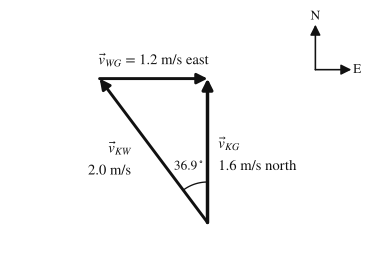
Her ground velocity is the remaining north component, (check: ), so the crossing takes . Landing opposite costs over the straight-across heading, because part of her paddling now fights the current instead of crossing. If the current were faster than , would exceed 1 and no heading could land her directly opposite.
A train moves east on a straight, level track at a constant . A passenger tosses a ball straight up at relative to the train and catches it at the height it left her hand. Use and ignore air resistance.
(a) Find the ball's velocity relative to the ground just after it is released. (b) Compare the ball's acceleration as measured by the passenger and by a person standing beside the track. (c) The passenger claims the ball lands back in her hand. Justify or refute the claim using both frames. (d) Suppose instead the train brakes at during the toss. Where does the ball land relative to her hand?
Show solution
(a) , with east and up. Its magnitude is , at above the horizontal, toward the east.
(b) The train moves at constant velocity, so and . Both observers measure downward.
(c) The claim is correct. In the train frame the ball starts with no horizontal velocity and has no horizontal acceleration, so it goes straight up and down and returns to her hand. In the ground frame, the ball and the hand both move east at the whole time, so they cover the same horizontal distance. The ball's time in the air is the same in both frames: .
(d) Now the train frame is not inertial, so use the ground frame. The ball, once released, keeps its horizontal and moves east in . The hand slows with the train: . The ball lands east of her hand, toward the front of the train. To the passenger, the ball seems to drift forward with nothing pushing it, which is the signature of an accelerating frame.
Where students lose points
On the exam
Questions ask you to find a velocity in another frame (often by sketching the vector triangle), to compare what two observers measure, or to justify why observers agree on acceleration. Name the frame for every velocity you write. For comparisons, a full answer states which quantities differ between frames (position, velocity, and the shape of the path) and which agree (acceleration, and time elapsed), with the reason: the frames differ by a constant velocity.
Check yourself
Question 1
Car A drives east at and car B drives west at , both relative to the road, approaching each other. What is car B's velocity as measured by the driver of car A?
- A
- B
west
- C
east
- D
west
Show answer
D
With east positive, , so west. Choice A comes from adding the two velocities, , instead of subtracting the observer's. Choice C has the subtraction in the wrong order.
- A
Question 2
Rain falls straight down at relative to the ground. A car drives east at . Find the rain's velocity relative to the car.
Show answer
, directed downward and toward the west, at from the vertical.
with east and up. Its magnitude is , and its angle from the vertical is . The drops seem to come from ahead of the car and slant backward.
Question 3
A passenger on a jet flying level at a constant drops a pen. How do the pen's accelerations measured by the passenger and by an observer on the ground compare?
- A
The ground observer measures a larger acceleration because the pen moves faster in that frame.
- B
The passenger measures zero acceleration because the pen moves with the jet.
- C
Both measure the same acceleration, downward.
- D
They measure the same magnitude but in different directions.
Show answer
C
The two frames differ by a constant velocity, and differentiating a constant gives zero, so . Choice A mixes up velocity and acceleration: the ground observer measures a larger velocity, but the velocity changes at the same rate in both frames.
- A
Question 4
An airport moving walkway is long and moves at . A traveler walks at relative to the walkway. How long does it take her to cover the walkway's length walking with its motion, and how long walking against it?
Show answer
walking with it; walking against it.
Relative to the floor, her velocity is going with the walkway and going against it. Then and .