Give a puck a shove on an air-hockey table and it glides across at a steady speed until it hits the rail. On a carpet it stops within a meter, and for two thousand years that kind of observation convinced people that keeping something moving takes a force. It doesn't. Motion at constant velocity needs no cause; what needs a cause is a change in velocity, and the carpet's friction is that cause.
The net force is a vector sum
When several forces act on a system, what matters for its motion is their combination. The net force (also written ) is the vector sum of every force exerted on the system, the forces you drew on its free-body diagram (Topic 2.2). You add forces the way you add any vectors: component by component.
Push a box across a frictionless floor with east while a friend pushes it with north. The net horizontal force is , with magnitude , directed north of east. Adding the magnitudes to get would be wrong. Magnitudes add directly only when the forces point the same way. These two are perpendicular: the push does nothing to the box's motion north and the push does nothing to its motion east, so each component of the net force gets a contribution from only one push, and the magnitude comes from the Pythagorean theorem.
Zero net force means constant velocity
Newton's first law: if the net force on a system is zero, the velocity of the system's center of mass stays constant. Constant velocity means both constant speed and constant direction, and "at rest" is the special case .
A system with zero net force is in translational equilibrium. Because the net force is a vector, it is zero only when each component is zero:
The law works in both directions, and exam questions use both. Given balanced forces, you conclude the velocity is constant. Given constant velocity, you conclude the forces balance, and you get an equation for each axis to solve for unknown forces. An elevator rising at a steady has a cable tension exactly equal to its weight, the same as if it were parked.
Newton's first law is about inertia: a system's tendency to keep its velocity. Mass is the measure of how much inertia it has, which is why a loaded shopping cart is harder to start and harder to stop than an empty one. The first law says nothing about how fast velocity changes when the forces don't balance; Topic 2.5's second law does.
Balanced in one direction, unbalanced in another
The component equations are independent. Forces can balance along one axis and fail to balance along another, and then the velocity changes only along the unbalanced axis. The component of velocity along a balanced axis stays exactly what it was.
A ball rolling off a table edge is the familiar case. Once it leaves the table, no horizontal force acts (air resistance negligible), so its horizontal velocity stays constant; gravity is unbalanced vertically, so its vertical velocity changes. That's the reason projectile motion splits into a constant-velocity horizontal motion and an accelerated vertical motion (Topic 1.5). Worked example 3 is a version where you control the unbalanced force.
Inertial reference frames
Velocity is measured relative to something (Topic 1.4), so Newton's first law needs a reference frame. Sit in a bus that brakes hard: your coffee cup slides forward along the tray, although nothing pushes it forward. In the bus's frame, the cup's velocity changed with zero net horizontal force on it, so the first law fails. From the sidewalk, the story is simple: the cup kept moving at the bus's old speed while the bus slowed down under it.
An inertial reference frame is a frame in which the first law checks out: objects with zero net force on them keep constant velocity. Any frame moving at constant velocity relative to an inertial frame is also inertial, which is why you can't tell, inside a smoothly cruising airplane, whether you're moving. A frame that accelerates relative to an inertial frame (a braking bus, a turning car, a merry-go-round) is not inertial, and Newton's laws don't apply in it unless you invent forces with no source.
The ground is close enough to inertial for nearly every problem. Earth spins, so a point on the equator accelerates toward Earth's axis at about , roughly of , small enough to ignore unless a question asks about it. Unless told otherwise, work from the ground's frame.
Worked examples
A flowerpot hangs at rest from two wires. The left wire makes an angle of with the horizontal and the right wire makes with the horizontal. Take . Find the tension in each wire.
Show solution
The pot is at rest, so it's in equilibrium and the forces on it add to zero. Its free-body diagram has three forces: down (), up and to the left along the left wire, and up and to the right along the right wire. With horizontal and vertical:
From the equation, . Substituting into the equation and solving:
The steeper wire carries more of the load, which makes sense: it points more nearly straight up, so more of its tension goes into holding the pot up. Neither tension is half the weight, and their sum () exceeds the weight, because part of each tension goes into pulling sideways against the other wire.
A sled is pulled up a snowy hill inclined at by a rope parallel to the slope. The sled moves at constant speed, and the snow exerts a friction force of on it. Take . Find the tension in the rope and the normal force on the sled.
Show solution
Constant speed in a straight line is constant velocity, so the sled is in equilibrium even though it is moving. Its free-body diagram: gravity (down), the normal force (perpendicular to the slope, away from it), friction (down the slope, opposing the sled's motion up it), and tension (up the slope). Tilt the axes: up the slope, perpendicular to it (Topic 2.2).
The rope has to supply the downhill part of gravity and the friction, and nothing more: no extra "force to keep it moving" is needed once the sled is up to speed.
A puck slides in the direction at across a level, frictionless air table. From to , a fan exerts a constant force of on the puck in the direction; after that the fan is off.
(a) Sketch graphs of and as functions of time from to .
(b) Justify the shape of your graph using Newton's first law.
(c) Find the puck's speed and direction of motion at .
Show solution
(a) In , nothing changes. In , the fan's force is the only unbalanced force while it runs, so it gives a constant acceleration (Topic 2.5): . Starting from , rises linearly to at , then stays there.
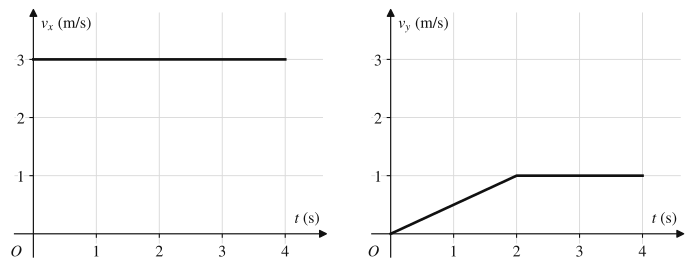
(b) In the direction the puck feels no force at all: the table is frictionless, the fan pushes only along , and gravity and the table's normal force are vertical and balance each other. With zero net force along , Newton's first law says the component of velocity can't change, so is a horizontal line at , before, during and after the fan's push. After the net force is zero in every direction, so the whole velocity is constant, which is why the graph goes flat too.
(c) At , and :
counterclockwise from the axis (toward ). The sideways push turned the puck and sped it up, but did nothing to its velocity.
Where students lose points
Check yourself
Question 1
An elevator moves downward at a constant speed of . How does the tension in its cable compare with the elevator's weight?
- A
The tension is less than the weight, since the elevator moves down.
- B
The tension equals the weight.
- C
The tension is greater than the weight, to keep the elevator from speeding up.
- D
It can't be determined without the elevator's mass.
Show answer
B
Constant velocity means equilibrium, so the upward tension balances the downward weight exactly, whichever way the elevator moves. Choice A confuses the direction of motion with the direction of the net force.
- A
Question 2
A car drives around a circular track at a constant speed of . Which statement is correct?
- A
The car is in equilibrium because its speed is constant.
- B
The net force on the car is zero because the forces from the road balance.
- C
The net force on the car is not zero, because the direction of its velocity changes.
- D
The net force on the car points in the direction it is moving.
Show answer
C
Equilibrium needs constant velocity, and the car's velocity keeps changing direction. By the first law, a changing velocity means the net force is not zero. Choice A treats speed and velocity as the same thing.
- A
Question 3
Three forces act on an object that moves at constant velocity. Two of them are and . Find the third force and its magnitude.
Show answer
, with magnitude ().
Constant velocity requires , so . Its magnitude is .
Question 4
Which observer is in an inertial reference frame?
- A
A passenger in a train that is pulling out of a station
- B
A rider on a spinning merry-go-round
- C
A passenger in a car driving along a straight, level highway at a steady
- D
A pilot in a jet accelerating down a runway
Show answer
C
A frame moving at constant velocity relative to the ground (itself very nearly inertial) is inertial. The other three frames accelerate: the train and jet speed up, and the merry-go-round changes direction continuously, so objects in them appear to change velocity with no net force.
- A