Push an empty shopping cart and a fully loaded one with the same force, and the empty one speeds up much faster. If the loaded cart has twice the empty cart's mass, pushing it twice as hard gives it the same acceleration. Newton's second law turns those two observations into one equation.
Unbalanced forces change velocity
When the forces on a system don't add to zero, they are unbalanced, and by the first law (Topic 2.4) the system's velocity must change. The second law says how:
The acceleration of the system's center of mass is proportional to the net force, inversely proportional to the system's mass, and in the same direction as the net force. That last part is the one students drop. The acceleration points along the net force, not along the velocity. A car moving north and braking with a net force of south has an acceleration of south, opposite its velocity, which is exactly what slowing down means.
The law also defines the unit of force. One newton is the net force that gives an acceleration of : .
Because it is a vector equation, it holds separately for each component:
The proportionalities let you predict changes without numbers. Double the net force on a system and its acceleration doubles; triple its mass at the same net force and the acceleration drops to a third. Doing both multiplies the acceleration by .
In calculus form, , so the second law is a differential equation: . When the net force is constant, the acceleration is constant and the Unit 1 kinematics equations apply. When the force changes with time, you integrate instead (worked example 3).
Only external forces move the center of mass
A system is made of many particles, each pushed by forces from outside the system and pulled by the other particles. Write the second law for particle , splitting its forces into the external ones and the forces from each other particle :
Add these equations for every particle. On the right, every internal force appears together with its third-law partner (Topic 2.3), so all the internal terms cancel. On the left, differentiating the center-of-mass definition twice (Topic 2.1) gives . What survives is
So the "system" in means its center of mass, and the forces in the sum are the external ones only. The velocity of a system's center of mass changes only if a nonzero net external force acts on it. An astronaut floating in space who throws a wrench drifts backward as the wrench flies forward, but the center of mass of astronaut plus wrench stays where it was: the throw was internal.
Like the first law, the second law holds in inertial reference frames (Topic 2.4). Work from the ground's frame.
Solving problems with the second law
The method is the same every time, and each step earns credit on a free-response answer:
- Choose the system. Pick it so the force you want is external and the forces you don't know are internal, when possible.
- Draw its free-body diagram (Topic 2.2).
- Choose axes with one along the acceleration.
- Write the second law for each axis, , with signs from your axes, and solve.
For objects tied by an ideal string, two facts from Topic 2.3 close the problem: the tension is the same at both ends, and the objects' accelerations have the same magnitude because the string doesn't stretch. Write the second law for each object along its own direction of motion, choosing each positive direction to follow the string, so both objects have the same acceleration . The tension then pulls forward on one object and backward on the other, so adding the two equations cancels it and leaves one equation for . Either equation alone then gives the tension. Worked example 2 does exactly that.
Testing the law with an experiment
Here is a lab design that tests whether acceleration is proportional to net force, the kind of procedure the exam asks you to write.
A cart rolls on a level, low-friction track. A string runs from the cart over an ideal pulley at the end of the track to a hanger with slotted masses. Call the mass of the cart, with whatever slotted masses ride on it, , and the mass of the hanger with its slotted masses . Along the track, the string's pull is the only unbalanced force on the cart, so . For the hanger, with down positive, . Adding the two equations cancels the tension:
where is the total mass of the cart, the hanger and all the slotted masses. The hanging weight is the force that drives the string-connected system along the string, and is the mass it accelerates. To keep constant while changing the driving force, start with the slotted masses on the cart and move them one at a time from the cart to the hanger. A motion sensor records the cart's velocity, and the slope of each velocity-time graph is the acceleration.
With and , one group measured:
| Hanging mass (kg) | (N) | () |
|---|---|---|
| 0.05 | 0.49 | 0.60 |
| 0.10 | 0.98 | 1.21 |
| 0.20 | 1.96 | 2.47 |
| 0.30 | 2.94 | 3.66 |
| 0.40 | 3.92 | 4.93 |
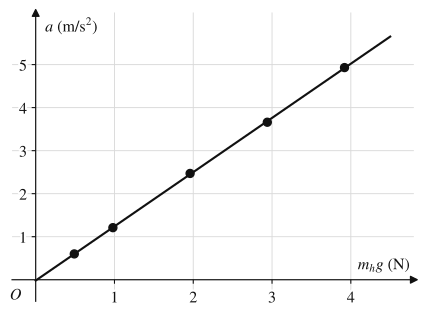
The points fall on a straight line through (nearly) the origin, which is the evidence that the acceleration is proportional to the driving force . The second law predicts the slope: , so the slope is . The best-fit slope is , giving , within about of the measured on a balance. The intercept, , is close to zero, so friction was negligible. If friction were significant, the line would cross the force axis at a positive value: the hanging weight would have to overcome friction before the cart accelerated.
To test the other half of the law, , hold the hanging mass fixed and add mass to the cart, then plot against . Plotting against rather than is the point: it turns a curve into a straight line whose shape you can judge by eye.
Worked examples
A student stands on a bathroom scale in an elevator. Take . What does the scale read (the normal force it exerts) when the elevator (a) moves upward and speeds up at , and (b) moves downward and speeds up at ?
Show solution
The system is the student. Two forces act: the scale's normal force up and gravity down. Take up as positive.
(a) Speeding up while moving up means the acceleration is upward, :
(b) Speeding up while moving down means the acceleration is downward, :
The scale reads more than the student's weight in (a) because the floor must supply a net upward force to accelerate the student upward. The sign of comes from how the velocity changes, not from which way the elevator moves.
A block sits on a frictionless ramp inclined at . A light string tied to it runs up the ramp, parallel to the surface, over an ideal pulley at the top, and down to a hanging block. The system is released from rest. Take . Find the acceleration of the blocks and the tension in the string.
Show solution
First decide which way things move. Along the string, gravity pulls the hanging block down with , and pulls the ramp block down the slope with . The hanging side wins, so the hanging block goes down and the ramp block goes up the slope.
Write the second law for each block along its own direction of motion, with the positive directions following the string: up the slope for block 1, down for block 2. Then both blocks have the same acceleration . The normal force on block 1 is perpendicular to its motion, so it drops out of the equation along the slope.
The tension pulls block 1 forward and block 2 backward along the string, so adding the two equations cancels it:
Now either equation gives the tension. From block 2's:
Check with block 1's equation: , and . The tension lies between the two driving forces, as it must: less than the hanging weight, since the hanging block accelerates downward, and more than the ramp component, since the ramp block accelerates up the slope.
A block of mass rests on a frictionless horizontal surface. Starting at , a horizontal force of magnitude pushes it in the direction, where is a positive constant.
(a) Derive an expression for the block's velocity in terms of , and .
(b) Derive an expression for the block's position , taking at .
(c) For and , calculate the velocity and position at .
(d) A student finds the acceleration at and uses to get the velocity. Explain why this gives the wrong answer, and by what factor.
Show solution
(a) The only unbalanced force is the push (gravity and the normal force balance vertically), so the second law along is . Separate and integrate from the initial state, at :
(b) Velocity is , so integrate again with at :
Units check: is in , so has units .
(c)
(d) assumes the acceleration was the same for the whole time. Here grows from zero, so its value at , , is the largest it has been. Using it for the whole interval gives , twice the correct . Because rises linearly from zero, its average over the interval is half its final value, which is where the factor of 2 comes from. When the force varies, the constant-acceleration equations are off the table; integrate the second law.
Where students lose points
Check yourself
Question 1
The net force on an object is tripled, and at the same time its mass is halved. By what factor does the object's acceleration change?
- A
It is multiplied by .
- B
It is multiplied by .
- C
It is multiplied by .
- D
It is multiplied by .
Show answer
C
, so tripling the numerator and halving the denominator gives . Choice A multiplies by the new mass factor instead of dividing by it.
- A
Question 2
In a lab, the net force on a cart system is held constant while its mass is changed, and the acceleration is measured each time. The students plot on the vertical axis against on the horizontal axis and get a straight line through the origin. What does the slope of that line represent?
- A
The mass of the system
- B
The net force on the system
- C
The reciprocal of the net force
- D
The acceleration due to gravity
Show answer
B
The second law gives , which has the form with , so the slope is . Its units confirm it: .
- A
Question 3
A object experiences a net force . Find its acceleration as a vector and its magnitude.
Show answer
, magnitude .
Divide each component of the net force by the mass: and . The magnitude is , in the same direction as the net force.
Question 4
A block on a frictionless table is connected by a light string over an ideal pulley to a hanging block of mass . The system is released and accelerates. How does the tension in the string compare with ?
- A
, because the string must also pull the block on the table.
- B
, because the string transmits the hanging block's weight.
- C
, because the hanging block accelerates downward.
- D
, because the hanging block is in free fall.
Show answer
C
For the hanging block, with downward and nonzero, so . Choice B would make the net force on the hanging block zero, which contradicts its acceleration.
- A