A skateboarder drops into a smooth half-pipe from a ledge above the bottom. The curved ramp pushes on her with a force that changes size and direction every instant, so Newton's second law would need calculus on a path you don't have an equation for. Energy skips all of that: the speed at the bottom follows from the height alone.
What energy a system can hold
Which energies you count depends on where you draw the system's boundary (Topic 2.1).
- A single object can only have kinetic energy. Potential energy belongs to pairs of interacting objects (Topic 3.3), so a ball by itself has none. If gravity acts on it, gravity is an external force, and its effect enters as work.
- A system of objects that interact through conservative forces can have kinetic and potential energy. The ball-Earth system has gravitational potential energy; a block-spring system has elastic potential energy.
- A system that can change shape reversibly, like a spring, a bow, or a trampoline, can store elastic potential energy in that deformation and give it back.
The two descriptions of a falling ball give the same answer by different bookkeeping. With the ball alone as the system, gravity does work on it as it falls a height , and the work-energy theorem gives . With the ball and Earth as the system, gravity is internal, nothing outside does work, and with , which rearranges to the same . What you must never do is both at once: counting gravity's work and also the change in gravitational potential energy counts the same energy twice.
Energy is conserved; mechanical energy sometimes is
The mechanical energy of a system is . Energy itself is conserved in every interaction: it is never created or destroyed, only moved between kinds inside a system or carried across the system's boundary. Any change in one kind of energy inside the system has to be matched by an opposite change in another kind, or by energy transferred in or out. For the systems in this course, that bookkeeping reads:
Two conditions, and both matter.
No net work from outside. If the selected system has work done on it, energy crosses the boundary. A person lifting a box at constant speed does positive work on the box-Earth system, and its potential energy rises by exactly that amount. If the work is zero (no external forces, or forces like a fixed surface's normal force that act perpendicular to the motion), nothing crosses.
No nonconservative forces inside. Kinetic friction and air resistance convert mechanical energy into thermal energy and sound. That energy is still in the universe, often still in the system (warmer surfaces), but it is no longer , and you can't get it back as motion. AP Physics C expects you to know it goes into thermal energy or sound and to calculate how much mechanical energy disappears, not to follow the heat.
You can always choose a system whose total energy is constant: just include everything that interacts. A block sliding on a rough ramp loses mechanical energy, but the block-Earth-ramp system has constant total energy, because the lost mechanical energy is now thermal energy in the block and ramp. The art is choosing the boundary that makes the problem easy: usually include Earth and any springs, so their effects become potential energies, and put friction's loss in .
Energy graphs and turning points
On a graph of for a system with constant mechanical energy, the total energy is a horizontal line. At every position, the kinetic energy is the gap between the line and the curve, . Since can never be negative, the object can only be where . The points where are turning points: there , the object stops for an instant, and the force (, Topic 3.3) sends it back.
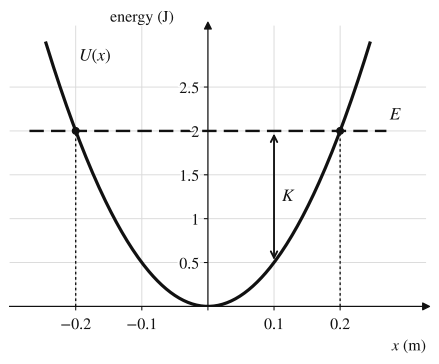
For the block and spring in the graph, and . The turning points are where , at . At , and ; at , all is kinetic and the speed is greatest. If friction acted, would be a line that steps down with each pass, and the turning points would move inward.
The same idea is how energy is graphed against time or position on the exam: and trade off so that their sum stays flat when mechanical energy is conserved, and the sum slopes down when friction is removing energy.
Worked examples
The skateboarder from the opening has a mass of and starts from rest above the bottom of a half-pipe. Friction and air resistance are negligible, and . Find her speed at the bottom using (a) the skater alone as the system and (b) the skater-Earth system.
Show solution
The ramp's normal force is always perpendicular to her motion, so it does no work in either description.
(a) Skater alone: she has only kinetic energy. Gravity, external, does on her, so by the work-energy theorem
(b) Skater-Earth: gravity is internal and conservative, nothing external does work, and there is no friction, so mechanical energy is constant. With at the bottom:
The same equation appears in both, with on different sides of the bookkeeping. The mass cancels: any rider dropping in from that height reaches , and the shape of the ramp never mattered.
A toy launcher fires a ball straight up. Its spring, , is compressed and released. Ignoring air resistance and the spring's own mass, and with , how high above its release point does the ball rise?
Show solution
Choose the ball-spring-Earth system, so both the spring force and gravity are internal and conservative. Nothing external does work, so is constant. Put at the release point and compare release (at rest, spring compressed) with the top (at rest, spring relaxed):
Comparing only the start and the end skips the moment the ball leaves the spring entirely. Energy conservation only needs the states you care about, which is its advantage over following the forces.
Design an experiment to test whether the elastic potential energy stored in a spring launcher becomes kinetic energy of a cart with no loss. The available equipment includes a level, low-friction track, the spring launcher, a meterstick, a motion detector and a set of hanging masses. Describe the measurements, the graph you would make, and how it tests the claim.
Show solution
First find the spring constant independently: hang known masses from the spring, measure each stretch with the meterstick, and take as the slope of the graph of weight against stretch. Suppose that gives .
Then, with the track level so that gravitational potential energy doesn't change, compress the launcher by a measured , release the cart, and record its speed just after it leaves the spring with the motion detector. Repeat for at least five compressions, several trials each, keeping the same cart and spring.
If no energy is lost, . So plot on the vertical axis against on the horizontal: conservation predicts a straight line through the origin with slope . At , for instance, it predicts . A best-fit slope that matches within uncertainty supports the claim; a smaller slope means some of the spring's energy went elsewhere, such as friction in the track or vibration of the launcher.
Graphing against rather than against is the step graders look for: it turns the predicted parabola into a line whose slope can be compared with a number.
A block is released from rest at height on a frictionless curved ramp. At the bottom, the horizontal track has a rough patch of length with coefficient of kinetic friction . Beyond the patch, on frictionless track, is a spring with . Use .
(a) Derive an expression for the spring's maximum compression in terms of , , , , and .
(b) Calculate .
(c) The block bounces back across the patch and up the ramp. How high does it rise?
(d) Where does the block finally stop?
Show solution
(a) Take the block, Earth, spring and track as the system. Nothing external does work, so its total energy is constant, but friction inside it turns mechanical energy into thermal energy, for one crossing. Compare release (at rest, height , spring relaxed) with maximum compression (at rest, height 0):
(b) The block starts with , and one crossing of the patch dissipates . So the spring stores at most, and
(c) The spring returns all (it is conservative), and the second crossing dissipates another , leaving to become potential energy on the ramp: .
(d) Friction is the only thing that removes mechanical energy, so the block stops once friction has taken all . That takes a total sliding distance on the patch of , which is three full crossings () plus . After crossings toward the spring, back, and toward the spring again, the fourth crossing heads back toward the ramp, so the block stops from the spring's end of the patch, from the ramp's end.
Part (d) works only because friction's loss depends on path length, not position. A justification that says so, with the total distance, earns the reasoning point.
Where students lose points
Check yourself
Question 1
A ball falls freely toward the ground. The system is chosen to be the ball alone. Which statement about the system's energy is correct?
- A
Its gravitational potential energy decreases and its kinetic energy increases by the same amount, so its total energy is constant.
- B
It has only kinetic energy, which increases because an external force does positive work on it.
- C
Its total energy is constant because gravity is a conservative force.
- D
It has only potential energy until it lands.
Show answer
B
A single object has no potential energy; that belongs to the ball-Earth system. With the ball alone, gravity is external, does positive work, and the system's energy (all kinetic) increases. A describes the ball-Earth system, not the ball alone.
- A
Question 2
A block slides from rest down a rough ramp from a height of and reaches the bottom at . With , how much mechanical energy was converted to thermal energy?
Show answer
About .
The block-Earth system starts with and ends with . Nothing external does work, so the missing is the thermal energy friction produced.
Question 3
From the top of a cliff, three identical stones are thrown with the same speed: one straight up, one horizontally, and one straight down. Air resistance is negligible. Which stone hits the ground below with the greatest speed?
- A
The one thrown up
- B
The one thrown horizontally
- C
The one thrown down
- D
All three hit with the same speed
Show answer
D
Each stone-Earth system starts with the same kinetic energy (same speed) and the same potential energy (same height), and ends at the same height, so each has the same kinetic energy, and speed, at impact. Direction doesn't enter because kinetic energy is a scalar. The stones arrive at different times, which is what makes C tempting.
- A
Question 4
A block on a horizontal frictionless surface is attached to a spring with . The block-spring system has a total mechanical energy of . What is the block's kinetic energy when it is from equilibrium?
Show answer
About .
The spring stores there, and mechanical energy is constant, so . The answer is the same on either side of equilibrium, because depends on .