Compress a toy's spring and latch it, and nothing moves, but energy is clearly waiting: release the latch and the toy jumps. That stored energy depends only on how compressed the spring is, so you can write it as a function of position. A potential energy is exactly that: energy a system has because of the arrangement of its parts, defined for interactions through conservative forces.
Potential energy belongs to a system
Potential energy is a property of two or more objects interacting through a conservative force, not of one object. A raised book doesn't "have" gravitational potential energy by itself; the book-Earth system does, and the energy depends on the separation between them. A stretched spring with a block on its end has elastic potential energy because of how far apart the spring's coils are pulled. For a system to have potential energy, the interactions inside it must be conservative. Friction between two parts of a system stores nothing you can get back, so it gets no potential energy (Topic 3.2).
The definition comes straight from the path independence in Topic 3.2. Because a conservative force does the same work between two configurations whatever the path, that work defines a function of position:
The minus sign says that when the conservative force does positive work (a falling book, a spring snapping back), the system's potential energy decreases by that amount, and the energy shows up elsewhere, usually as kinetic energy. When an outside agent pushes against the conservative force (lifting the book, stretching the spring), the potential energy rises.
Choosing where U is zero
Only changes in potential energy have physical consequences: forces depend on the slope of , and energy bookkeeping uses . Adding a constant to changes neither, so where is your decision, made to keep the problem simple. Typical choices: the lowest point an object reaches, for gravity near the ground; the relaxed length, for a spring; infinite separation, for planets and stars. Once you choose, state it and keep it for the whole problem, because every you write is measured from that zero.
Potential energy can be negative. That only means the system has less potential energy than it has at your chosen zero. Worked example 1 computes the same fall with two different zeros.
Three potential energies you need
Each comes from integrating its force with .
An ideal spring. The spring's force is , where is the stretch or compression from the relaxed length. With at the relaxed length,
Squared, so stretched and compressed by the same amount store the same energy, and doubling the deformation stores four times as much.
Gravity between two spherical masses. The attractive force has magnitude , directed toward the other mass, so its radial component is . Choose when the masses are infinitely far apart and bring them in to separation :
It is negative at every finite , because gravity does positive work as the masses come together from infinity, lowering below its zero. Pulling them apart raises toward zero.
Gravity near a planet's surface. For an object of mass raised from the surface (radius ) to height , the general formula gives
When is tiny compared with , , and with this becomes
That approximation holds because the field barely changes over heights much smaller than the planet's radius, so the force is effectively constant. Worked example 3 shows how far off it gets when that isn't true.
More than two objects. Potential energy belongs to pairs, so for three or more objects you add the potential energy of every pair, once each. For three masses,
There is no term for an object with itself, and and are the same pair, counted once.
Reading a potential energy graph
Because , a graph of shows the force at every position: steep slope, large force; positive slope, force in ; negative slope, force in . Picture a ball on a hill shaped like the graph: it is pushed downhill, toward lower .
Where the slope is zero, the force is zero, and an object placed there at rest stays put: an equilibrium position. The shape around it decides what happens after a nudge.
- At a local minimum of , a small displacement either way puts the object on an upward slope, and the force points back toward the minimum. That is stable equilibrium: the object is pushed back, and oscillates about the point.
- At a local maximum, a small displacement puts the object on a downward slope, and the force points further away. That is unstable equilibrium: the object, once nudged, accelerates away.
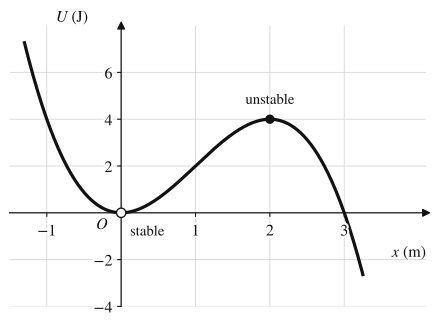
In the graph, the slope is positive between and , so the force there points in , back toward the minimum. Past the slope is negative and the force points in , away from the maximum. Topic 3.4 adds the total energy to this picture to find where a moving object turns around.
Worked examples
(a) A flowerpot falls from a balcony above the street. With , find the gravitational potential energy of the pot-Earth system at the balcony and at the street, first with at the street and then with at the balcony. Find for the fall each way.
(b) A spring with is already compressed . How much does its elastic potential energy increase when it is compressed further, to ?
Show solution
(a) Near the surface, with measured up from the chosen zero; .
- Zero at the street: , , so .
- Zero at the balcony: , , so .
The values of differ by a constant, and , the only thing that affects motion, is the same.
(b) Use the deformation at each end, not the change in deformation:
Squaring the change, , gives half the right answer. That number is the energy for compressing a relaxed spring to , while the force grows from to . Here the spring starts already pushing back with and ends at . Because the force grows linearly with compression, the work against it is the average force times the distance, , which matches the subtraction.
A particle moving along the -axis is part of a system with potential energy , where and (the graph above).
(a) Find the force on the particle at and at .
(b) Find every equilibrium position and classify each as stable or unstable.
Show solution
(a) Differentiate and change the sign:
At : , so in the direction, toward . At : , so in the direction. Each points downhill on the graph, as it must.
(b) Set : , so or . To classify, look at the curvature, . At it is , a local minimum: stable. At it is , a local maximum: unstable. You can also check with forces: just right of , at , , pushing the particle further away.
A satellite of mass is lifted from Earth's surface (radius , mass ) to an altitude above the surface.
(a) Starting from Newton's law of gravitation, derive the gravitational potential energy of the Earth-satellite system at center-to-center separation , taking at infinite separation.
(b) Derive an expression for the increase in potential energy when the satellite goes from the surface to altitude . Show that it is , where .
(c) For and , calculate the increase, using , and . Compare it with using .
(d) Explain physically why gives the wrong value in (c).
Show solution
(a) The gravitational force on the satellite points toward Earth, so its radial component is . From the definition, with ,
(b) The satellite goes from to :
Substitute : .
(c) With , the result of (b) becomes :
The estimate is about twice as large.
(d) assumes the gravitational force stays all the way up. But the force falls off as : at it is a quarter of its surface value. Less force over the same distance means less work against gravity, so the true is smaller. The factor is near 1 only when , which is the condition for to be valid.
Where students lose points
Check yourself
Question 1
A particle is at rest exactly at a local maximum of the potential energy curve and is nudged slightly in the direction. What does the force on it do?
- A
It points in , returning the particle to the maximum
- B
It points in , pushing the particle further from the maximum
- C
It is zero, because the slope at a maximum is zero
- D
It points toward whichever side has lower at large distances
Show answer
B
Just right of a maximum the slope is negative, so is positive: the force pushes the particle away, which is what makes the equilibrium unstable. C is true only at the maximum itself, not after the nudge.
- A
Question 2
The potential energy of a system is . What is the conservative force on the particle at ?
Show answer
in the direction ().
, which is at . The slope of is positive there, so the force points toward decreasing .
Question 3
Three identical spheres sit at the corners of an equilateral triangle with sides of . Using and zero at infinite separation, what is the gravitational potential energy of the three-sphere system?
Show answer
There are three pairs, each at , so . Counting each pair twice would double it; forgetting a pair would give two thirds of it.
Question 4
A student moves the zero of gravitational potential energy for a dropped ball from the floor to the ceiling of the room. Which quantity changes?
- A
The value of at each height
- B
The change as the ball falls
- C
The gravitational force on the ball
- D
The ball's speed when it hits the floor
Show answer
A
Moving the zero subtracts the same constant from every value of , so each value changes (they all become negative or zero). Differences in , the slope that gives the force, and therefore the motion are all unchanged.
- A
Go deeper
- OpenStax, University Physics Volume 1, 8.1 Potential Energy Of A System
- OpenStax, University Physics Volume 1, 8.2 Conservative And Non Conservative Forces
- OpenStax, University Physics Volume 1, 8.4 Potential Energy Diagrams And Stability
- OpenStax, University Physics Volume 1, 13.3 Gravitational Potential Energy And Total Energy