At 6 a.m. the air temperature is 4 degrees Celsius, and at 2 p.m. it is 17 degrees. You can be sure that at some moment in between it was exactly 10 degrees, even with no thermometer reading at that moment, because temperature cannot get from 4 to 17 without passing through every value in between. The Intermediate Value Theorem (IVT) makes that reasoning precise for any continuous function. It is an existence theorem: it proves that a value is reached without telling you where.
What the theorem says
The picture explains it. Continuity on means the graph from to is a single unbroken curve. If the horizontal line lies between the heights of the two endpoints, one endpoint is below the line and the other above it, and an unbroken curve cannot get from one side to the other without meeting the line. Each place it meets the line is an input with .
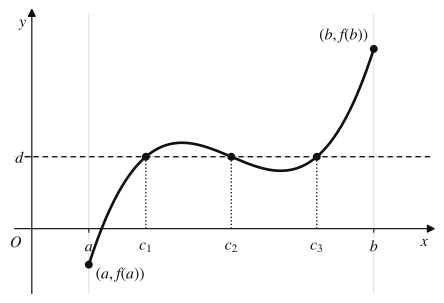
This curve meets three times, at , and , while the theorem promises only one; the section after next says what it leaves out. A full proof relies on a property of the real numbers (that they have no gaps) studied in college analysis, and the AP exam treats the IVT as a theorem you apply, not one you prove.
The most-used special case is . If is continuous on and and have opposite signs, then 0 is between them, so has at least one zero in .
Continuity on the closed interval is the condition that matters
Every conclusion of the IVT depends on continuity on all of , including the endpoints. Without it, the graph can skip over the line .
- A jump skips values. Let for and for . On , and , and 4 is between them. But the left piece only produces values from 1 up to (not including) 3, and the right piece produces values from 5 to 7. No input gives 4. The IVT does not apply, because has a jump at .
- An asymptote skips values. On , and , opposite signs. Yet has no zero on that interval ( only where , at multiples of ). The graph gets from positive to negative by going up to and coming back from at the vertical asymptote .
On the exam you confirm continuity in one of three ways:
- the problem says so (" is continuous on ");
- the function is built from continuous pieces: polynomials, exponentials, and everywhere; rational functions, logarithms, roots and on intervals inside their domains; and sums, products, quotients (with nonzero denominator) and compositions of these (topic 1.12);
- the problem says is differentiable, since a function that is differentiable at a point is continuous there (topic 2.4).
What the theorem does not say
The IVT is a one-way statement, and three tempting extensions of it are false.
It doesn't count. It guarantees at least one , never exactly one. Claiming "the solution" or "exactly one zero" needs more information, such as knowing is always increasing (Unit 5).
It doesn't locate. It gives an interval that contains a , not the value of . You can shrink the interval by testing more inputs (Example 1 does this), but the IVT alone never names .
It is silent when the value isn't bracketed. If is not between and , the theorem makes no claim at all; in particular, if and have the same sign, it says nothing about zeros. The function might still have some. For on , both endpoint values are 3, and still . "The IVT does not guarantee a zero" and "there is no zero" are different statements.
Equations, tables, and the written justification
Equations between two functions. To show two continuous functions are equal somewhere, apply the IVT to their difference , which is continuous because and are. A sign change in between and means for some between them.
Tables. When a continuous function is given only by a table, apply the IVT on each pair of consecutive inputs. Each subinterval where passes from below to above it (or the reverse) contains its own solution of , and subintervals that don't overlap give different solutions. Counting those subintervals gives the fewest solutions the table guarantees.
Worked examples
Show that the equation has a solution between and , and then find an interval of length that contains a solution.
Show solution
Let , a polynomial, so is continuous on . Evaluate the endpoints:
Since , the Intermediate Value Theorem gives a number with and , so .
To narrow it down, test inputs inside the interval: , which is less than 3, and , which is more than 3. Since is continuous on and , the IVT puts a solution in . Repeating this with more test points shrinks the interval as far as you like, though it never produces exactly.
Show that the equation has at least two real solutions.
Show solution
Move everything to one side and define . A solution of the equation is a zero of . The function is a sum of an exponential and a polynomial, so it is continuous for all real .
To get two solutions, find two non-overlapping intervals that each have a sign change. Try a few easy inputs:
On : is continuous and , so by the IVT there is a in with .
On : is continuous and , so by the IVT there is a in with .
The intervals and do not overlap, so , and the equation has at least two solutions. The middle test point is what makes this work: is negative there and positive at both ends, so there is one sign change on each side of it.
Water flows into and out of a tank. The volume of water in the tank, in liters, is modeled by a differentiable function of time , in hours, for . Selected values of are given in the table below.
(a) Must there be a time , , at which ? Justify your answer.
(b) What is the fewest number of times in the interval at which ? Justify your answer.
(c) Does the Intermediate Value Theorem guarantee a time at which ? Explain.
(d) A second tank holds liters at time . Show that there is a time , , at which the two tanks hold the same volume.
Show solution
Since is differentiable, it is continuous on , and so on every closed subinterval. State this once at the start; every part uses it.
(a) Yes. is continuous on , and . By the Intermediate Value Theorem, there is a time with at which .
(b) At least 3 times. On each of these intervals is continuous and 40 lies between the endpoint values:
- : ;
- : ;
- : .
By the IVT, at some time in each of , and . These intervals don't overlap, so the three times are different. On both values are above 40, so the table guarantees nothing there.
(c) No. The IVT gives a value only when lies between two values of , and every value in the table is at most 51, so no pair of table values brackets 55. That does not mean never reaches 55: the volume could rise above 51 between readings. The table and the IVT just can't show it.
(d) The tanks hold the same volume exactly when , so let . It is continuous on as the difference of two continuous functions ( is linear). At the endpoints,
Since , the IVT gives a time with and , that is, : the two tanks hold the same volume at that time.
Where students lose points
On the exam
The exam asks about the IVT in forms like Example 3: a table of values of a function stated to be continuous or differentiable, with a question such as "must there be a value..." or "what is the fewest number of times...." The answer earns credit only with the three-part justification: continuity, the inequality bracketing the value with numbers from the table, and the theorem's name with the conclusion. The work is the same with or without a calculator.
Check yourself
Question 1
The function is continuous on , with and . Which of the following must be true?
- A
for at least one in .
- B
has exactly one zero in .
- C
- D
for every in .
Show answer
A
0 lies between and 4, and is continuous on , so the IVT gives at least one zero in . B claims a count and C a location, neither of which the theorem provides; 1 is the average of the endpoint values, but nothing forces to be that. D can fail because may rise above 4 between the endpoints.
- A
Question 2
Let . Then and . Does the Intermediate Value Theorem guarantee that has a zero in ?
Show answer
No. is not continuous on (it is undefined at ), so the theorem does not apply, and in fact has no zero anywhere.
The sign change comes from the vertical asymptote at : jumps from to there. A fraction is 0 only when its numerator is 0, and the numerator here is the constant 1.
Question 3
A continuous function has , , , and . What is the fewest number of zeros can have on ?
Show answer
3
The sign changes between consecutive inputs on , and , and is continuous on each, so the IVT gives a zero in each of , and . These intervals don't overlap, so the zeros are different. On both values are negative, so no zero is guaranteed there.
Question 4
The function is continuous on with and . Does it follow that has no zeros in ?
Show answer
No. The IVT makes no claim when 0 is not between and ; may or may not have zeros.
For example, is continuous, equals 3 at both endpoints, and has zeros at and . Endpoint values of the same sign only mean the theorem gives no guarantee.