A ball is thrown upward from a 20-meter ledge, and its height after seconds is meters. Asking how fast it is rising over the first two seconds has an easy answer: divide the change in height by the elapsed time. Asking how fast it is rising at exactly is harder, because at a single instant no time passes and nothing changes, so the division becomes . Calculus answers the second question by taking a limit of the first.
Average rate of change: the difference quotient
The average rate of change of over an interval from to is the change in output divided by the change in input:
Geometrically, it is the slope of the secant line, the line through the two points and on the graph. Its units are output units per input unit: for height in meters and time in seconds, meters per second.
For the ball, over :
This says the ball gained height at 5.2 meters per second on average over those two seconds. It does not say the ball was moving at that speed at any particular moment. The ball rose faster at first and slower later.
When the interval starts at a fixed point , two ways of naming the other endpoint are standard, and they give the same quotient:
- Call the other endpoint . The average rate over the interval between and is .
- Call the length of the step , so the other endpoint is . The average rate is .
Either expression is called a difference quotient. Substituting turns the first into the second. The step may be negative, which puts the second point to the left of ; the quotient is still the slope of the secant line between the two points. It is never allowed to be , since then there would be no interval and the quotient would be .
From average to instantaneous: the limit
To get the rate at exactly , compute the average rate over the interval from to for a general , and then watch what happens as the interval shrinks. Expand first:
Since ,
Dividing by is legal because . Now the quotient is a simple expression in , and you can see where it goes:
| average rate over (m/s) |
From both sides, the average rates close in on , and the formula shows exactly why: the error is , which goes to with . So at the instant , the ball is rising at 5.2 meters per second.
Look at what the limit did. Plugging into the original quotient gives , which carries no information. The algebra cancels the factor of that causes the (the same move as the limits of topic 1.6), and then direct substitution into finishes the job.
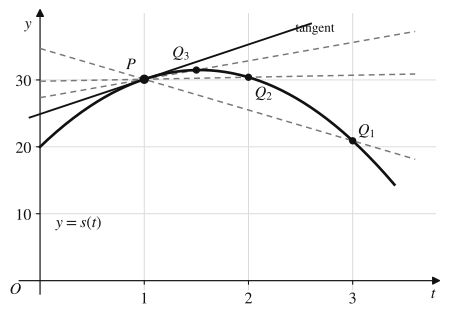
The figure shows the same thing geometrically. As the second point slides along the curve toward , the secant line through and rotates, and its slope approaches the slope of the tangent line at , the line that touches the curve at and matches its direction there. Topic 2.2 writes equations for tangent lines.
"Provided the limit exists" is a real condition. For at , the difference quotient is , which equals for every and for every . The one-sided limits disagree, so there is no instantaneous rate of change at , which matches the sharp corner in the graph. Topic 2.4 sorts out when derivatives fail to exist.
Reading a limit as a derivative
Because the definition has a fixed shape, a limit in that shape can be recognized as a derivative without evaluating it. In
the pieces match with and , because is and is . So the limit is , the instantaneous rate of change of at , which is also the slope of the parabola at the point . Expanding gives .
The test is that the subtracted term must be the same function evaluated at the base point. In , the term is for and the denominator is , so this is the same derivative in the other form, and factoring gives again.
Worked examples
Use the definition of the derivative to find the instantaneous rate of change of at .
Show solution
The -form keeps the algebra short here:
Direct substitution gives , so rewrite. For , the denominator factors as a difference of squares, . For the common factor cancels:
This new expression is continuous at , so the limit is found by substitution:
At , the square root grows by about of a unit per unit increase in . That is slow because flattens as grows.
A tank is draining, and the volume of water in it is liters, minutes after the drain is opened, for .
(a) Find the average rate of change of over . Using correct units, interpret it.
(b) Use the definition of the derivative to find the instantaneous rate of change of at . Using correct units, interpret it.
Show solution
(a) and , so
Over the first 5 minutes, the volume of water decreased at an average rate of 35 liters per minute.
(b) Expand :
Then
At time minutes, the volume of water is decreasing at a rate of 30 liters per minute.
The two answers differ because the draining slows down: it averaged 35 liters per minute over the first five minutes but is down to 30 at the five-minute mark. The interpretation in (a) names the interval, and the one in (b) names the instant. Swapping them is a wrong interpretation.
(A) (B) (C) (D) nonexistent
Show solution
Look for the shape . With and , the numerator's first two terms are , and is the subtracted term. So the limit is , which exists because is a polynomial, which rules out (D).
To get its value, expand :
The answer is (C). Choice (A) comes from substituting into the numerator only, and (B) from keeping only the cube's contribution and dropping the from .
The same limit can also be read as for . A limit determines a number; it does not determine one function and one point. Both readings give 5.
Where students lose points
On the exam
Average rates of change appear constantly in free-response contexts, usually as "find the average rate of change of over the interval" followed by "using correct units, interpret." Multiple-choice questions often present a limit in the shape of the definition and ask for its value; when the function is one whose derivative you know, recognize it rather than expanding. Questions that say "use the definition of the derivative" require the limit, written with on every line until (or ) is gone.
Check yourself
Question 1
What is the average rate of change of over the interval ?
Show answer
and , so the average rate is . Dividing by 2 instead of by the interval's length 3 gives 3, which is the most common slip.
Question 2
If , which of the following must be true?
- A
- B
The instantaneous rate of change of at is .
- C
The average rate of change of over is .
- D
for all .
Show answer
B
The limit is the -form of the definition of , so . It says nothing about the value (choice A) or about any interval of fixed length (choice C). Choice D would make a straight line; the limit only describes the slope at the single point .
- A
Question 3
For , a student simplifies the difference quotient to . Is that right, and what is ?
Show answer
Yes; .
and , so the quotient is for . Its limit as is 0: the parabola has a horizontal tangent at its vertex .
Question 4
The limit represents which of the following?
- A
The value of at
- B
The average rate of change of over
- C
The slope of the line tangent to the graph of at
- D
The slope of the line tangent to the graph of at
Show answer
C
The numerator is for , since , so the limit is , the slope of the tangent line at . Choice D mistakes the output for the input; choice B is a secant slope over a fixed interval, which is , not a limit.
- A