Topic 2.1 found the derivative at one point, , as a limit of difference quotients. Doing that limit separately at , then at , then at repeats the same algebra each time. Do it once with a variable in place of , and the result is a formula that gives the slope of at every point at once: a new function, called the derivative of .
The derivative as a function
The derivative of is the function whose value at each is the limit of the difference quotient at that :
During the limit, is held fixed and only moves. That is why the answer can still contain : the limit is taken at one at a time, and the formula records the result for all of them.
For :
One limit now answers every slope question about this parabola. At the slope is ; at it is , so the vertex is at ; at it is .
The domain of can be smaller than the domain of . The function is defined everywhere, but the limit fails at (topic 2.1), so is defined only for : it equals for and for . Topic 2.4 covers where and why derivatives fail to exist.
Notation
Several notations for the derivative are in use, and the exam uses all of them. For :
| Notation | Read as | Value at |
|---|---|---|
| " prime of " | ||
| " prime" | at | |
| " " or "the derivative of with respect to " | ||
| "the derivative of " |
The prime notation, from Lagrange, is short and names the function. The notation, from Leibniz, is built to look like , the change in over the change in , which is what it is the limit of. It names both variables, so it works with any letters: if a volume depends on a radius , its derivative is , and if a position depends on time , it is . The symbol by itself is an instruction: take the derivative, with respect to , of whatever follows.
Leibniz notation also carries units. is measured in units of per unit of , so if is in cubic centimeters and in centimeters, is in cubic centimeters per centimeter.
One notational distinction matters on the exam. is the derivative evaluated at 3, the slope of there. differentiates the number , which never changes as changes, so it is . Differentiate first, then substitute.
Four ways to see a derivative
The same derivative can be given as a formula, a graph, a table, or a sentence, and exam questions move between all four.
Analytically, it is a formula, like above.
Graphically, the value is the slope of the graph of at , so the graph of tells you the graph of without any formula:
- where is increasing, its slopes are positive, so the graph of is above the -axis;
- where is decreasing, is below the -axis;
- where the graph of has a horizontal tangent, is ;
- where is steeper, is farther from .
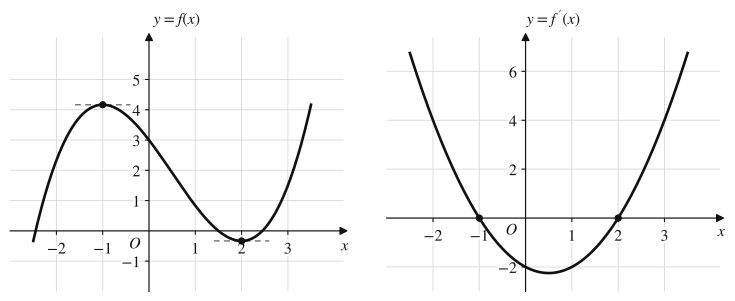
In the figure, rises until , falls until , and rises after. So is positive, then zero at , negative until it reaches zero again at , then positive. The steepest descent of is near , which is where is most negative. (The formulas, if you want them, are and .)
Numerically, the derivative is a table of values of , often given outright in a free-response question. When only values of are given, you estimate from them (topic 2.3).
Verbally, the derivative is a rate stated in words with units: " is the rate at which the temperature of the soup is changing, in degrees Fahrenheit per minute, at time minutes." A sentence that says what changes, with respect to what, in what units, and when, is the form a free-response interpretation takes.
The tangent line
The derivative at a point is the slope of the tangent line there (topic 2.1). The tangent line also passes through the point on the graph, and a point plus a slope is all a line needs.
For at : and , so the tangent line is .
A tangent line does not have to touch the curve only once, and it can cross the curve. For at , the difference quotient is , so the tangent line is , the -axis, and the cubic crosses it at the origin. What makes a line tangent is matching the curve's slope at the point. Zoom in on a differentiable function at a point and its graph looks more and more like that line, which is why the tangent line approximates the function near the point (topic 4.6).
Worked examples
Let .
(a) Use the definition of the derivative to find . What is the domain of ?
(b) Write an equation for the line tangent to the graph of at .
Show solution
(a) Combine the two fractions in the numerator over a common denominator:
Divide by (allowed, since ) and take the limit:
The limit exists for every ; at , itself is undefined. So the domain of is all . The derivative is negative everywhere it exists, which matches the graph of : each of its two branches falls from left to right.
(b) and , so the tangent line is
The volume of a spherical balloon with radius centimeters is cubic centimeters. Use the definition of the derivative to find , and then find . Using correct units, explain its meaning.
Show solution
Expand , so
At ,
When the radius is 5 centimeters, the volume of the balloon is increasing at a rate of , about 314.159, cubic centimeters per centimeter of increase in the radius.
The formula is the surface area of the sphere, and that is not a coincidence. Growing the radius by a thin amount adds a shell whose volume is about (surface area) , so the volume grows at the rate of the surface area.
Let .
(a) Find using the definition of the derivative.
(b) At what point is the line tangent to the graph of parallel to the line ? Write an equation for that tangent line.
(c) Find all values of for which the line tangent to the graph of at passes through the origin.
Show solution
(a) , so
(b) Parallel lines have equal slopes, so the tangent line must have slope 2. Solve : , so . The point is , and the tangent line is
(c) The tangent line at is , with both and written in terms of :
It passes through the origin when at :
So or . Check: at , and , giving ; at , and , giving . Both lines pass through .
The move in (c) is to keep the point of tangency as an unknown and impose the condition on the line. Setting or plugging into would answer a different question, since the origin is not on the parabola ().
Where students lose points
On the exam
Questions mix notations on purpose: a stem may define and then ask about at a point, or give as a graph and ask about . When a question asks for a tangent line, point-slope form, , with unsimplified numbers is a complete answer. When a question says "use the definition of the derivative," the limit is the work being asked for, so an answer reached with derivative rules (topics 2.5 and later) does not show it.
Check yourself
Question 1
The line tangent to the graph of at is . Which of the following is true?
- A
and
- B
and
- C
and
- D
and
Show answer
B
The tangent line passes through , and at the line has , so . Its slope, 4, is . Choice C reads the -intercept as the function value, but the intercept is where the line meets , not .
- A
Question 2
A differentiable function is increasing on , has a horizontal tangent at , and is decreasing on . What are the signs of , and ?
Show answer
, , .
is the slope of the graph of at . The graph rises at , is flat at , and falls at .
Question 3
The limit is the derivative of which function, and what does it equal?
Show answer
It is the derivative of , and it equals .
The numerator is for . It simplifies to , so the quotient is , which tends to .
Question 4
The amount of water in a tank is liters, minutes after a valve opens, and . Which statement is correct?
- A
At time minutes, the amount of water in the tank is decreasing at a rate of 3 liters per minute.
- B
During the first 10 minutes, the amount of water decreased by 3 liters.
- C
At time minutes, the tank holds 3 liters less than it did at the start.
- D
The average rate of change of over is liters per minute.
Show answer
A
is an instantaneous rate at the single time , measured in liters per minute, and its negative sign means decreasing. Choices B, C and D all describe what happened over the interval from 0 to 10, which a derivative at one instant does not determine.
- A