A derivative is the limit of as . The denominator goes to , so for the quotient to settle on a finite number, the numerator has to go to as well. That forces , which is continuity. Differentiability is the stronger condition: it demands continuity and more.
Differentiable implies continuous
Here is the proof. For , multiply and divide by :
As , the first factor approaches , a finite number because is differentiable at , and the second factor approaches . The limit of a product is the product of the limits, so
That is the definition of continuity at (topic 1.11).
Two consequences follow:
- No function value, no derivative. If is not in the domain of , it is not in the domain of . The difference quotient needs the value , so no derivative can exist where is undefined. For , both and are undefined at .
- Every discontinuity is a point of non-differentiability. At a jump, a hole, or a vertical asymptote, the derivative does not exist, and nothing more needs checking. At a removable discontinuity this is true even though the graph looks smooth on both sides of the hole: the quotient's numerator approaches a nonzero number while the denominator goes to .
Continuous does not imply differentiable
The converse is false. A function can be continuous at and still have no derivative there, because the difference quotient can fail to have a finite limit even when . Usually it fails in one of two ways: its one-sided limits disagree, or it grows without bound. (A third way exists: the quotient can oscillate forever. For with , is continuous at , but the quotient swings between and infinitely often as and approaches nothing.)
Corners: one-sided slopes disagree
For at , the difference quotient is . For it equals , and for it equals . The one-sided limits are and , so the two-sided limit does not exist. The graph is continuous at but has a corner: there is no single line that matches its direction from both sides.
Any graph made of two smooth pieces that meet at an angle has the same problem. If the slope from the left approaches one value and the slope from the right approaches another, there is no derivative at the meeting point.
Vertical tangents and cusps: slopes grow without bound
For at , the difference quotient is
which is positive for every and grows without bound as . The secant lines through the origin get steeper and steeper from both sides and approach the vertical line . That vertical line is the tangent line, but a vertical line has no slope, so does not exist. The function is continuous at , and its graph is perfectly smooth there; it just stands straight up.
For at , the quotient is , which goes to from the right and to from the left. The graph comes down steeply into the origin and goes back up steeply, forming a sharp point called a cusp. Again, no derivative exists.
Piecewise functions: continuity first, then slopes
A function defined in pieces, such as
is differentiable away from the break point wherever its pieces are. At the break point , check in this order.
First, continuity. , and , so is continuous at . If this had failed, you would be done: no continuity, no derivative.
Then, the one-sided limits of the difference quotient. From the left, with :
From the right:
The left-hand slope is and the right-hand slope is , so is continuous but not differentiable at : the graph has a corner there.
Once continuity is established, the one-sided limits of the difference quotient equal the slopes of the two pieces at the break point, so with pieces whose derivatives you know, comparing those slopes is a valid shortcut. Without continuity, it is not, as the first trap below shows.
Worked examples
Show that is continuous but not differentiable at .
Show solution
Continuity. is the absolute value of a polynomial, a composition of continuous functions, so is continuous everywhere, and in particular .
Differentiability. Near , the sign of decides the formula. For slightly greater than 2, , so . For slightly less than 2 (between and ), , so . With :
The one-sided limits of the difference quotient are and . They are not equal, so does not exist. The absolute value reflects the part of the parabola below the -axis upward, which folds the graph into a corner where it touches the axis.
The graph of on is shown below.
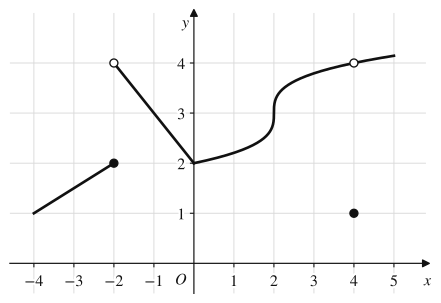
(a) At which values of in is not continuous?
(b) At which values of in is not differentiable? Give a reason for each.
Show solution
(a) is not continuous at , where the graph jumps (the left-hand limit is 2, the right-hand limit is 4), and at , where but .
(b) is not differentiable at four values:
- and : is not continuous there, and a function is differentiable only where it is continuous.
- : is continuous, but the graph has a corner. The slope from the left is (the segment from to ), and the slope from the right is a small positive number, so the one-sided limits of the difference quotient are not equal.
- : is continuous, but the tangent line there is vertical, so the difference quotient grows without bound and does not exist.
Everywhere else in the interval, the graph is a smooth unbroken curve or segment with a non-vertical tangent, so is differentiable there.
Let be defined by
where and are constants. Find the values of and for which is differentiable at . Justify your answer.
Show solution
For to be differentiable at , it must be continuous there, and the one-sided limits of its difference quotient must be equal.
Continuity. and , so continuity requires
Equal one-sided slopes. From the left, using :
From the right, use continuity to replace by :
Differentiability requires .
Solve. Substituting into the continuity equation gives , so and .
Check. With these values, for and for . Both pieces equal at , and both have slope there, so is continuous at and .
Both conditions are needed. Using only the slope condition leaves infinitely many pairs, most of which make jump at ; using only continuity leaves infinitely many pairs, most of which make a corner.
Where students lose points
On the exam
Questions on this topic ask you to decide whether a function is differentiable at a point and justify it. For a piecewise function, the justification states continuity with limits and then compares the one-sided slopes. Multiple-choice questions may show a graph and ask at how many points the function is not differentiable, or give a piecewise function with unknown constants. The fact "differentiable implies continuous" also appears as a step inside other justifications: when a question says is differentiable, you may cite it to conclude is continuous wherever it is differentiable. Check what that gives you against each theorem's hypotheses. The Intermediate Value Theorem needs continuous on the closed interval , and the Mean Value Theorem needs continuous on and differentiable on . If is differentiable at every point of (for example, differentiable for all real ), continuity on follows. If you are told only that is differentiable on the open interval , that gives continuity inside the interval but not at or , so continuity at the endpoints must be given or checked separately.
Check yourself
Question 1
The function is differentiable at , and . Which of the following must be true?
- A
- B
- C
- D
for all near
Show answer
A
Differentiability at 3 implies continuity at 3, and continuity means the limit equals the function value, 5. Nothing given determines the value of , so B and C need not hold, and D would make constant near 3.
- A
Question 2
Which of the following functions is continuous at but not differentiable at ?
- A
- B
- C
- D
Show answer
B
is for and for : continuous, with slopes and on the two sides, a corner. For A, the difference quotient is , so is differentiable at 0 with derivative 0. D is undefined at 0, so it is not continuous there.
- A
Question 3
Let . Find the one-sided limits of the difference quotient as and , and say whether the graph has a corner, a cusp, or a vertical tangent at .
Show answer
As the quotient goes to ; as it goes to . The graph has a cusp at , so does not exist.
is continuous at 0 with . For the quotient is ; for it is . Infinite limits of opposite sign make a cusp; a vertical tangent would need both to be (or both ), and a corner needs two different finite limits.
Question 4
A function is not continuous at . Can exist? Explain.
Show answer
No. If existed, would be continuous at .
Differentiability at a point implies continuity there. Since is not continuous at 4, it cannot be differentiable at 4, whatever its graph looks like on either side.