Put some extra electrons on a metal ball and they do not stay where you put them. Within about a billionth of a second they spread out until they all sit on the outer surface, the field inside the metal is exactly zero, and every point of the ball is at the same potential. Almost every result about conductors follows from one question: what has to be true once the charges stop moving?
What a conductor is
A conductor is a material with charges that are free to move through it. In a metal those are the outer electrons of each atom, which are not bound to any one nucleus and drift through the whole crystal. The positive ions stay locked in place. An ideal conductor is the model in which these electrons move with no resistance at all, so any electric force on them, however small, moves them.
A conductor's net charge is about the balance between those electrons and the fixed ions:
- A negatively charged conductor has more electrons than its ions' charge balances. The extra electrons are real particles, and they end up on the surface.
- A positively charged conductor is missing electrons. Nothing positive moves; instead, the surface is left short of electrons, and you can describe it exactly as if positive charge carriers sat on the surface. Physicists and the exam use that description routinely: "positive charge on the surface" means "a surface deficient in electrons."
Electrostatic equilibrium is the state in which no charge in the conductor is moving. After charge is added or a nearby charge moves, a metal reaches it in a time far too short to matter (around s or less for ordinary objects), so on the exam a conductor is always treated as already in equilibrium.
Why the field inside is zero and the charge sits on the surface
Suppose there were a nonzero field at some point inside the metal. The free electrons there would feel a force and move, so the conductor would not be in equilibrium. So in equilibrium, at every point in the material of the conductor. Charges keep moving until their own field exactly cancels whatever field would otherwise be there.
Now draw a Gaussian surface (topic 8.6) anywhere inside the metal, as close to the outer surface as you like. The field is zero at every point on it, so the flux is zero, and Gauss's law says the net charge enclosed is zero. Because this works for a surface just beneath the outer skin, any excess charge must be on the surface itself. The physical reason is mutual repulsion: like charges push one another as far apart as they can get, and in a solid object the farthest they can get is the outer surface.
Hollow conductors and charge in a cavity
The same Gauss's law argument decides where charge goes on a hollow conductor. Take a metal shell with an empty cavity. A Gaussian surface inside the metal, wrapped around the cavity, has zero flux, so the cavity's inner wall carries zero net charge; all the conductor's charge is on its outer surface.
Now put a point charge inside the cavity, not touching the walls. The Gaussian surface in the metal must still enclose zero net charge, so the inner wall must carry . Charge is conserved, so if the shell's net charge is , the outer surface carries . The inner wall's is crowded toward wherever sits, but the outer surface's charge spreads out exactly as it would with no cavity at all: the metal hides the cavity's details from the outside.
The surface: one potential, field at right angles
Because inside, the potential difference between any two points in the metal is along a path through the metal (Unit 9). Every point of the conductor, including every point on its surface, is at the same potential. The surface is an equipotential.
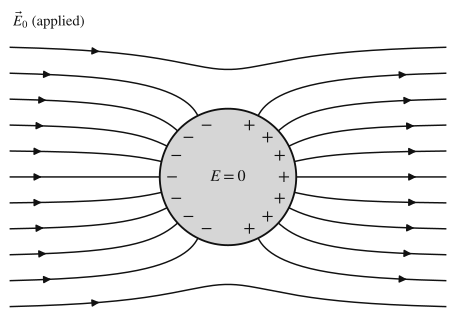
That fixes the direction of the field just outside. If the field had a component along the surface, it would push the surface charges sideways and they would move, so in equilibrium only the perpendicular component survives. Field lines always meet a conductor at right angles, as in the figure, which is also what you expect from field lines crossing an equipotential.
The magnitude comes from Gauss's law with a small cylinder (a "pillbox") that straddles the surface, one flat end of area just outside and the other just inside the metal. Flux passes only through the outer end: the inner end is in the metal, where , and the field runs along the curved side. The cylinder encloses the patch of surface charge , so
This is twice the field of an isolated thin sheet, , because all the field is on one side. For example, if the field just outside a flat part of a charged metal panel is , the charge density there is .
The surface charge is not spread evenly unless the conductor is a sphere far from anything else. On an irregular conductor, charge density is greatest where the surface curves most sharply: at points, edges and corners. Topic 10.2 shows the reason with two spheres joined by a wire, which must be at the same potential: the smaller sphere ends up with the larger surface charge density. A sharp tip acts like a very small sphere, so , and with it , is largest there. That is why sparks jump from points and why lightning rods are pointed.
Induced charge and electrostatic shielding
Bring a conductor with zero net charge into an external field. The free electrons are pushed opposite to the field and pile up on one side, leaving the other side short of electrons. The conductor is now polarized: equal and opposite induced charges on its two sides, with zero net charge overall. The figure shows the result for a sphere in a uniform field pointing right: negative charge on the left face, where the field lines end, and positive charge on the right face, where new lines begin.
The electrons stop moving when the field of the induced charges exactly cancels the external field everywhere inside the metal. This is the same equilibrium condition as before, stated as potential: the external field would make one side of the conductor higher in potential than the other, and the electrons shift until the conductor is one equipotential again. Take the external field away and the electrons spread back; the polarization disappears. (Topic 10.2 shows how a ground connection turns a polarized conductor into a charged one.)
A closed conducting shell gives electrostatic shielding. Surround an empty region with metal, and charges outside cannot produce any field inside it. The outer surface polarizes to cancel the outside field in the metal; the inner wall stays uncharged, as shown above; and the empty cavity, enclosed by a single equipotential with no charge in it, has the same potential everywhere, so its field is zero. This is a Faraday cage. It is why a car's metal body protects the people inside from a lightning strike and why sensitive electronics are wrapped in metal cases. Shielding works in one direction only: a charge inside a cavity still induces charge on the outer surface (the above), so the outside does feel it.
Worked examples
A solid metal sphere of radius , far from other objects, carries a net charge of . Use and .
(a) Where is the charge, and what is the surface charge density?
(b) Find the electric field at , just outside the surface, and at from the center.
(c) Find the potential at the center of the sphere.
Show solution
(a) All the excess charge is on the outer surface. An isolated sphere has no preferred direction, so the charge spreads uniformly:
(b) At the point is inside the metal, so . Outside, a Gaussian sphere encloses all of , so the sphere acts like a point charge at its center. Just outside the surface,
directed radially outward. The pillbox result agrees: . At , , outward.
(c) At the surface, . Inside, , so the potential does not change as you move inward: the center is also at . The potential is not zero just because the field is.
A thick conducting spherical shell has inner radius and outer radius and carries a net charge of . A point charge of is held at the center of the cavity. Use .
(a) Find the charge on the inner and outer surfaces of the shell.
(b) Find the electric field at , and from the center.
(c) Find the potential of the shell.
(d) The point charge is moved off center (still not touching the shell). Which of your answers to (a) through (c) change?
Show solution
(a) A Gaussian sphere of radius lies inside the metal, where , so it encloses zero net charge: , giving . The shell's total is , so .
(b) At , only the point charge is enclosed:
At the point is in the metal, so . At the enclosed charge is :
(c) Outside, everything acts like at the center, so at the outer surface . The whole shell is one equipotential, so its potential is .
(d) Only the arrangement of the inner wall's charge changes: the crowds toward the point charge. The amounts in (a) are fixed by Gauss's law and charge conservation, so they do not change. The field inside the metal is still zero, which means the inner charges cancel the point charge's field everywhere beyond the inner wall; the outer therefore feels no push from the cavity and stays uniform. So the field at and the potential of the shell are unchanged. The field at does change, because it now depends on the off-center charge and the uneven inner charge.
Two large parallel metal plates, apart, carry equal and opposite charges and are disconnected from everything, so their charges cannot change. The potential difference between them is . An uncharged metal slab thick, with the same area as the plates, is slid into the middle of the gap, parallel to the plates and touching neither. Use .
(a) On a side view, sketch the charge on the slab's faces and the field lines in the gap.
(b) Calculate the magnitude of the induced surface charge density on each face of the slab.
(c) Calculate the new potential difference between the plates.
(d) A student says, "The slab blocks the field, so the potential difference between the plates is now zero." Explain what is wrong with the claim.
Show solution
(a) The field between the plates, , points from the positive plate to the negative plate. Free electrons in the slab are pushed opposite the field, so the slab face nearer the positive plate becomes negative and the face nearer the negative plate becomes positive. The sketch shows evenly spaced straight field lines running from the positive plate to the slab's negative face, none inside the slab, and an equal set running from the slab's positive face to the negative plate, all perpendicular to the surfaces.
(b) The slab is uncharged, so its two faces carry equal and opposite charge. Apply the conductor-surface result to one face: the field just outside it is still , because the plates' charge has not changed and the slab's two faces together add no field outside the slab (they act like a pair of oppositely charged sheets). So
Every field line that leaves the positive plate ends on the slab, so the slab's induced density matches the plates' own.
(c) The field is in the two air gaps, in total, and zero across the of metal:
(d) The slab removes the field only inside its own metal. Its induced charges cancel the field within the slab, not in the air gaps, where the field is set by the plates' unchanged charge. The potential still drops by across each gap, so the plates differ by , and the slab sits above the negative plate. Topic 10.4 compares this with an insulating slab, which weakens the field inside it without cancelling it.
Where students lose points
On the exam
Expect claim-and-justify questions: where the charge is, what the field is inside, why the field is perpendicular, what changes when a charge moves in a cavity. A full justification names the physical cause (free charges move until the force on them is zero) or the law (Gauss's law with a surface in the metal). Sketches of conductors are graded on the charge signs, field lines that start and stop on charge, and right angles at the surface. A calculator is allowed throughout.
Check yourself
Question 1
A solid metal sphere of radius carries net charge and is far from other objects. Which correctly gives the electric field and the potential at its center? (Take far away.)
- A
and
- B
and
- C
and
- D
and cannot be found without knowing the charge inside
Show answer
B
Inside a conductor in equilibrium the field is zero, so the potential is the same everywhere in the metal, equal to the surface value . Choice A treats zero field as zero potential; zero field only means the potential is constant. Choice D misses that there is no charge inside: it is all on the surface.
- A
Question 2
A hollow metal shell carries net charge . A small ball with charge hangs on an insulating thread in the middle of the cavity. The ball is then lowered until it touches the inner wall. Give the charge on the inner and outer surfaces of the shell before and after the touch.
Show answer
Before: inner surface , outer surface . After: inner surface , outer surface (and the ball is neutral).
Before, a Gaussian surface in the metal must enclose zero net charge, so the inner wall carries and the outer surface the rest, . On contact the ball's charge and the inner wall's charge cancel, and the ball becomes part of the inner wall of an empty cavity, which carries no charge. The outer surface never changes, because the total charge of shell plus ball, , never changes.
Question 3
An isolated metal object shaped like a teardrop, rounded at one end and pointed at the other, is given a positive charge. Which statement is correct once the charge stops moving?
- A
The potential is highest at the pointed end, and the field just outside is the same everywhere.
- B
The surface charge density is the same everywhere, because the object is an equipotential.
- C
The potential is the same everywhere, and the field just outside is strongest at the pointed end.
- D
The field just outside is strongest at the rounded end, because more charge fits on the larger surface there.
Show answer
C
A conductor in equilibrium is one equipotential, but its charge density is largest where the surface curves most sharply, and the field just outside is , so it is strongest at the point. Choice B wrongly reads equal potential as equal charge density.
- A
Question 4
A closed, uncharged hollow metal box is empty inside. A positively charged rod is brought close to one side of the box. Which statement describes the result?
- A
The field inside the cavity points away from the rod, but it is weaker than outside.
- B
The box's outer surface polarizes, its inner wall stays uncharged, and the field in the cavity is zero.
- C
The inner wall becomes negative on the side nearest the rod, cancelling the field in the cavity.
- D
The box gains a net negative charge, which cancels the rod's field inside.
Show answer
B
Electrons in the box move toward the rod's side of the outer surface until the field in the metal is zero; with no charge in the cavity, a Gaussian surface in the metal shows the inner wall carries no net charge, and the cavity, enclosed by one equipotential, has zero field. Choice C puts the induced charge on the wrong surface; choice D forgets that an isolated box's net charge cannot change.
- A