Touch a charged metal ball to an uncharged one and some charge moves across. How much? The answer is not "until the charges are equal." Charge flows until the two conductors are at the same potential, and for conductors of different size or shape, equal potential means unequal charge.
Contact makes one equipotential
Topic 10.1 showed that a single conductor in equilibrium is an equipotential. Two conductors touching, or joined by a wire, form a single conductor, so the same rule applies to the pair: charge redistributes until every point of both surfaces is at the same potential.
Here is the mechanism. If one ball is at a higher potential than the other when they touch, there is a field in the contact region pointing from high potential to low. Free electrons move against the field, from the low-potential conductor to the high-potential one. That lowers the potential of the high one and raises the potential of the low one, and the flow stops when they match. As with a single conductor reaching equilibrium (topic 10.1), the flow is over in far less than a microsecond, so the final state is all that matters.
Two rules fix the final charges:
- Charge is conserved. The total charge of the conductors before contact equals the total after. Opposite charges cancel when you add them: and make to share, not .
- The potentials are equal after contact.
For identical conductors, the second rule means equal charges, by symmetry: nothing distinguishes one from the other, so they must end up the same. Each gets half the total.
Spheres of different size
Two metal spheres of radii and , far enough apart that each one's field barely affects the other, are joined by a long thin wire. Each sphere is then at the potential of an isolated sphere, , and equal potentials require
Combined with , this gives : each sphere's share is proportional to its radius. For example, a sphere with joined to an uncharged sphere ends with , and the large sphere ends with . Most of the charge moves to the larger sphere.
Now compare the surface charge densities. With and , you get : the small sphere has the larger density, and since the field just outside a conductor is , it also has the stronger surface field. This is the argument behind topic 10.1's rule that charge crowds onto sharp points: a sharply curved part of a conductor behaves like a small sphere held at the same potential as the rest.
The proportional rule needs the spheres to be far apart. Two unequal spheres pressed directly together still end at a common potential, but each one's charge changes the other's potential, so the shares are not exactly proportional to the radii. A numerical split therefore needs one of two setups: identical conductors (symmetry gives equal shares) or spheres far enough apart that each one's potential is .
Ground
Ground is an idealized conductor that is always at zero potential and can supply or absorb any amount of charge without its potential changing. In practice it is the Earth, reached through a buried metal rod or a building's wiring.
Why can the Earth play this role? Treat it as a conducting sphere of radius . Adding , a large charge in lab terms, changes its potential by only
So the Earth's potential is effectively fixed. That makes it a natural reference point: by convention, ground is .
Grounding a conductor means connecting it to ground with a wire. The conductor and the Earth then form one equipotential, so the conductor is held at , and charge flows to or from the Earth as needed to keep it there. An isolated charged sphere that is grounded loses all its excess charge, because requires . But a grounded conductor near other charges is generally not neutral, as the next section shows.
Charging by induction
A charged object can give an opposite charge to a conductor without ever touching it. The steps, shown in the figure for a positively charged rod:
- Bring the rod near the conductor. The conductor polarizes (topic 10.1): electrons gather on the side near the rod, leaving the far side short of electrons. The net charge is still zero.
- Ground the conductor while the rod is near. The rod's positive charge would make the conductor's potential positive. Grounding holds it at zero, so electrons flow up from the ground until the conductor's own negative charge cancels the rod's contribution to its potential.
- Break the ground connection, with the rod still near. The extra electrons now have no path back.
- Remove the rod. The conductor keeps its net negative charge, which spreads over its surface.
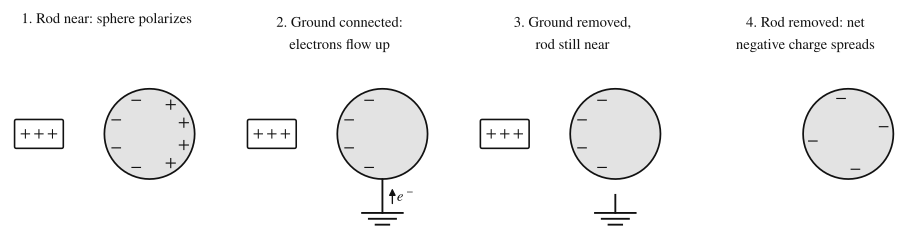
The result has the opposite sign to the inducing charge, and the inducing rod loses none of its own charge. Two details change the outcome:
- The order of steps 3 and 4 matters. If you remove the rod while the ground is still connected, the conductor's potential would go negative, and the extra electrons flow back to the Earth: the conductor ends up neutral.
- It does not matter where the ground wire touches. The conductor is one equipotential, so touching the near side, the far side or the bottom gives the same result. The electrons come up from the Earth either way. ("The ground removes the positive charge from the far side" describes the same final state, but nothing positive actually moves in a metal.)
The same idea works without ground. Put two uncharged metal spheres in contact, bring a charged rod near one of them, and separate the spheres while the rod is still near. The near sphere carries the charge opposite to the rod's, and the far sphere carries an equal amount of the same sign as the rod. Charge is conserved, so the two induced charges add to zero.
Worked examples
Three identical metal spheres on insulating stands carry charges , and . Sphere A touches sphere B, and they are separated. Then sphere B touches sphere C, and they are separated. Use .
(a) Find the final charge on each sphere.
(b) During the first contact, how many electrons move, and in which direction?
Show solution
(a) Identical spheres in contact share the total equally, because by symmetry equal charges are what give equal potentials. First contact: the total is , so A and B each end with . Second contact: B and C share , so each gets . Final: , , . Check: the total, , is the same as at the start.
(b) Only electrons move. Sphere B goes from to , so it loses worth of electrons, and they go to A:
A's charge falling from to is the same electrons arriving.
A small metal sphere of radius carries . A large metal sphere of radius , far away, carries . They are connected by a long, thin wire. Use and .
(a) Find the final charge on each sphere and their common potential.
(b) Compare the electric field magnitudes just outside the two spheres.
(c) Which way do electrons flow through the wire, and how many?
Show solution
(a) The total is . Equal potentials give , so the shares are in the ratio of the radii, :
The common potential is . The large sphere gives the same value, , which confirms the split.
(b) Just outside each sphere, :
Both fields point inward (the charges are negative). The small sphere's field is 4 times larger: at equal potential, for a sphere, so the field scales as .
(c) The small sphere goes from to , a change of , so it gains electrons, which come from the large sphere:
That direction matches the potentials before connection: the small sphere started at and the large one at , and electrons move toward higher potential.
A metal sphere of radius is connected to ground by a thin wire. A point charge is held a distance from the center of the sphere, with . Ignore any charge on the wire.
(a) Derive an expression for the net charge that flows onto the sphere from the ground, in terms of , and .
(b) For , and , calculate and the number of electrons that flow up the wire. Use .
(c) The ground wire is then disconnected, and after that the point charge is taken far away. Calculate the sphere's potential at the end. Use .
(d) If instead the point charge had been taken away first and the ground wire disconnected afterward, what would the sphere's final charge be? Justify your answer.
Show solution
(a) The grounded sphere is an equipotential at , so the potential at its center is zero. That point is the useful one because every bit of the sphere's own charge, however unevenly it is spread over the surface, is the same distance from the center. The potential there is the sum of the point charge's contribution and the sphere's:
The induced charge is opposite in sign to and smaller in size, since . It is not uniform: it crowds toward the side facing .
(b) . Electrons flowing up the wire:
(c) With the wire disconnected, the is trapped. When leaves, it spreads uniformly over the isolated sphere, so
(d) The final charge would be zero. While the sphere is still grounded and the point charge is removed, the sphere must stay at ; with nothing else nearby, that requires zero charge on the sphere, so the of electrons flows back down to the ground before the wire is disconnected.
Where students lose points
On the exam
Redistribution questions ask for final charges, a common potential, a comparison of surface fields, or the direction of electron flow, and they reward stating the governing condition (equal potential, conservation of charge) before computing. Induction questions can describe a sequence of steps and ask for the final sign of the charge, with a justification that names polarization and the role of the ground. A calculator is allowed throughout.
Check yourself
Question 1
A small metal sphere and a large metal sphere, far apart, are connected by a long thin wire and given some positive charge. Which statement is correct?
- A
The spheres carry equal charges, and the small sphere is at a higher potential.
- B
The spheres are at the same potential, and the field just outside the small sphere is stronger.
- C
The spheres are at the same potential, and the field just outside the large sphere is stronger because it holds more charge.
- D
The large sphere is at a higher potential because it holds more charge.
Show answer
B
Connected conductors share one potential. Equal potential means , so and the surface field is larger on the small sphere. Choice C is right that the large sphere holds more charge, but that charge is spread over far more area.
- A
Question 2
A metal sphere of radius carries charge . It is connected by a long thin wire to a distant, uncharged metal sphere of radius . What is the final charge on each sphere?
Show answer
on the sphere of radius and on the sphere of radius .
Equal potentials give , so , and conservation gives . So and .
Question 3
A negatively charged rod is held near an uncharged metal sphere on an insulating stand. The sphere is touched briefly with a grounded wire, the wire is removed, and then the rod is taken away. What is the sphere's final charge?
- A
Positive, because electrons flowed from the sphere to the ground.
- B
Negative, because the rod's charge was transferred to the sphere.
- C
Zero, because grounding always leaves a conductor neutral.
- D
Positive, because positive charge flowed up from the ground.
Show answer
A
The rod would make the sphere's potential negative; grounding holds the sphere at zero, so electrons are pushed down to the ground, leaving the sphere positive once the wire is removed. Choice D gets the sign right but describes a flow that doesn't happen: in a metal wire only electrons move.
- A
Question 4
A grounded metal sphere sits near a point charge . The point charge is moved so that its distance from the sphere's center doubles. What happens to the magnitude of the charge induced on the sphere?
- A
It doubles.
- B
It is unchanged, because the sphere is still grounded.
- C
It is halved.
- D
It becomes one quarter as large.
Show answer
C
Setting the potential at the center to zero gives , so , which is inversely proportional to . Choice D wrongly uses the inverse-square dependence of the field instead of the dependence of the potential.
- A