An X-ray tube accelerates electrons from rest across a gap held at , and they hit the target at about a third of the speed of light. You can find that speed without knowing the shape of the field in the gap, how long the gap is, or the path the electrons take. All you need is the potential difference and conservation of energy, because the electric force is conservative and the work it does depends only on the endpoints.
The energy change across a potential difference
When a charge moves from a point at potential to a point at potential , the potential energy of the charge-field system changes by the amount below. As in topic 9.1, that energy belongs to the moving charge together with the charges that produce the field, not to the moving charge alone:
This is topic 9.2's definition of potential, , solved for the energy. The four sign combinations are worth knowing without computing:
| Charge | Moves toward | If only the electric force acts | ||
|---|---|---|---|---|
| positive | lower | negative | negative | speeds up |
| positive | higher | positive | positive | slows down |
| negative | higher | positive | negative | speeds up |
| negative | lower | negative | positive | slows down |
Left alone, a positive charge accelerates toward lower potential, the way a ball rolls downhill. A negative charge accelerates toward higher potential. In both cases the system's potential energy falls.
Because for a particle is a small multiple of , atomic and nuclear energies are often given in electron volts. One electron volt is the energy change of a charge moving through a potential difference of :
A proton moving through loses of potential energy; an alpha particle, with charge , moving through the same difference loses . Convert to joules before you put an energy into .
Energy conservation for a moving charge
If the electric force is the only force doing work, the total of kinetic and electric potential energy stays fixed:
Applied to the X-ray tube, gives , about a third of .
The formula carries the factor-of-change answers:
- the speed grows as , so four times the potential difference gives twice the speed;
- the kinetic energy is proportional to the charge, so an alpha particle () gains twice the energy of a proton through the same ;
- the speed goes as , so the alpha particle, with twice the charge but about four times the mass, ends up slower by a factor of .
For particles, gravity is almost always negligible. A proton between plates apart with across them feels an electric force of and a weight of , a hundred billion times smaller.
Energy conservation also finds turning points. An alpha particle fired straight at a gold nucleus (, heavy enough to treat as fixed) with of kinetic energy slows as it climbs the potential hill around the nucleus and stops, for an instant, where all its kinetic energy has become potential energy:
When both charges are free to move, neither one sits in a fixed potential. Then use topic 9.1's energy of the whole system, , together with conservation of momentum, as Example 2 does.
Showing the energy with bar charts
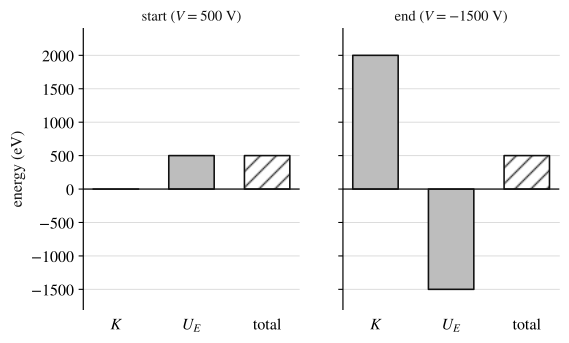
An energy bar chart draws one bar for each form of energy at two moments, with height proportional to the energy. Potential energy can be negative, so its bar can hang below the zero line. The total (the sum of the bars, with signs) is the same at both moments when no outside work is done. Drawing one before calculating catches sign mistakes: if the potential energy bar grows, the kinetic energy bar must shrink by the same amount.
Worked examples
In a vacuum chamber, point A is at a potential of and point B is at . Use , and .
(a) A proton is released from rest at A. Calculate its speed when it reaches B.
(b) An electron is released from rest at B instead. Does it move toward A? Calculate its speed if it gets there.
Show solution
(a) A positive charge accelerates toward lower potential, so the proton does head for B. Only the electric force does work, so
Starting from rest, :
The bar chart above shows this energy transfer in electron volts.
(b) Yes: a negative charge accelerates toward higher potential, and A is higher than B. Now , the same energy as the proton, but the electron's mass is times smaller:
Equal energies and a mass ratio of 1830 give a speed ratio of .
Two small charged spheres rest on a frictionless, insulating horizontal surface, held apart. Sphere A has mass and charge ; sphere B has mass and charge . Both are released at the same moment. Use .
(a) Calculate the speed of each sphere when they are very far apart.
(b) Suppose instead B is glued down and only A is released. Will A's final speed be greater than, less than, or equal to its speed in (a)? Justify your answer, and calculate it.
Show solution
(a) Both spheres move, so treat the two of them as the system. No outside force acts horizontally, so its momentum stays zero; only the internal electric force does work, so its energy is conserved.
The initial potential energy is
and far apart , so all becomes kinetic energy shared between the spheres. Momentum: , so . Energy:
so and , moving in opposite directions. As a check, A carries and B : the lighter sphere gets the larger share.
(b) Greater. With B fixed, the glue absorbs momentum, and the same of potential energy goes entirely to A instead of being shared:
A lab has an ion source that releases ions nearly at rest, a pair of grids across which a known, adjustable potential difference can be applied, and a field-free tube long after the grids, with detectors at each end that record how long each ion takes to cross it.
(a) Describe a procedure to determine the charge-to-mass ratio of the ions, including what to graph.
(b) A student collects the data below. Use it to determine .
| (V) | Time to cross the tube () |
|---|---|
| 100 | 4.14 |
| 200 | 2.86 |
| 300 | 2.37 |
| 400 | 2.03 |
| 500 | 1.83 |
(c) The ion source turns out to release ions with a small, fixed kinetic energy rather than at rest. How does that affect the graph and the value from (b)?
Show solution
(a) Set with the power supply and measure it with a voltmeter across the grids. For each setting, record the ions' crossing time for the tube (averaging several ions), and compute their speed ; the tube is field-free, so the speed is constant there. Repeat for at least five values of . Energy conservation for an ion that starts from rest gives , so
Graph on the vertical axis against on the horizontal axis. The graph should be a straight line through the origin with slope . Using a best-fit line through all the points, rather than one measurement, averages out random timing errors.
(b) Compute and for each row:
| (V) | ( m/s) | ( m/s) |
|---|---|---|
| 100 | 0.966 | 0.934 |
| 200 | 1.40 | 1.96 |
| 300 | 1.69 | 2.85 |
| 400 | 1.97 | 3.88 |
| 500 | 2.19 | 4.78 |
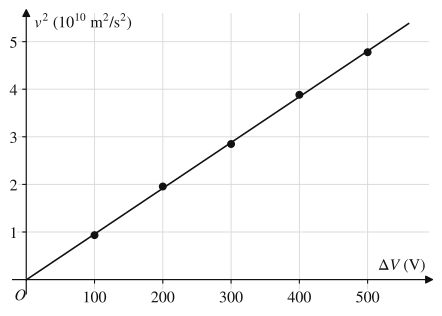
The best-fit line has slope and passes very close to the origin, as the model predicts. Its units work out to C/kg, since and . So
That is half the proton's value, : the ions carry one elementary charge on about twice the proton's mass, as a deuteron (one proton and one neutron) does.
(c) With initial kinetic energy , energy conservation becomes , so . The points shift up by the same amount: the line gets a positive vertical intercept, but its slope, and so the value of from the slope, is unchanged. Computing from a single point instead, as , would come out too high, which is another reason to use the slope.
Where students lose points
On the exam
Questions on this topic give a potential difference (as numbers, a graph of , or an equipotential map) and ask for a speed, a kinetic energy, a stopping point, or how one of these changes when the charge, mass or potential difference is scaled. Justifications should name the principle ("only the electric force does work, so mechanical energy is conserved") and state the system. Experimental questions use the same relation and expect you to choose quantities to graph that make it a straight line, then read the physical quantity from the slope.
Check yourself
Question 1
A proton and an alpha particle (charge , mass about ) each start from rest and are accelerated through the same potential difference. Compared with the proton, the alpha particle ends with
- A
twice the kinetic energy and times the speed
- B
the same kinetic energy and half the speed
- C
twice the kinetic energy and the same speed
- D
half the kinetic energy and the speed
Show answer
A
doubles with the charge. Then has twice the energy over four times the mass, a factor . Choice B assumes every particle gains the same energy through a given potential difference, which is true only for equal charges.
- A
Question 2
An electron moving at enters a region where only electric forces act on it, heading toward points of lower potential. How far down in potential can it go before it stops? Use and .
Show answer
About below its starting potential.
An electron loses kinetic energy moving toward lower potential. It stops when : , and dividing by gives .
Question 3
Ions starting from rest are accelerated through a potential difference . If is multiplied by 9, their final speed is multiplied by
- A
- B
3
- C
9
- D
81
Show answer
B
, so and . Choice C confuses the speed with the kinetic energy, which does grow by 9.
- A
Question 4
A student accelerates ions from rest through several potential differences , measures each final speed , and graphs against . What does the slope of the best-fit line equal?
Show answer
Energy conservation gives , so , a line through the origin whose slope is . Squaring the slope and halving it gives .
Question 5
An alpha particle is fired directly at a fixed nucleus and comes to rest momentarily at a distance . If its initial kinetic energy is doubled, the new distance of closest approach is
- A
- B
- C
- D
Show answer
B
At the turning point all the kinetic energy has become potential energy, , so . Doubling halves . Choice A uses the dependence of the force instead of the dependence of the energy.
- A