Coulomb's law gives the field of a point charge (topic 8.3), but a charged rod or ring is not a point: its charge sits at many different distances and directions from the spot where you want the field. The fix is to cut the object into pieces small enough to be point charges, write the field of one piece, and add all of them as vectors. Because there are infinitely many pieces, the sum is an integral.
Building a field from point-charge pieces
Charge spread along a thin object is described by its linear charge density , the charge per length in . A piece of length carries . (A surface uses in and a volume uses in , with or .) For a uniform rod of charge and length , .
The integral of a vector is not the integral of magnitudes: two pieces whose fields point in different directions partly cancel, and only the components keep track of that.
The cleanest case has no cancellation at all. Take a uniform rod of charge along the -axis from to , and find the field at a point on the same line, a distance past the right end, at . Every piece pushes a positive test charge in the direction, so the components all add. The piece at position is a distance from :
directed in . Check the limit: when , and the result becomes the point-charge field . Seen from far away, any finite object looks like a point, and a correct answer must reproduce that.
Letting symmetry cancel components
Before integrating, ask what the arrangement looks like after a reflection or rotation that leaves the charge unchanged. The field must be unchanged by that same operation, and that often forces a component to be zero. In practice you pair each piece with a mirror-image partner: their fields have equal magnitude, and the components perpendicular to the mirror line cancel.
Take a uniform rod of length and charge along the -axis from to , and a point a distance from its center on the perpendicular bisector.
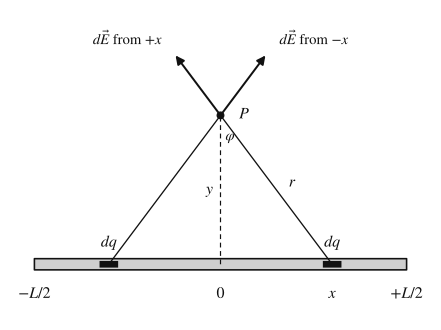
The piece at is a distance from , and its field makes angle with the -axis, where . The piece at has the same and the opposite horizontal component, so and only the -components survive:
The substitution makes this easy: and , so the integrand becomes and the integral is evaluated between the angles to the two ends. With ,
directed away from the rod along the bisector for .
Two limits tell you what this formula means.
- Far away (): , so , a point charge.
- Very close, or an infinitely long line (, or with fixed): , so
The field of an infinite line falls off as , not : moving away from a line, you get farther from every piece, but more of the line's length comes into view at a useful angle, and the two effects leave a slower falloff. Near the middle of any long rod (a few millimeters from a meter-long wire), the line result is an excellent approximation.
A long uniformly charged cylinder, solid or hollow, can be cut into thin lines parallel to its axis. At a point outside it, those lines together produce the same field as one line on the axis carrying the cylinder's charge per length , so with measured from the axis. Topic 8.6 gets that result, and the field inside the cylinder, from Gauss's law with no integral at all.
Arcs and rings: curved charge
When the charge lies on a circle, polar angle is the natural variable. A piece of arc of radius spanning angle has length , so .
At the center of an arc, every piece is the same distance away, which is what makes this case easy. Put the arc's center at the origin and let the arc run from to , symmetric about the -axis. The piece at angle sits at , and for positive charge its field at the center points from the piece toward the center, in the direction . The -components cancel in pairs, and
For a semicircle, and , so the field at the center has magnitude
pointing away from the arc's midpoint for . That is of the you'd get by pretending all the charge sat at one spot away, because the pieces near the ends of the semicircle push almost sideways and cancel each other. For a full circle, and : every piece has an opposite partner, and the field at the center of a uniform ring is zero.
On the axis of a ring, the field is not zero. Every piece of the ring is the same distance from a point a distance along the axis, and opposite pieces cancel each other's components perpendicular to the axis, but the components along the axis all point the same way and add. Example 3 carries out that integral and finds where the field is strongest.
| Distribution (uniform, charge ) | Point | Field magnitude |
|---|---|---|
| Rod of length | On its line, past an end | |
| Rod of length | Perpendicular bisector, from center | |
| Infinite line or long cylinder, | Distance from the axis (outside) | |
| Arc of radius spanning | Center | |
| Ring of radius | Axis, from center |
These are the arrangements the exam expects you to integrate. Don't memorize the table: the exam rewards the setup (the , the , the component, the limits), and each row takes a few lines once the setup is right. A nonuniform density changes only the : on a rod with , use inside the same integral.
Worked examples
A thin plastic rod long carries spread uniformly along it. Point lies on the rod's line, beyond one end. Use .
(a) Calculate the field at .
(b) A student models the rod as a point charge at its center. What field does that model predict at , and why is it too small?
(c) Repeat both calculations for a point beyond the end.
Show solution
(a) Every piece of the rod is on the same line as , so all the fields point the same way (away from the rod) and add directly. From the collinear result,
directed along the rod's line, away from the rod.
(b) The center is from , so the model gives , about 25% low. The field goes as , so the half of the rod nearer adds far more than the far half loses. Averaging over the rod is not the same as taking at the average distance.
(c) Now : the exact field is and the point model, with the center away, gives . They agree to within 0.3%, because from ten rod-lengths away the rod looks like a point.
A thin wire bent into a quarter-circle of radius lies in the first quadrant, from the positive -axis to the positive -axis, centered on the origin. It carries spread uniformly. Find the magnitude and direction of the electric field at the origin. Use .
Show solution
The arc's length is , so . A piece at angle (measured from the -axis) sits at and carries . Because the charge is negative, its field at the origin points toward the piece, in the direction . All pieces are a distance away, so
Here the components don't cancel; they come out equal because the arc is symmetric about the line , which already told you the field must point along that line. Numerically, , so
directed at above the -axis, toward the middle of the arc (as it must be for negative charge). Putting all the charge at the arc's midpoint would give , too large, because the pieces near the two ends pull partly against each other.
A thin ring of radius carries charge spread uniformly. The ring lies in the -plane, centered on the origin, so the -axis is its axis. Express answers in terms of , , and physical constants.
(a) Derive an expression for the electric field at a point on the axis a distance from the center.
(b) At what distance from the center is the field strongest?
(c) Sketch as a function of from to .
(d) A student estimates the field at by treating the ring as a point charge at the origin. Is the estimate too large or too small? Justify your answer, and find the percent difference.
Show solution
(a) Take a piece of the ring. Its distance to is , the same for every piece. The piece diametrically opposite has the same distance and a field whose component perpendicular to the axis is equal and opposite, so those components cancel around the ring and only survives, with :
directed along the axis away from the ring ( for , for ).
(b) Set the derivative to zero for :
The derivative is positive for and negative beyond, so this is a maximum, with . By symmetry the field has the same magnitude at .
(c) The graph is zero at the center, rises steeply to its peak at , then decays toward zero, approaching the point-charge curve . For negative it is the same shape flipped below the axis, because the field points in there.
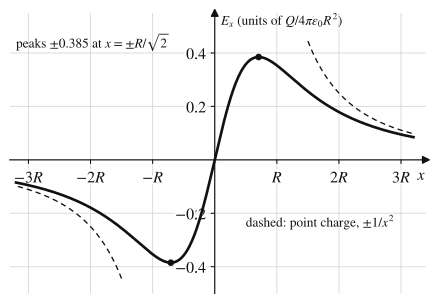
(d) Too large. The exact field at is , while the point-charge estimate is , about 17% larger. Two effects make the real field smaller: every piece of the ring is away rather than , and only the axial component, a fraction of each piece's field, counts.
Where students lose points
On the exam
Derivations are graded on the setup as much as the answer: a correct in terms of one variable (, ), the correct distance , the surviving component with a stated reason the others cancel, and limits of integration that cover the object once. Give the direction with the magnitude, and expect to explain a result through a limit ("far away it matches a point charge") or to predict a factor of change from the result's dependences: a semicircle of fixed charge whose radius doubles has one quarter the field at its center, because . The exam's integrals here are limited to the rod, line, cylinder, ring and arc cases above; for other shapes, reason about direction from symmetry instead.
Check yourself
Question 1
A thin wire bent into a semicircle carries uniform charge , and the field at its center is . The wire is replaced by a semicircle of twice the radius carrying charge . What is the field at the new center?
- A
- B
- C
- D
Show answer
C
The field at the center is , so doubling doubles it and doubling divides it by 4: the net factor is . Choice B notices that is unchanged and assumes the field is too, but at fixed the field at the center, , still falls as .
- A
Question 2
A thin rod lies on the -axis from to (with ) and has charge density , where is a positive constant. Find the electric field at the origin.
Show answer
in the direction.
A piece at carries and is a distance from the origin, so and . The charge is positive and lies in , so the field at the origin points away from it, in .
Question 3
A uniformly charged straight rod is long. A point on its perpendicular bisector moves from to from the rod. By what factor does the field magnitude change, to a good approximation?
- A
It falls to about one quarter.
- B
It falls to about one half.
- C
It stays about the same.
- D
It falls to about of its value.
Show answer
B
Millimeters from the middle of a meter-long rod, , so the rod acts as an infinite line with , and doubling halves (the exact ratio is 0.99998 of one half). Choice A applies the point-charge law, which holds only when .
- A
Question 4
A long hollow plastic tube of radius carries per meter of length, spread uniformly over its surface. What is the field magnitude from the tube's axis, far from its ends? Use .
- A
- B
- C
- D
Show answer
B
Outside, the tube acts like a line on its axis with the same , so . Choice A drops the factor of 2, choice C measures from the tube's surface (0.18 m), and choice D uses the tube's radius.
- A