Hold a window frame in a steady wind. How much air passes through it depends on three things: how fast the wind blows, how big the frame is, and how the frame is turned. Face-on, the most air gets through; edge-on, none does. Electric flux, written , is the same measurement for an electric field: how much field passes through a surface. In the field-line picture, it is proportional to the number of field lines crossing the surface. Gauss's law (topic 8.6) is a statement about flux.
Flux through a flat surface in a uniform field
To describe how a flat surface is turned, give it an area vector : its magnitude is the surface's area, and its direction is perpendicular (normal) to the surface. A surface is then fully described by one vector, and its tilt relative to the field is the angle between and .
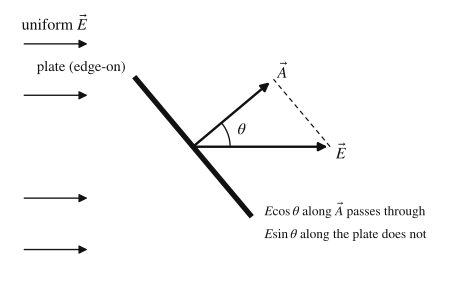
There are two ways to see where the cosine comes from. Split into a part along the normal, , and a part lying in the surface, . Only the normal part carries field through; the part along the surface slides past it. Or keep the whole field and shrink the surface instead: seen from the direction the field comes from, a tilted surface looks like a smaller one, of area , and that "shadow" is what the field lines have to cross.
For example, a square plate on a side sits in a uniform field of , with its normal at to the field. The flux is
Turn the plate face-on () and the flux reaches its maximum, . Turn it edge-on (, field parallel to the plate) and the flux is zero, even though the field at the plate is just as strong.
The sign of flux, and closed surfaces
A flat surface has two normals, pointing out of its two faces, and the formula needs you to pick one. Flux then has a sign, set by the dot product:
- : positive flux, the field crosses the surface in the direction of ;
- : zero flux, the field runs along the surface;
- : negative flux, the field crosses against .
For an open surface (a flag, a window, a bowl: something with an edge), the choice of normal is yours, and the sign only means something relative to it. Flipping the normal flips the sign of the flux. State the choice and stick with it over the whole surface.
A closed surface (a box, a sphere, a can with both lids: something enclosing a volume with no gaps) removes the choice. By convention every area vector points outward, away from the enclosed volume. Then the sign has a physical meaning: positive flux through a patch means field leaving the volume there, and negative flux means field entering. The net flux through a closed surface, written , adds the leaving and entering parts with their signs.
In a uniform field, every field line that enters a closed surface also leaves it, so the net flux through any closed surface in a uniform field is zero, whatever its shape. Example 2 checks this face by face. Topic 8.6 shows what a nonzero net flux means: charge inside.
Flux when the field varies: the surface integral
When the field changes in size or direction across the surface, or the surface is curved, has no single value to use. Cut the surface into patches small enough that each is flat and the field is constant across it, find the flux through each, and add them:
The skill is choosing patches on which is the same everywhere, so the integral has one variable:
- if the field changes along one direction across a flat surface, use thin strips perpendicular to that direction;
- if the field depends on distance from a point on a flat surface (a point charge facing a disk, as in Example 3), use thin rings, ;
- if the surface is a sphere or cylinder centered on the charge's symmetry, the field may be the same over the whole surface (topic 8.6 uses exactly this).
For example, take a square of side in the -plane, from to in both and , with normal , in the field , where and are constants. The part lies in the surface and contributes nothing. The part depends only on , so use strips of width and length , with :
With and , .
Curved surfaces in a uniform field have a shortcut. Cap an open curved surface with a flat one sharing its edge, and the two together form a closed surface, whose net flux in a uniform field is zero. With outward normals on that closed surface, , where the cap's outward normal points away from the curved part. Flip the cap's normal to point the same way across as the curved surface's normals (for a dome bulging toward with normals pointing away from its center, the cap's flipped normal is ), and : both count field crossing from the same side to the other. In a uniform field, the flux through any surface depends only on its edge.
Worked examples
A rectangular window by sits in a uniform field of magnitude . The field makes an angle of with the plane of the window.
(a) Calculate the magnitude of the electric flux through the window.
(b) What is the largest flux the window could have in this field, and how must it be oriented?
(c) The window's area vector is chosen to point to the side the field arrives from. What is the sign of the flux?
Show solution
(a) The is measured from the window's plane, but the flux formula needs the angle from the normal, which is . The area is , so
A field only from lying along the window passes little through it, which is why the answer is less than half the maximum.
(b) The flux is largest when : the window faces the field squarely, with the field perpendicular to the glass. Then .
(c) An area vector aimed toward the side the field comes from makes an angle of with the field, so the cosine is negative and . The physics hasn't changed; only the reference direction has.
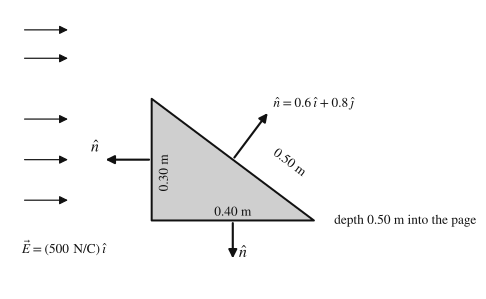
A closed wedge-shaped surface sits in a uniform field . Its bottom is a by rectangle on the floor, its back is a vertical by rectangle facing , its sloped top is a rectangle running from the top of the back down to the far edge of the bottom, and its two ends are right triangles. Find the flux through each face and the net flux.
Show solution
All area vectors point outward, because the surface is closed.
- Back face (): outward normal , opposite the field, so . Field enters here.
- Bottom and both triangular ends: their normals ( and ) are perpendicular to , so the field runs along them and each has zero flux.
- Sloped face: its length is , so its area is . Its outward normal points up and to the right, perpendicular to the slope: (going down the slope is the direction , and the unit vector perpendicular to that, pointing out of the wedge, swaps the numbers and fixes the signs). Then . Field leaves here.
Net flux: . The sloped face is larger than the back, but it is tilted, and its shadow seen along the field is exactly the back's by . The same field lines enter through one and leave through the other.
A point charge sits on the axis of a flat disk of radius , a distance from the disk's center. Take the disk's area vector to point away from the charge.
(a) Derive an expression for the electric flux through the disk in terms of , , and physical constants.
(b) Find the flux in the limit and explain the result physically.
(c) For what radius , in terms of , does one quarter of the charge's total flux pass through the disk?
(d) Calculate the flux for and . Use .
Show solution
(a) The field changes in size and direction across the disk but depends only on the distance from the disk's center, so cut the disk into thin rings of radius , width and area . Every point of one ring is a distance from the charge, where the field has magnitude and makes angle with the axis, with . So
With , , the integral is , and
The rings are the right patches because is the same all the way around each one.
(b) As , and . An infinite plane splits space in half, and by symmetry half of the charge's field lines go toward the plane's side and all of them cross it. Topic 8.6 shows that the total flux leaving a charge through any closed surface is ; the plane catches half.
(c) Set , so , , and . Geometrically, the disk's edge is then seen from the charge at from the axis.
(d) With , the bracket is :
Where students lose points
On the exam
Expect to calculate flux (through a tilted surface, a face of a box, or a surface where the field varies), to compare fluxes by ranking or factor of change as the orientation or area changes, and to evaluate the flux side of Gauss's law, , which each derivation in topic 8.6 sets equal to . In a derivation, state the patch you chose and why is constant on it, and give the sign of a flux with the direction of the area vector you used.
Check yourself
Question 1
An open hemispherical bowl of radius sits in a uniform field that points along the bowl's axis of symmetry. What is the magnitude of the flux through the bowl?
- A
- B
- C
- D
, because the field is not perpendicular to most of the bowl
Show answer
B
Cap the bowl with the flat disk across its rim. The closed surface has zero net flux in a uniform field, so the bowl carries the same flux as the disk, , the bowl's shadow along the field. Choice A multiplies by the bowl's full curved area, ignoring that most of it is tilted away from the field.
- A
Question 2
A flat loop in a uniform field has flux when it faces the field squarely. Through what angle must it be turned (about an axis in its own plane) for the flux to drop to ?
- A
- B
- C
- D
Show answer
C
Face-on, the area vector is parallel to the field and . Turning the loop by turns its normal by , so , and at . Choice B assumes the flux falls in proportion to the angle, and choice A mixes up and .
- A
Question 3
In a region of space the field is . A square on a side lies in the plane , with its area vector along . What is the flux through it?
Show answer
On the plane the -component of the field is everywhere, so it is uniform over the square: . The part lies in the square and contributes nothing.
Question 4
A cube sits in a uniform electric field, turned at some odd angle so that the field passes through three of its faces in and three faces out. Which statement is correct?
- A
The flux through each face is zero.
- B
The net flux through the cube is zero, but the fluxes through individual faces are not.
- C
The net flux is positive because the field passes through all six faces.
- D
The net flux depends on the angle at which the cube is turned.
Show answer
B
With outward area vectors, the three faces where the field enters have negative flux and the three where it leaves have positive flux, and in a uniform field every line that enters also leaves, so the total is zero at any orientation. Choice C adds magnitudes and ignores that entering flux is negative.
- A