Wrap any closed surface around some charges and add up the electric flux leaving it (topic 8.5 defined flux). The total depends on exactly one thing: the net charge inside. That fact is Gauss's law. It is true for every closed surface and every arrangement of charge, and for charge spread with enough symmetry it replaces the field integrals of topic 8.4 with one line of algebra.
What the law says
A Gaussian surface is a closed surface: it encloses a volume with no gaps, like a balloon or a sealed box, rather than an open sheet like a flag. It is imaginary, so you can draw it anywhere, including straight through charged material. As in topic 8.5, the area vector of each small patch points outward, away from the enclosed volume.
Two details decide most questions about the law.
- The field in the integral is the total field at each point of the surface, produced by every charge, inside and outside. Charges outside the surface change on the surface.
- Charges outside contribute zero net flux. Every field line from an outside charge that enters the surface leaves it somewhere else, so its inward flux and outward flux cancel. That is why only appears on the right.
For example, put and inside a lumpy closed surface and just outside it. The net flux is
no matter where inside the charges sit or what shape the surface has. The charge reshapes the field on the surface but adds nothing to the total. A negative gives negative flux: more field enters the surface than leaves.
Why the size and shape of the surface don't matter
Start with a point charge at the center of a sphere of radius . On the sphere the field has magnitude and points straight outward, parallel to at every patch, so and is the same everywhere on the sphere:
The radius cancels. A bigger sphere has a weaker field on it, falling as , but more area, growing as , and the two changes offset exactly. Gauss's law is the inverse-square law in disguise: if the field fell off as , the flux through a sphere would shrink as and no such law could hold.
For a surface of any other shape, think in field lines. The number of lines leaving a charge is proportional to the charge, and every line that starts inside a closed surface must cross it outward (on net) to get out, whatever the surface looks like. So the flux through any closed surface around is the same as through the sphere, . With several charges, the fields add, so the fluxes add, and each outside charge contributes zero.
The practical consequence: if you grow or shrink a Gaussian surface while the charge it encloses stays the same, the total flux does not change, even though the field on the surface does. If the surface cuts through a charged object, growing it encloses more charge and the flux grows with it.
Gauss's law is also the first of Maxwell's equations, the four equations that together describe all of classical electricity and magnetism: Gauss's law for electric fields, Gauss's law for magnetic fields (topic 12.1), Faraday's law (topic 13.2), and Ampère's law with Maxwell's addition (topic 12.4). Coulomb's law only describes charges at rest; Gauss's law stays true even when charges move.
Picking a surface that makes the integral easy
Gauss's law always holds, but it gives you only when you can pull out of the integral. That requires a surface built from pieces of two kinds:
- pieces where is perpendicular to the surface (parallel to ) and has the same magnitude everywhere, so that piece's flux is just ;
- pieces where lies along the surface, so and the piece carries no flux.
Symmetry tells you the field's direction before you calculate anything. For a ball whose charge density depends only on distance from the center, any rotation about the center leaves the charge looking the same, so the field cannot favor any direction other than radial, and its magnitude can depend only on . For a very long cylinder with charge depending only on distance from the axis, the field points straight away from the axis (a component along the axis would have to pick one end over the other). For a large flat sheet, the field is perpendicular to the sheet and has the same magnitude at equal distances on either side.
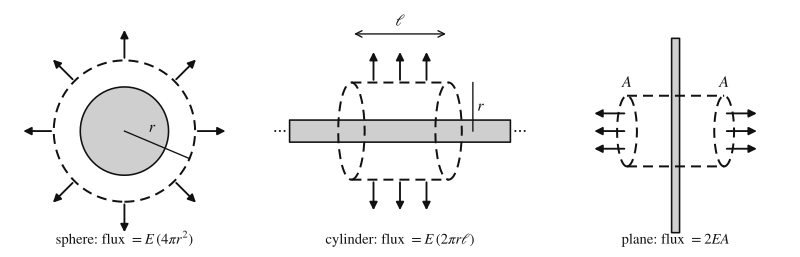
| Symmetry | Gaussian surface | Flux | Field |
|---|---|---|---|
| Spherical (or a point charge) | Concentric sphere, radius | ||
| Cylindrical (very long) | Coaxial cylinder, radius , length | ; ends carry none | |
| Planar (large sheet) | Cylinder or box through the sheet, end area | ; sides carry none | for a thin sheet |
The sheet result comes from setting the flux through the two end faces, , equal to , where is the charge on the patch of sheet inside the box. The distance from the sheet never appears, so the field of an infinite sheet is the same at every distance: its field lines are parallel and do not spread out. For a line charge , the cylinder gives , the same result topic 8.4 reaches by integrating along the whole line.
Inside a uniformly charged solid ball of total charge and radius , a Gaussian sphere of radius encloses only the fraction of the volume, so and
The field grows linearly from zero at the center to its largest value at the surface; outside, it falls as , exactly as if all the charge sat at the center.
The exam asks you to use Gauss's law to calculate fields only for point charges and for spherical, cylindrical and planar symmetry. For a finite rod, a cube or a disk, the law is still true, but no closed surface has a field of constant magnitude perpendicular to it, so it cannot give you ; use topic 8.4's integration instead. Topic 10.1 applies Gauss's law to conductors.
Finding the enclosed charge from a density
Charge spread over a region is described by a density: (coulombs per meter) along a line, (coulombs per square meter) over a surface, or (coulombs per cubic meter) through a volume. If the density is uniform, multiply it by the length, area or volume. If it varies, add up thin pieces on which it is nearly constant:
The trick is to choose pieces whose every point has the same density. When depends only on :
- for a sphere, use thin spherical shells, ;
- for a cylinder of length , use thin cylindrical shells, ;
- for a flat disk with depending on , use thin rings, .
Two short examples. A rod along the -axis from to with carries . A disk of radius with carries .
For Gauss's law you usually need the charge inside the Gaussian surface, not the total. Then the upper limit of the integral is the radius of the Gaussian surface (if it lies inside the charge) or the edge of the charge (if the surface lies outside it).
Worked examples
A point charge sits at the center of a spherical Gaussian surface of radius . Use and .
(a) Calculate the electric flux through the surface and the magnitude of the field on it.
(b) The radius of the surface is tripled to . Calculate the new flux and field magnitude.
(c) A charge is placed from the center. What is the flux through the surface? What is it if that charge is moved to from the center?
Show solution
(a) Gauss's law gives the flux directly from the enclosed charge:
On the sphere, , directed radially outward.
(b) The enclosed charge has not changed, so the flux is still . The field on the larger sphere is , one ninth as large, because the area grew by a factor of 9 and the flux stayed fixed.
(c) At the new charge is outside the sphere, so the flux stays . The field on the sphere is no longer uniform (it is stronger on the side facing the negative charge and weaker on the far side), but the outside charge's own field lines enter and leave the sphere, so its inward and outward flux cancel. At the charge is inside, so and
A large flat slab of insulating plastic is thick and carries a uniform charge density . Treat the slab as infinite in its two long directions, and measure from its midplane. Find the electric field (a) from the midplane and (b) from the midplane. Use .
Show solution
Start with the surface. The charge has planar symmetry about the midplane, so is perpendicular to the slab, points away from the midplane on both sides (the charge is positive), and has the same magnitude at and . By the same symmetry, on the midplane itself. Use a box with end faces of area at and , parallel to the slab. The field is perpendicular to both end faces and pointing out of them, and it runs along the four side faces, so
Placing the box symmetrically about the midplane is the move that makes the field equal on both end faces.
(a) Inside the slab, at , the box holds a layer of slab thick, so :
directed away from the midplane.
(b) Outside the slab, at , the box now holds the slab's full thickness, , so :
directed away from the slab. The answer does not depend on : outside, the slab acts like a thin sheet with , and matches.
A very long solid insulating cylinder of radius has a volume charge density that falls off from its axis as
where is a positive constant and is the distance from the axis. Express answers in terms of , , and physical constants.
(a) Derive an expression for the charge per unit length of the cylinder.
(b) Using Gauss's law, derive an expression for the magnitude of the electric field at a distance from the axis.
(c) Derive an expression for the magnitude of the field at a distance .
(d) Sketch as a function of from to . A student claims the field is strongest at the surface of the cylinder. Is the student correct? Justify your answer.
Show solution
(a) The density depends only on , so slice a length of the cylinder into thin cylindrical shells of radius , thickness and volume , each with uniform density:
Dividing by , .
(b) By cylindrical symmetry, points radially away from the axis and depends only on . Take a coaxial Gaussian cylinder of radius and length . The field is perpendicular to its curved side with constant magnitude and lies along its end caps, so the flux is . The enclosed charge is the same integral with upper limit :
Gauss's law, , gives
(c) For the same Gaussian cylinder encloses all the charge in its length, :
As a check, both expressions give at . With no surface charge, the field must be continuous there.
(d) The sketch starts at on the axis (no enclosed charge), rises, reaches a maximum inside the cylinder, comes down to at with no jump, and then decreases as , so that at it is half its value at and at a third.
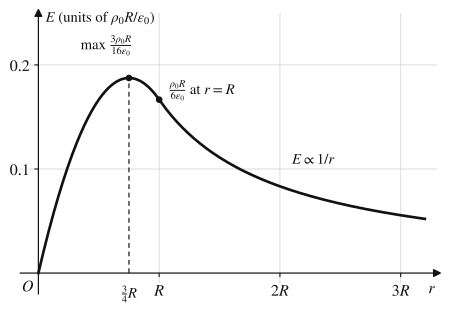
The student is not correct. Inside, , which is zero at , positive before it and negative after it. So the field is largest at , where , which is greater than the surface value . Physically, past the thin outer layers add so little charge that the enclosed charge grows more slowly than the area it is spread over.
Where students lose points
On the exam
In a Gauss's law derivation, show each step the reasoning needs: state the law, name the Gaussian surface and say why is constant and perpendicular on it (and zero flux through the other parts), compute (with an integral when the density varies), and solve for . Sketches of against are graded on behavior: zero or linear growth inside, the right falloff outside ( for spheres, for cylinders, constant for planes), and continuity at a surface with no surface charge. Factor-of-change questions ("the radius doubles; what happens to ?") come straight from those dependences. A calculator is allowed throughout the exam.
Check yourself
Question 1
A point charge sits at the exact center of a closed cubical surface. What is the electric flux through one face of the cube?
- A
- B
- C
- D
Gauss's law can't be used because the field is not uniform on a face.
Show answer
C
The total flux through the closed cube is by Gauss's law, and with the charge at the center the six faces are identical, so each carries one sixth. Choice D confuses finding (which needs a uniform field on the surface) with finding flux (which never does).
- A
Question 2
A solid insulating ball of radius has charge spread uniformly through its volume. What is the ratio of the field magnitude at to the field magnitude at ?
Show answer
2 (the field at is twice the field at ).
Inside, , which at is . Outside, , which at is . The ratio is 2.
Question 3
A closed surface encloses charges and . A charge sits outside it. Which statement is correct?
- A
The net flux through the surface is .
- B
The net flux is , and the field on the surface is produced only by the two enclosed charges.
- C
The net flux is , because only the sizes of the enclosed charges count.
- D
The net flux is , and the field on the surface is produced by all three charges.
Show answer
D
The flux counts only the net enclosed charge, . The field at each point of the surface is still the total field of every charge, including the outside one, whose flux simply cancels over the closed surface. Choice B gets the flux right but wrongly drops the outside charge from the field.
- A
Question 4
An insulating ball of radius has volume charge density , with . What is its total charge?
Show answer
Use thin spherical shells, : . Multiplying the density at the surface by the ball's volume would give a value times too large.
Question 5
Why can't Gauss's law by itself give the electric field at a point near the middle of a uniformly charged rod of length 10 cm?
- A
Gauss's law applies only to charges that are infinitely large.
- B
No closed surface around the rod has a field of constant magnitude perpendicular to it everywhere, so can't be taken out of the flux integral.
- C
The flux through any closed surface around the rod is zero.
- D
The rod's charge is spread out, and Gauss's law applies only to point charges.
Show answer
B
Gauss's law is true for the rod, but on any closed surface around the rod or part of it, the field changes from place to place: at a given distance from the rod, it is strongest opposite the rod's middle and points straight away from the rod there, and toward the rod's ends it weakens and tilts to point partly along the rod, away from its middle. So varies in size and direction over the surface, stays inside the integral, and the law gives only the total flux. Choices A and D describe limits on when the law is useful as if they were limits on when it is true.
- A