Hold one proton fixed and push a second proton toward it. The repulsion fights you the whole way, so you have to do work, and when you let go the second proton flies off and gets that work back as kinetic energy. The work went somewhere in between: it was stored in the arrangement of the two charges. That stored energy is the electric potential energy of the system, and because the electric force is conservative it depends only on where the charges are, not on how they got there.
Potential energy as the work to assemble the charges
Suppose a charge sits fixed and you bring a second charge in from very far away. Move it slowly, so that at every instant your push exactly cancels the electric force and gains no kinetic energy. Then all of your work goes into the system's potential energy:
The work done by the field is the negative of yours because the two forces are equal and opposite at every point. This is the same bookkeeping as lifting a book slowly in mechanics: the work you do equals the gain in gravitational potential energy.
To get a formula, carry straight in along a radial line from to a separation . The Coulomb force on is , pointing outward when the product is positive, so your force is the opposite of that. Integrating your force along the path from in to (the limits take care of the inward direction), the work you do is
The path didn't matter. On any curved path, break the motion into small radial steps and small steps along circles centered on . The force is radial, so the circular steps take no work, and the radial steps add up to the same integral. A force whose work depends only on the endpoints is conservative, and only conservative forces have a potential energy.
Choosing when the charges are infinitely far apart (where they don't interact at all) gives the formula.
Notice the power of : , not the of the force. Doubling the separation halves the energy but quarters the force.
What the sign of the energy tells you
The sign of is the sign of , and each sign has a physical meaning.
- Like charges: . You had to push to bring them together. Released, they fly apart and convert the stored energy to kinetic energy. The closer they are, the more energy is stored, and grows without limit as .
- Unlike charges: . They attract, so bringing them in from infinity, you hold them back and do negative work. Pulling them apart again takes positive work, exactly , to get back to zero. A negative potential energy marks a bound system: the hydrogen atom, or an ion pair in a salt crystal.
For example, and held apart have
so separating them completely, slowly, takes of external work.
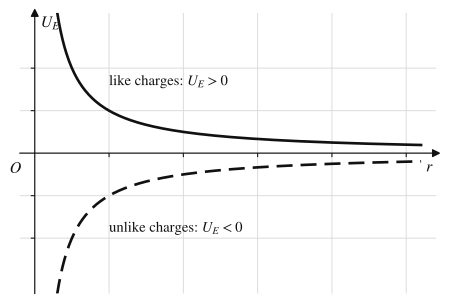
The graph of against is a curve: above the axis for like charges and below it for unlike charges, approaching zero far away in both cases. As in mechanics, the force along the line joining the charges is the negative slope, . For like charges the slope is negative, so : the force pushes the charges apart, toward lower energy. For unlike charges the slope is positive, so : attraction. Either way, a system left alone moves toward lower potential energy. Differentiating checks the formula: , Coulomb's law.
Systems of three or more charges
Build the system one charge at a time. Bringing in the first charge costs nothing, since nothing else is there yet. The second costs the energy of the pair it forms with the first. The third interacts with both, and since forces add, the work to bring it in is the sum of the energies of its pairs with charges 1 and 2. Continuing, the total is a sum over every pair, each counted once:
For three equal charges at the corners of an equilateral triangle of side , all three pairs are identical, so .
Two consequences come up constantly.
- Adding or removing one charge changes the energy only by that charge's pairs. Pairs between the other charges are untouched, so they cancel out of .
- Moving one charge while the others stay fixed changes only the pairs that involve the moving charge. If a question asks for the work to move it, the fixed charges' energy with each other is a constant you can leave out. (Topic 9.2 packages this as the charge times the electric potential at its location.)
Worked examples
A charge is fixed in place. An external agent slowly moves a charge from away to away. Use .
(a) Calculate the work done by the agent.
(b) How would the answer change if the agent took a long curved path between the same two points?
(c) Calculate the work if the moving charge were instead.
Show solution
(a) The motion is slow, so the charge gains no kinetic energy and the agent's work equals the change in the system's potential energy:
The work is positive: the agent pushes against the repulsion.
(b) It wouldn't change. The electric force is conservative, so , and the work, depend only on the starting and ending separations.
(c) Flipping one sign flips : . The charges now attract, so the agent holds the moving charge back to keep it from speeding up.
Three small charged beads are glued at the corners of a right triangle whose legs are and long. Bead A, , is at the right angle; bead B, , is at the end of the leg; bead C, , is at the end of the leg. Use .
(a) Calculate the electric potential energy of the three-bead system.
(b) Bead C is unglued and carried slowly to a point very far away. Calculate the work done by whoever carries it.
Show solution
(a) There are three pairs. B and C are separated by the hypotenuse, . Each pair's energy, with signs:
The total is . Negative means that, overall, assembling these beads from far apart releases energy.
(b) Removing C ends the AC and BC interactions and leaves the AB pair as it was. So
The work is negative. A's repulsion on C outweighs B's attraction, so the system pushes C away, and the person carrying it must restrain it.
Two particles, each with charge , are fixed on the -axis at and . A particle with charge can move along the -axis. Express algebraic answers in terms of , , , and physical constants.
(a) Derive an expression for the electric potential energy of the three-particle system when the particle is at position .
(b) Sketch as a function of for from to .
(c) Use your answer to (a) to find the -component of the electric force on the particle. Verify it against Coulomb's law.
(d) Calculate the work an external agent must do to move the particle slowly from the origin to a point very far away, for , and .
Show solution
(a) Sum over the three pairs. The two charges are apart. The particle is from each of them:
The first term is the fixed pair's energy; it is constant, but it is part of the system.
(b) The graph is symmetric about because appears only as . Its minimum is at , where the subtracted term is largest: . As grows, rises smoothly and levels off toward , the fixed pair's energy alone. The curve is flat (zero slope) at .
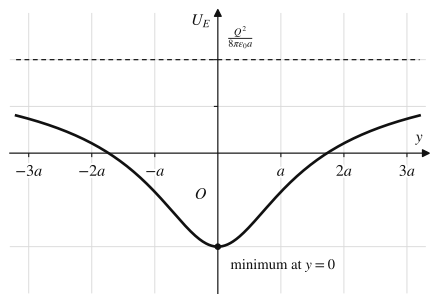
(c) The force component is the negative slope of the energy with respect to the moving particle's coordinate:
For the force is negative and for it is positive, so it always points back toward the origin: is a stable equilibrium, as the valley in the graph shows. From Coulomb's law, each attracts with magnitude . The -components cancel by symmetry, and each -component is that magnitude times , toward the -axis. Adding the two gives exactly the above.
(d) Slow motion means . Write both energies in full, with . Far away only the fixed pair's term survives, so , not zero:
The fixed pair's term cancels because that pair never moves.
Positive work is needed because the particle sits at the bottom of the energy valley.
Where students lose points
On the exam
Questions about this topic ask you to compute a system's energy from charges and distances, to say how it changes when a charge or distance changes by a factor, to sketch against separation, or to find the work done by an external agent or by the field. When you justify a claim, name the principle: the work done slowly by an external agent equals the change in the system's potential energy, and the field's work is its negative. Topic 9.3 adds kinetic energy to the bookkeeping for charges that are free to speed up.
Check yourself
Question 1
Two charges, each , are a distance apart, and the system's electric potential energy is . One charge is replaced by and the separation is changed to . What is the new potential energy?
- A
- B
- C
- D
Show answer
B
. The product of the charges becomes times as large and doubles, so becomes . Choice A treats the energy as , which is how the force scales.
- A
Question 2
Four charges, each , sit at the corners of a square of side . Find the electric potential energy of the system in terms of , and .
Show answer
Four charges form six pairs: four along the sides, each , and two along the diagonals, each . The sum is .
Question 3
The graph of the electric potential energy of two point charges against their separation has a positive slope at every . What does that tell you?
- A
The charges have the same sign and repel.
- B
The charges have opposite signs and attract.
- C
The charges have the same sign and attract.
- D
Nothing about the force; the slope of is unrelated to the force.
Show answer
B
The force along the line of centers is , so a positive slope means : the force pulls the charges together. A curve with positive slope everywhere is the negative branch, . Choice A reads the slope as the force itself, forgetting the minus sign.
- A
Question 4
An external agent slowly carries a charge halfway around a circle of radius centered on a fixed charge. How much work does the agent do?
Show answer
Zero.
The separation is at the start and at the end, so , and for slow motion the agent's work equals . At every point of the circle the electric force is radial and the motion is tangent to the circle, so no work is done along the way either.
Question 5
An electron and a proton are bound in an atom, so their electric potential energy is negative. Which statement is correct?
- A
Separating them to infinity takes positive external work equal to the magnitude of the potential energy (with no kinetic energy at the end).
- B
Separating them releases energy, because the potential energy rises toward zero.
- C
The negative sign only reflects the choice of zero and has no physical meaning.
- D
The potential energy belongs to the electron, since it is the particle that moves.
Show answer
A
Taking the pair from to at infinite separation means , which an external agent must supply. Choice B gets the direction of the energy change backward, and choice D forgets that potential energy belongs to the system of both charges.
- A