A car rounding a curve at a steady is accelerating, even though its speedometer never moves. Acceleration is any change in velocity, and the direction of the car's velocity is turning. Moving in a circle therefore requires a net force, and the whole topic comes down to two questions: how big must the inward acceleration be, and which real forces provide it?
Centripetal acceleration
Put an object on a circle of radius , moving at constant speed, and describe its position with the angle it has swept out, where is the rate the angle changes (in rad/s):
Differentiate twice:
The velocity is tangent to the circle with speed . The acceleration is : it points opposite the position vector, straight at the center, with magnitude . This inward part of an object's acceleration is the centripetal acceleration.
If the speed is also changing, the object has a second component of acceleration, the tangential acceleration , along the direction of motion (forward if speeding up, backward if slowing). The centripetal component changes the direction of the velocity, the tangential component changes its size, and the object's total acceleration is their vector sum. They are perpendicular, so its magnitude is .
Which forces make the centripetal acceleration
"Centripetal force" is not a new kind of force. It is a job: whatever real forces act on the object, the components of their sum that point toward the center must equal . Draw the free-body diagram with only real forces (gravity, normal, tension, friction), choose one axis pointing toward the center, and write
The job can be done by a single force (the string's tension on a ball whirled on a frictionless table, or gravity on a satellite), by several forces together (at the top of a roller-coaster loop, gravity and the track's normal force both point down, toward the center), or by components of forces:
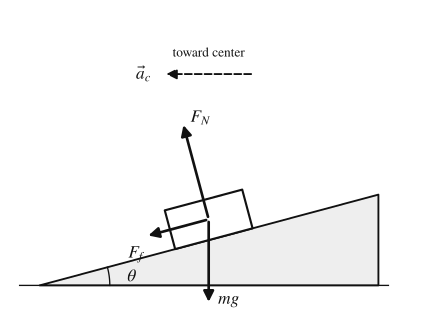
- Banked curve. The road is tilted at angle , so the normal force tilts toward the center and its horizontal component helps turn the car. Friction along the tilted surface contributes a horizontal component too. The figure shows a car going faster than the speed the bank is designed for, so friction points down the slope.
- Conical pendulum. A mass on a string swings in a horizontal circle, with the string sweeping out a cone. The tension's vertical component holds up the weight and its horizontal component points to the center of the circle.
The top of a vertical loop. At the top, gravity points down (toward the center) and the track pushes down on a car riding inside it, so . A slower car needs less inward force, so shrinks as drops. The normal force can't go below zero, because the track can only push, so the slowest the car can go and still follow the circle is when and gravity alone provides the centripetal acceleration:
Any slower and gravity pulls the car inward more than the circle requires, so it leaves the track. For a loop of radius , . A rider going over that top at needs of inward force; gravity supplies , so the seat pushes down on her with .
Circular orbits and Kepler's third law
For a satellite of mass in a circular orbit of radius around a central body of mass , gravity (topic 2.6) is the only force and does the whole centripetal job. Set it equal to and use :
A communications satellite that circles once every () above the equator keeps pace with Earth's rotation and stays over nearly the same spot on the equator. With Earth's mass as the central mass, its radius is , an altitude of about . (AP doesn't ask about Kepler's first and second laws.)
Worked examples
A car drives on a circular track of radius . (a) At a constant , find its centripetal acceleration, its period, and its frequency. (b) Later, at the instant its speed is , it is speeding up at . Find the magnitude and direction of its total acceleration.
Show solution
(a) , toward the center. , and .
(b) The centripetal part depends only on the instantaneous speed, so it is still toward the center. The tangential part is forward. They are perpendicular:
The acceleration points from the direction toward the center, tilted forward. It is no longer aimed at the center, because the speed is changing.
A ball on a string moves in a horizontal circle with the string at from the vertical. Use . Find the tension, the ball's speed, and the period.
Show solution
Two real forces act: tension along the string and weight. The center of the circle is level with the ball, directly below the pivot, so the radius is , not the string length.
Vertical (no vertical acceleration): , so .
Horizontal (toward the center): . Dividing by the vertical equation eliminates and : , so
Dividing the two component equations is the standard move: it removes the unknown tension in one step.
A highway curve of radius is banked at angle , and the coefficient of static friction between tires and road is .
(a) Derive the speed at which a car can round the curve with no friction at all.
(b) For a speed above , explain which way friction acts, and derive the maximum speed at which the car can round the curve without sliding.
(c) Evaluate and for , , and .
Show solution
(a) With no friction, only and act. Take horizontal toward the center and up; the acceleration is horizontal, so
(b) Above , the normal force's inward component is too small to supply the larger inward force that the higher speed requires, so the car tends to slide up and outward. Static friction opposes that and points down the slope, as in the figure. At friction is at its limit, . Resolve both forces horizontally and vertically:
Divide the first by the second (after moving across) to eliminate and :
Check: with this reduces to , as it must.
(c) and
Below friction would point up the slope instead. Here , so friction can even hold a parked car in place, and there is no minimum speed.
Where students lose points
On the exam
A free-response circular-motion part may ask for a free-body diagram, Newton's second law along the radial direction, and a derived expression such as a minimum or maximum speed. A complete derivation states which forces have components toward the center and ends in the requested variables. Questions about minimum speed at the top of a loop expect you to argue that the normal force reaches zero there; questions about orbits expect gravity set equal to , then .
Check yourself
Question 1
Satellite B orbits a planet in a circle whose radius is 4 times that of satellite A's circular orbit. What is the ratio of B's period to A's?
- A
- B
- C
- D
Show answer
C
Kepler's third law gives , so and . Choice B assumes the period is proportional to the radius, which ignores that the farther satellite also moves more slowly.
- A
Question 2
A Ferris wheel of radius turns at constant speed, making one revolution every . Using , find the normal force the seat exerts on a rider at the bottom and at the top of the circle.
Show answer
About at the bottom and at the top, both directed upward.
and . At the bottom the center is up: gives . At the top the center is down: gives .
Question 3
A car moves counterclockwise around a circular track and is speeding up. Which best describes the direction of its acceleration?
- A
Exactly toward the center
- B
Exactly along the direction of motion
- C
Between the direction toward the center and the direction of motion
- D
Between the direction toward the center and the direction opposite the motion
Show answer
C
The acceleration is the sum of a centripetal part toward the center and a tangential part forward (the speed is increasing). Choice A holds only at constant speed; choice D describes a car that is slowing down.
- A
Question 4
On a flat, unbanked curve, the maximum speed a car can have without skidding is limited by static friction. If the curve's radius is doubled and nothing else changes, the maximum speed is multiplied by
- A
- B
- C
- D
Show answer
B
Friction alone supplies the centripetal force: , so and doubling multiplies it by . Choice C forgets the square root on .
- A