A garbage truck rolling at and a car at need the same amount of energy taken away by their brakes to stop. The truck has four times the mass, the car has twice the speed, and speed counts squared. The quantity that makes those two equal is translational kinetic energy, the energy an object has because its center of mass is moving.
Kinetic energy is one-half m v squared
"Translational" means the motion of the object as a whole from place to place. A wheel spinning in place on an axle has no translational kinetic energy, because its center of mass isn't moving; the energy of its spin is rotational kinetic energy, which Topic 6.1 covers. A ball flying through the air can have both. This topic is about the first kind only, and for any object you model as a single particle it is the only kind there is.
Where does come from? It is the work you must do to bring an object from rest to speed . Push a mass along a line with a net force . Newton's second law says , and the chain rule turns into . So the work done over a small displacement is
and adding these up from rest to the final speed gives
The force doesn't have to be constant and the details of the push don't matter: any net force that brings from rest to transfers exactly of energy to it. Topic 3.2 turns this calculation into the work-energy theorem.
Kinetic energy is proportional to mass and to the square of speed:
- double the mass at the same speed: doubles;
- double the speed at the same mass: is multiplied by ;
- triple the speed: is multiplied by .
That is why braking distance grows so fast with speed. A car at has times the kinetic energy it has at , and with the same braking force it needs times the distance to dissipate it.
A scalar built from a vector
Velocity has a direction; kinetic energy does not. The formula uses , the square of the speed, and every component enters squared. Two consequences follow.
Direction never matters. A ball moving at has whether it moves up, down, east or at any angle. A ball that leaves your hand at upward and later passes the same point at downward has the same kinetic energy both times, even though its velocity reversed.
Kinetic energies add without canceling. Two carts moving toward each other at each have velocities that cancel when you add them, but their kinetic energies are both positive: the system has . The kinetic energy of a system of objects is the sum of the kinetic energies of its parts, and since no term can be negative, the total is zero only if every part is at rest.
The component form tells you how to handle a projectile. Gravity changes and leaves alone, so at the top of a projectile's flight but is still there: the kinetic energy at the peak is , which is zero only for a launch straight up. Worked example 3 builds the full graph of against time.
Different observers measure different kinetic energies
Speed is measured relative to something, so kinetic energy is too. A passenger asleep in a seat on a train moving at has zero kinetic energy in the train's frame and with in the ground's frame. Neither number is wrong. An observer's frame of reference is part of the description of any kinetic energy you state, and when a problem doesn't say, the frame is the ground (or whatever surface the motion is measured against).
The change is not a simple shift. If two frames move at velocity relative to each other, velocities differ by (Topic 1.4), but kinetic energies don't differ by any fixed amount, because the velocity is squared after the shift. Worked example 2 puts numbers on this for three observers of one hockey puck.
What every observer does agree on is the bookkeeping. In any frame that isn't accelerating, the change in an object's kinetic energy equals the net work done on it, measured in that same frame. You pick one frame at the start of a problem and use it for every speed in it; mixing a speed measured from a moving cart with one measured from the ground is how energy calculations go wrong.
Worked examples
A truck moves at and a car moves at , both measured relative to the road.
(a) Calculate each vehicle's kinetic energy.
(b) The truck speeds up to . By what factor does its kinetic energy increase?
Show solution
(a) Substitute each mass and speed into :
They are equal: the truck's factor of in mass exactly matches the car's factor of in .
(b) The mass is unchanged and the speed doubles, so is multiplied by , to . Reasoning with the ratio is faster than recomputing and is what a "by what factor" question wants to see.
A hockey puck slides east at relative to the ice. Find its kinetic energy as measured by (a) a referee standing still on the ice, (b) a skater gliding east at , and (c) a skater gliding west at .
Show solution
In each case, first find the puck's speed relative to the observer, then use .
(a) Relative to the referee, , so .
(b) The skater moves with the puck, so relative to the skater the puck is at rest: and .
(c) Take east as positive. The puck's velocity is and the skater's is , so the puck's velocity relative to the skater is , and .
All three answers are correct in their own frames. Compare (a) and (c): relative speed goes from to , an increase of , while kinetic energy goes from to , an increase of . Because the speed is squared, a change of frame never just adds a constant to .
Two identical balls are launched from level ground at . Ball 1 goes straight up. Ball 2 is launched at above the horizontal. Air resistance is negligible, and the gravitational field strength is .
(a) Derive an expression for Ball 2's kinetic energy as a function of time while it is in the air, in terms of , , , and .
(b) Calculate Ball 2's minimum kinetic energy and the time at which it occurs.
(c) On one set of axes, sketch versus for both balls from launch until each returns to the ground.
(d) A student says Ball 2 must have more kinetic energy than Ball 1 when it lands, because Ball 2 is moving sideways as well as down. Do you agree? Justify your answer.
Show solution
(a) Gravity acts only vertically, so the horizontal velocity stays and the vertical velocity is . Kinetic energy depends on the square of the speed, which is the sum of the squared components:
(b) The first term never changes, and the second is smallest (zero) when , at . There the speed is , so
The launch kinetic energy is , so Ball 2 never has less than three quarters of it.
(c) Both curves start at . Ball 1's kinetic energy is : a parabola opening upward that touches zero at the top of the flight, , and returns to when the ball lands at . Ball 2's is the same parabola shape, because expanding gives the same term, , that Ball 1's has; its vertex sits at and , and it returns to at landing, . It looks flatter on the graph only because it covers a smaller stretch of the parabola: of drop instead of . A sketch earns credit for the features: same starting value, Ball 1 reaching zero, Ball 2's nonzero minimum at half of Ball 1's peak time, and each curve symmetric about its minimum.
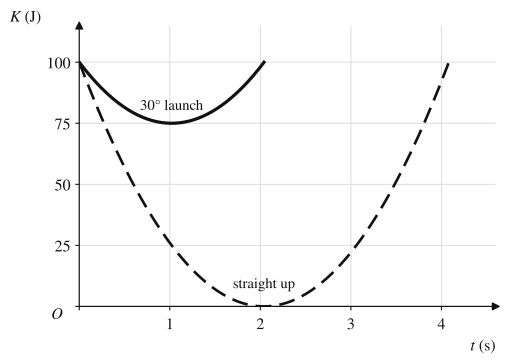
(d) Disagree. When Ball 2 lands, its vertical velocity is , the reverse of its launch value, so its speed is again . Ball 1 also lands at . Kinetic energy depends only on mass and speed, not on direction, so both land with . Moving sideways doesn't add extra kinetic energy; the horizontal and vertical components together make up the same speed.
Where students lose points
Check yourself
Question 1
A runner increases her speed by . By what factor does her kinetic energy increase?
- A
- B
- C
- D
Show answer
C
Kinetic energy is proportional to , so the factor is . Choice A treats as proportional to speed.
- A
Question 2
Two carts roll toward each other on a level track, each at relative to the track. What is the total kinetic energy of the two-cart system?
- A
- B
- C
- D
Show answer
C
Each cart has , and kinetic energies are scalars that are never negative, so they add to . Choice A adds the velocities, which do cancel, and then treats kinetic energy as if it had a direction.
- A
Question 3
Relative to the ground, a cart moving east at has of kinetic energy. What is its kinetic energy measured by a cyclist riding east alongside it at ?
Show answer
The cart's mass is . Relative to the cyclist the cart moves at , so . Halving the relative speed quarters the kinetic energy; it does not halve it.
Question 4
A stone is dropped from rest and falls with negligible air resistance. Which describes the graph of its kinetic energy versus time ?
- A
A straight line through the origin with positive slope
- B
A curve starting at zero that gets steeper as time goes on
- C
A curve starting at zero that rises quickly and then levels off
- D
A horizontal line, because no energy is added to the stone
Show answer
B
The speed is , so , a parabola through the origin whose slope keeps increasing. Choice A describes the speed, not the kinetic energy. ( is linear in the distance fallen, not in the time.)
- A