Drop a marble in air and it speeds up at ; drop it in a jar of honey and within a moment it sinks at a steady crawl. The difference is a force that depends on how fast the marble moves: the faster it goes, the harder the fluid pushes back. Because that force changes as the speed changes, the acceleration isn't constant, the constant-acceleration equations from Unit 1 fail, and you need calculus.
A force that depends on velocity
A resistive force depends on the object's velocity and points opposite to it. Air resistance, drag in water, and the braking force of a magnet on a moving metal plate (eddy-current braking) are all examples. The simplest model, and the one AP builds its calculus on, makes the force proportional to the velocity:
The linear model fits small objects moving slowly through thick fluids (a bead in oil, a dust grain in air) and magnetic braking. Larger, faster objects in air, like a falling person or a baseball, feel a drag closer to . The method below works for any resistive force; only the integral changes.
Newton's second law gives a differential equation
Since and the force depends on , Newton's second law becomes an equation relating to its own derivative, a differential equation. You solve it by separation of variables: get every on one side with and every on the other with , then integrate both sides between matching limits (the initial time with the initial velocity, a general time with the velocity at that time).
Coasting with only a resistive force. An object moving along with initial speed and nothing but acting on it:
Once you have , differentiate for acceleration and integrate for position, using the initial conditions:
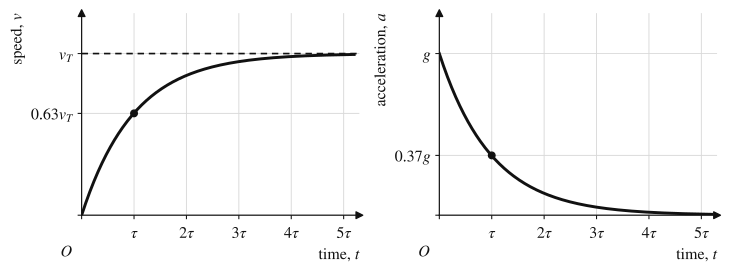
The speed and acceleration decay toward zero, but never reach it in any finite time, and the position approaches a horizontal asymptote, : the object coasts a finite distance in infinite time. The combination , in seconds, is the time constant. Every , the speed falls by a factor of ; after one it is at of , after at .
Falling against a resistive force: terminal velocity
Now add a constant force in the other direction: gravity on an object released from rest. Take down as positive, so gravity is and the resistive force is :
At the start, , so the object accelerates at . As it speeds up, drag grows, the net force shrinks, and so does the acceleration. The speed keeps rising but more and more slowly, approaching the speed at which drag equals weight. That limit is the terminal velocity: the largest speed reached when a constant force and a resistive force act in opposite directions, reached when the net force is zero.
To get the whole motion, separate and integrate from to :
Then , and integrating from gives . The graphs below show the shapes: rises toward the asymptote (reaching of it at ), and decays from toward the asymptote . The position graph starts as a parabola and straightens into a line of slope . Which asymptotes appear is set by the forces () and the initial conditions (, and where the object starts).
Worked examples
A cart rolls along a level track at into a region where a magnetic brake exerts a resistive force with . Ignore friction. (a) How long does it take the cart to slow to ? (b) How far does it travel in that time, and how far does it travel before stopping?
Show solution
(a) The only horizontal force is the brake, so with . Set :
(b) , and . At , , so . The cart never quite stops, but its position approaches , the total distance. Reusing from part (a) saves recomputing the exponential.
A object is released from rest and falls through a fluid that exerts a resistive force with . Use . Find (a) its terminal speed, (b) its speed and acceleration after release, (c) how far it has fallen by then.
Show solution
(a) Net force zero: .
(b) , so is and :
(c) . In free fall it would have dropped , so drag has already cut the fall to , about of the free-fall distance.
Model a skydiver of mass whose parachute opens when she is falling at speed , after which the air exerts a resistive force . Assume .
(a) Derive an expression for her speed after the chute opens, taking at opening.
(b) Sketch and explain its shape.
(c) With , , and , find her speed after opening and her acceleration just after opening.
Show solution
(a) Down positive. Newton's second law: . Separate and integrate from to :
Check: at , ; as , . The lower limit is what makes this differ from the from-rest result.
(b) The graph starts at and decreases, steeply at first and then more gradually, concave up, approaching a horizontal asymptote at from above without crossing it. While , drag exceeds weight, so the net force and acceleration point up and the speed drops. As falls, drag shrinks, so the upward net force and the rate of slowing both shrink toward zero.
(c) and :
Just after opening, : magnitude , directed upward. That is more than nine times , which is why real parachutes are built to open gradually.
Where students lose points
On the exam
Free-response questions ask you to write Newton's second law as a differential equation, separate variables, integrate with limits, and sketch or with the asymptote labeled. An experimental question may ask how to tell whether drag is linear or quadratic: drop objects of different mass with the same shape (stacked coffee filters, say), measure each terminal speed, and graph. A straight line for against means , linear drag; a straight line for against means quadratic drag.
Check yourself
Question 1
A falling object feels a drag force of magnitude . If its mass is multiplied by 4 with the same shape and size, its terminal speed is multiplied by
- A
- B
- C
- D
Show answer
B
At terminal speed , so , and quadrupling doubles . Choice C is the answer for linear drag, where is proportional to .
- A
Question 2
A ball is thrown straight up and feels a resistive force in addition to gravity. What is its acceleration at the instant it reaches its highest point?
Show answer
Exactly , directed downward.
At the top the velocity is zero, so the resistive force is zero and gravity is the only force. Just before the top the acceleration is larger than (drag and gravity both point down); just after, smaller (drag points up).
Question 3
An object released from rest falls with a linear resistive force and has terminal speed . At the instant its speed is , what is the magnitude of its acceleration?
- A
- B
- C
- D
Show answer
C
and , so at , . The acceleration falls linearly with speed even though it decays exponentially with time.
- A
Question 4
A puck coasting on a surface is slowed only by a force , and its time constant is . How long does it take for its speed to fall to half its initial value?
Show answer
.
, so and . The half-life is the same from any starting speed: it takes another to halve again.