Two bowling balls sitting apart pull on each other with about , roughly the weight of a grain of fine sand. The same law, applied to the of Earth, pulls each of those balls down with . Gravity is the weakest force you deal with in mechanics, and it dominates anyway because it only attracts, so the pulls from every bit of a planet add up instead of canceling.
Newton's law of universal gravitation
Every pair of objects with mass attracts. For two objects whose centers of mass are a distance apart, the force each exerts on the other has magnitude
In vector form, with the unit vector pointing from object 1 toward object 2 (topic 1.1), the force on object 2 is . The minus sign is the attraction: the force on 2 points back toward 1.
The opening numbers come straight from the formula: . The force is proportional to each mass and to , so tripling the separation divides the force by 9, and doubling one mass doubles it. Write the new force as a ratio to the old one and every constant cancels.
The gravitational field and weight
A mass changes the space around it so that any other mass placed there feels a force. The gravitational field is a way to describe that: at each point, it is the force a small test mass would feel, divided by . For a source of mass at distance ,
The field depends only on the source and on where you are, not on the test mass. Its unit is , which is the same as . That is no accident: if gravity is the only force on an object, Newton's second law gives , so the object's acceleration equals the field at its location. A field of means a falling rock speeds up by every second.
The gravitational force a planet or moon exerts on a small object near it is called the object's weight, . Earth, with and , gives at its surface.
When g counts as constant. The field falls off with distance, but slowly compared with Earth's size. A jet at altitude is at , and there is smaller by a factor , a change of . So whenever an object's distance from the center changes by a tiny fraction of that distance, you treat the gravitational force as constant over the whole motion and use near Earth's surface. For a satellite whose distance changes by thousands of kilometers, you can't: you use at each .
Apparent weight, weightlessness, and two kinds of mass
A bathroom scale doesn't measure gravity. It measures how hard it pushes up on you, the normal force. That push is your apparent weight: its magnitude is the magnitude of the normal force. Apply Newton's second law to you, with up positive and your acceleration:
If you are not accelerating, and the scale reads your true weight. If you accelerate upward (), the scale reads more; downward (), less. The sign of the acceleration decides it, not the direction you are moving. An elevator moving up and slowing down has a downward acceleration, so you feel light.
You appear weightless when nothing pushes on you, which happens in two cases: no forces act at all (deep space, far from any mass), or gravity is the only force acting (free fall, , so ). Astronauts on the International Space Station, about up, are in a field of about , close to of the surface value. They float because they and the station fall together around Earth, so the floor never pushes on them.
The equivalence principle goes further. Inside a closed room, you can't tell whether the floor presses on you because the room sits at rest in a gravitational field or because the room accelerates at through empty space. Every measurement you could make inside, from a scale reading to a dropped ball, comes out the same. Gravity and acceleration of your reference frame are locally indistinguishable.
That only works because of a striking experimental fact. Mass shows up in two separate laws:
- Inertial mass is the in : how strongly an object resists having its motion changed by any interaction.
- Gravitational mass is the in : how strongly an object is pulled by gravity.
Nothing in Newton's laws forces these to be equal. If they weren't, a falling object would have , and a lead ball and a wooden ball would fall at different rates. Experiments have compared the two for more than a century, from Eötvös's torsion balances in the early 1900s (agreement to a few parts in a billion) to the MICROSCOPE satellite in 2022 (about one part in ). They are equivalent, which is why every object in a given field has the same free-fall acceleration and why you can write a single in both places.
Gravity from a sphere: the shell theorem
A planet is not a point. To find its pull on you, you'd split it into tiny pieces of mass , find each piece's force along the line to that piece, and add the vectors (an integral). Newton did this for a sphere and found results simple enough to use without redoing the integral. You don't need to prove them, only apply them.
Why zero inside a shell? Stand off-center inside it and look along any narrow cone in both directions. The cone cuts a small patch out of the near wall and a larger patch out of the far wall. A patch's area, and so its mass, grows as the square of its distance from you, while each kilogram's pull falls as . The two effects cancel, so opposite patches pull equally hard in opposite directions, and the whole shell sums to zero.
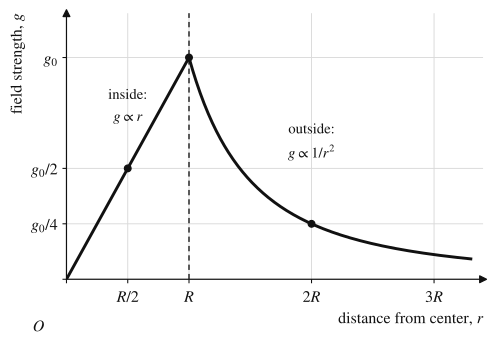
Inside a uniform solid sphere. Let the sphere have mass , radius , and density . At distance , the mass that pulls is the mass inside radius :
The force grows in proportion to and points toward the center, so as a component along it has the form with . Dividing by gives the field shown below. At the center it is zero (pulls from every side cancel), it rises linearly to its surface value , then falls off as .
Worked examples
A probe has a weight of on Earth's surface, where . (a) What is the gravitational force on it at an altitude of ? (b) At what altitude, in kilometers, is its weight half its surface value? Use .
Show solution
(a) Altitude is measured from the surface, but the law needs distance from Earth's center: . Taking the ratio to the surface value cancels and :
(b) Half the force needs , so . The altitude is . Working with ratios is the move here: no constants, no chance to mistype .
A student stands on a scale in an elevator. Use . Find the scale reading when the elevator (a) moves upward and speeds up at , (b) moves upward and slows down at , (c) is in free fall after a cable fails.
Show solution
Draw the student's free-body diagram: weight down, normal force up. Take up as positive, so and . Only the acceleration enters.
(a) Speeding up while going up means the acceleration points up: . , more than the true weight of .
(b) Slowing down while going up means the acceleration points down: . .
(c) In free fall, and . The student appears weightless, yet the gravitational force on her is still ; it is what makes her fall.
A planet is a uniform sphere of mass and radius . A narrow tunnel is drilled through its center, and a small object of mass is in the tunnel at distance from the center.
(a) Derive an expression for the magnitude of the gravitational force on the object in terms of , , , and .
(b) Calculate the gravitational field strength at the surface and at .
(c) Above the surface, at what distance from the center is the field strength the same as at ? Justify why the field is not the same at and .
Show solution
(a) By the shell theorem, the shells farther out than exert no net force, and the mass inside radius acts as a point at the center. The planet is uniform, so the mass inside scales with volume:
(b) At the surface, . Inside, , which is linear in , so at , .
(c) Outside, . Setting gives from the center. At the field is , half of the value at : moving in to removes seven-eighths of the pulling mass but only halves the distance, while moving out to keeps all the mass and quadruples . Halving and doubling are not mirror-image moves, because the field grows in proportion to inside the planet and falls as outside it.
Where students lose points
On the exam
Functional-dependence questions ("the separation is tripled; by what factor does the force change?") are answered fastest as ratios. A derivation for a point inside a sphere earns credit for the step that uses only the enclosed mass and for expressing that mass through density or . A claim about weightlessness or apparent weight needs the normal force named and Newton's second law applied, not a description of how the person feels. The value of and near Earth are on the equation sheet; the shell theorem is not, so state it in words when you use it.
Check yourself
Question 1
Two objects attract each other with a gravitational force of magnitude . Both masses are doubled and the distance between their centers is doubled. What is the new force?
- A
- B
- C
- D
Show answer
B
The force goes as : doubling both masses multiplies it by 4, and doubling divides it by 4, so it is unchanged. Choice D forgets the distance; choice C treats the dependence on as .
- A
Question 2
A planet has twice Earth's mass and twice Earth's radius. Taking at Earth's surface, what is the gravitational field strength at this planet's surface?
Show answer
(equivalently ), half of Earth's value.
, so the ratio is , and . A bigger planet does not automatically have stronger surface gravity: the radius enters squared.
Question 3
A small ball sits inside a thin, uniform spherical shell of mass, much closer to one side of the shell than the other. What is the net gravitational force the shell exerts on the ball?
- A
Toward the nearer side of the shell
- B
Toward the center of the shell
- C
Zero
- D
Toward the farther side of the shell
Show answer
C
By the shell theorem the net force anywhere inside a uniform shell is zero. Choice A reasons that the nearer mass pulls harder, which is true per kilogram, but the farther side has proportionally more mass in each direction, and the two cancel exactly.
- A
Question 4
You wake up in a closed, windowless cabin. Your mass is , the scale under you reads , and a pen you let go of accelerates toward the floor at relative to the cabin. Which statement is correct?
- A
The cabin must be at rest on Earth's surface, since only gravity makes things fall.
- B
The cabin must be accelerating at through empty space, since the scale reads more than zero.
- C
The cabin could be at rest on Earth's surface or accelerating at (floor to ceiling) far from any mass, and no experiment inside the cabin can tell which.
- D
The cabin is in free fall near Earth, since the pen falls at .
Show answer
C
, and both situations produce that normal force and that pen motion. The equivalence principle says that from inside, gravity and the acceleration of your frame can't be distinguished. Choice D fails because in free fall the scale would read zero and the pen would float beside you.
- A