Lean on a heavy crate with and it doesn't move, so the floor must push back with exactly . Push with and it still doesn't move: now the floor pushes back with . Friction that holds things still adjusts itself to whatever the situation demands, up to a limit, while friction on a sliding object has a fixed size. Those are two different forces with two different rules, and each needs its own test.
The normal force and friction are two parts of one contact force
When two surfaces touch, each pushes on the other with a single contact force. You split it into two components:
- the normal force , the component perpendicular to the surface, always directed away from the surface (a surface can push on you but never pull);
- the friction force, the component parallel to the surface.
The normal force is not automatically . It is whatever it has to be to stop the object from sinking into the surface, so you find it from Newton's second law perpendicular to the surface. A sled on level snow pulled by a rope angled upward has part of its weight held up by the rope, so the snow pushes up with less than . On an incline at angle , if nothing else acts perpendicular to the slope. In an accelerating elevator (topic 2.6), . Get the normal force wrong and every friction value after it is wrong too.
Kinetic friction: surfaces sliding past each other
Kinetic friction acts when the two surfaces are moving relative to each other. Its direction on each surface is opposite to that surface's motion relative to the other one. Its magnitude is
"Relative to the other surface" matters. A box sliding backward across the bed of a truck that is speeding up forward may still be moving forward relative to the ground, but relative to the truck bed it slides backward, so kinetic friction on the box points forward.
Why area doesn't matter. Surfaces that look flat touch only at microscopic high points. Press them together harder and the high points squash, so the true contact area grows in proportion to the normal force. Lay a brick on its broad face instead of its end and the apparent area triples, but the weight is now spread over three times as many high points, each pressed a third as hard and so squashed less. The total true contact area, set by the brick's weight, is unchanged, and so is the friction.
Static friction: holding surfaces together
Static friction acts between surfaces that are not sliding relative to each other. It has no formula for its value. It takes whatever magnitude and direction are needed to keep the surfaces from slipping, and you find it from Newton's second law like a tension. It has a ceiling:
The ceiling is higher because surfaces at rest settle into each other and form more and stronger bonds at their contact points; once sliding, the bonds don't have time to form. Rubber on dry concrete has against .
The figure follows a crate on a level floor (, , , so ) as you push horizontally, slowly increasing the push. While the crate stays put, static friction matches the push exactly, a straight line of slope 1. At static friction can't grow any more, the crate breaks loose, and friction drops to , where it stays however hard you push.
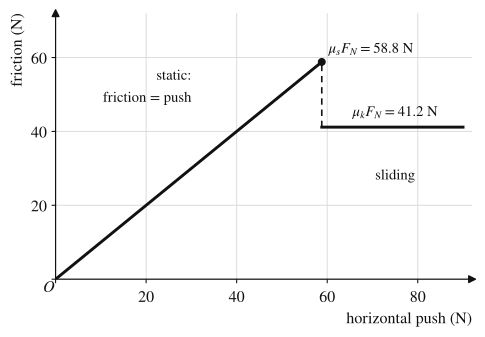
Static friction can point in the direction of motion, and often causes it. When you push off to start walking, your shoe pushes backward on the ground without slipping, and static friction from the ground pushes you forward. A crate riding on the bed of a truck that speeds up is accelerated forward by static friction from the bed.
Worked examples
A sled is pulled across level snow by a rope that makes above the horizontal and has tension . The coefficient of kinetic friction is and . Find the sled's acceleration.
Show solution
The sled slides, so friction is kinetic: . Find first, from the vertical direction, where the sled doesn't accelerate:
The rope lifts part of the sled's weight, which is why . Then , backward. Horizontally, with forward positive:
The crate from the figure (, ) starts at rest. Find the friction force and the crate's acceleration when the horizontal push is (a) , (b) .
Show solution
Always test static first: compare the force needed to hold the crate still with the maximum static friction, .
(a) Holding the crate still needs of friction, less than , so static friction supplies exactly that: opposite the push, and . Writing here would make the net force point backward and the crate accelerate toward you, which is absurd.
(b) Holding it would need , more than the available, so the crate slides and friction is kinetic: . Then in the direction of the push.
A block rests on top of a block, which sits on a frictionless floor. Between the blocks, and . A horizontal force pulls the bottom block to the right. Use .
(a) Draw the directions of the friction forces on each block while they move together.
(b) Derive an expression for the largest for which the blocks move together, and evaluate it.
(c) Find the acceleration of each block when .
Show solution
(a) Only friction from the bottom block can accelerate the top block to the right, so friction on the top block points right. By Newton's third law, friction on the bottom block from the top block points left. Here friction on the top block points in its direction of motion: it opposes slipping, not motion.
(b) Moving together, both blocks share an acceleration . The top block's only horizontal force is static friction: . The whole system, top plus bottom, has only as an external horizontal force: . Static friction is capped at (the top block's normal force is ), so
Using the system for and the top block alone for the friction limit is the efficient route: each equation has one unknown.
(c) exceeds , so the top block slips and friction between the blocks is kinetic, . The top block slides backward relative to the bottom block, so friction on it still points right:
The bottom block pulls ahead, consistent with the top block slipping backward relative to it.
Where students lose points
On the exam
An experimental-design question may ask how to measure a coefficient of friction. For , tilt a board with the object on it until the object just begins to slide: at that angle , from . For , pull the object at constant velocity with a force sensor, so friction equals the measured pull, and plot friction against normal force for several added masses: the slope of the line is . A full answer names what is measured, what is varied, and how the graph gives the coefficient.
Check yourself
Question 1
A box with weight rests on a level floor, with . You push it horizontally with and it does not move. What is the magnitude of the friction force on the box?
- A
- B
- C
- D
Show answer
B
The box doesn't accelerate, so the net horizontal force is zero and static friction equals the push, . Choice C is , the maximum static friction, which is reached only when the box is about to slip.
- A
Question 2
You hold a book against a vertical wall by pushing on it horizontally. The coefficient of static friction between book and wall is , and . What is the smallest push that keeps the book from sliding down?
Show answer
, directed horizontally into the wall.
The wall's normal force equals your push, . Static friction, pointing up, must hold the weight: , so . Here the normal force has nothing to do with the book's weight.
Question 3
A brick slides across a floor on its broad face. It is flipped onto its narrow end, which has one-third the contact area, and slides at the same speed. How does the kinetic friction force change?
- A
It is one-third as large.
- B
It is unchanged.
- C
It is three times as large.
- D
It is nine times as large.
Show answer
B
Kinetic friction is , and the normal force is still the brick's weight. The true microscopic contact area is set by the normal force, not the apparent area. Choice A assumes friction scales with apparent area.
- A
Question 4
You start walking from rest on a dry sidewalk and speed up. As you push off, what is the direction and type of the friction force the ground exerts on your planted shoe?
- A
Kinetic friction, backward
- B
Static friction, backward
- C
Kinetic friction, forward
- D
Static friction, forward
Show answer
D
Your planted shoe doesn't slide on the ground, so the friction is static. Your foot pushes backward on the ground, and the ground's friction on you opposes that would-be slip, pointing forward; it is the external horizontal force that speeds you up. Choice B points friction against your motion instead of against the slipping.
- A