Hang a mass on a spring and it stretches ; hang and it stretches . Double the force, double the stretch. That proportionality is what makes a spring useful as a force meter, and it is the single fact behind everything in this topic: a spring's force depends only on how far it is stretched or squeezed from its relaxed length, and it always pushes or pulls back toward that length.
Hooke's law and the ideal spring
An ideal spring has two properties: its mass is negligible, and the force it exerts is proportional to the change in its length measured from its relaxed length (the length it has with nothing pulling or pushing on it). For an ideal spring,
A spring with stretched pulls with ; compressed , it pushes with .
A nonideal spring breaks one of the two conditions. If its mass matters, different coils carry different forces (the bottom coil of a hanging Slinky supports almost nothing, the top coil supports the whole thing), so "the spring's force" isn't a single number. If the force isn't proportional to the deformation, the force-versus-stretch graph curves. Every real spring does this if stretched far enough: past its elastic limit the coils bend permanently, and the same added force produces more stretch than before.
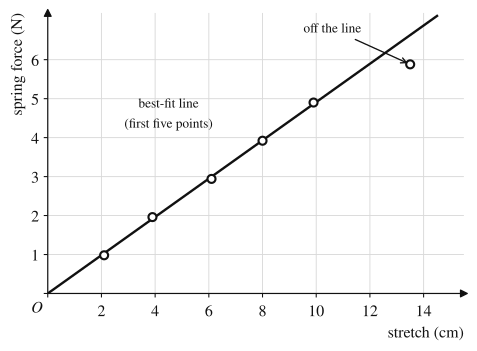
Finding k from data. Hang known masses, measure the stretch for each, and plot spring force (the hanging weight, since the mass is at rest) against stretch. For an ideal spring the points fall on a straight line through the origin, and the slope is .
Which way the spring force points
The relaxed position is where the spring exerts no force, so for a block on a frictionless horizontal surface it is the block's equilibrium position: displace the block either way and the spring force points back toward it. That is why springs make things oscillate (Unit 7 builds simple harmonic motion on exactly this).
Hang the block vertically and the equilibrium shifts down to where the spring's pull balances the weight, a stretch of . The spring force alone still points toward the relaxed length, but the net force of spring plus gravity now points toward the new equilibrium, and it has the same size times the displacement from that equilibrium. Gravity only moves the center point; it doesn't change the stiffness.
Combining springs: series and parallel
Several springs acting on one object behave like a single spring with an equivalent spring constant . Two arrangements matter.
Series (end to end, like train cars). Pull the free end with force . Each massless spring carries the same force , since each one's ends must balance. Their stretches add: . Setting and canceling :
Every extra spring adds more stretch for the same force, so a series combination is softer than any one of its springs: is smaller than the smallest .
Parallel (side by side, attached to the same object, which is kept from tilting). Every spring stretches by the same , and their forces add on the object: . So
Parallel springs share the load, so the combination is stiffer than any one of them.
With and , series gives , less than , and parallel gives . The course expects you to reduce only arrangements that are all series or all parallel, not a system that mixes the two.
Worked examples
A block on a frictionless horizontal surface is attached to a spring with , whose other end is fixed to a wall on the left. (a) The block is pulled to the right of the relaxed position and released. Find its acceleration just after release. (b) The same block now hangs at rest from the same spring. How far is the spring stretched? (c) The hanging block is pulled below that rest position. Find the net force on it.
Show solution
(a) , pointing left, back toward the relaxed position. It is the only horizontal force, so , to the left.
(b) At rest, the spring's pull up equals the weight: , so .
(c) Now the spring is stretched from its relaxed length, so it pulls up with . Gravity pulls down with . The net force is upward, toward the rest position, and it equals times the displacement from that position: .
Use the graph above. (a) Determine the spring constant. (b) A student claims the spring is ideal over the whole range tested. Evaluate the claim using the data.
Show solution
(a) The spring constant is the slope of force against stretch. Use points on the best-fit line, not individual data points, so measurement scatter averages out. The line runs through the origin and :
Converting centimeters to meters before dividing is what keeps the unit right; is the same number in units nobody wants.
(b) The claim is false. An ideal spring's force is proportional to its stretch, so all points would lie on one line through the origin. The first five do. For the load, the line predicts a stretch of , but the measured stretch is : the spring stretched more than proportionally, so above about it is no longer ideal.
A uniform ideal spring has spring constant . A block of mass hanging from it stretches it by .
(a) The spring is cut into two equal halves. Derive the spring constant of one half.
(b) The two halves hang side by side from the ceiling, both attached to the top of the block so that they stretch equally. Derive the equivalent spring constant and the new stretch in terms of .
(c) With , and , calculate and the new stretch.
Show solution
(a) The whole spring is the two halves in series. Call each half's constant :
Physically: under a force each half carries all of but has half the coils, so it stretches half as much, which is twice the stiffness.
(b) Side by side with equal stretch, the halves are in parallel: . At equilibrium the stretch is . Since , the new stretch is .
(c) , and the new stretch is . The same piece of wire is four times stiffer when cut and doubled up.
Where students lose points
On the exam
Expect to plot force against stretch from a data table, draw a best-fit line, and get from its slope with units; graders look for a line drawn through the trend (not through every point) and for the slope taken from points on that line. Justifying that a spring is or isn't ideal means pointing to the linearity of that graph. A derivation of an equivalent spring constant earns credit for stating which quantity is shared (force in series, stretch in parallel) and which quantity adds.
Check yourself
Question 1
Two identical ideal springs, each with spring constant , are connected end to end, and a block hangs from the bottom one. What is the equivalent spring constant of the pair?
- A
- B
- C
- D
Show answer
B
End to end is series: , so . Each spring carries the full weight and stretches as much as one spring alone would, so the total stretch doubles. Choice D is the parallel rule.
- A
Question 2
A spring has a relaxed length of . When a mass hangs at rest from it, its length is . Using , find the spring constant.
Show answer
.
At rest, with , so . Using the full length would give about .
Question 3
Which observation shows that a spring is nonideal?
- A
Doubling the hanging mass doubles the stretch.
- B
The spring force points back toward the relaxed length.
- C
A graph of force versus stretch bends away from a straight line at large stretches.
- D
The spring has a large spring constant.
Show answer
C
An ideal spring's force is proportional to its deformation, so its force-stretch graph is a straight line through the origin. A curving graph breaks that proportionality. Choices A and B describe ideal behavior, and stiffness alone says nothing about ideality.
- A
Question 4
Three ideal springs with constants , and are combined. Find the equivalent spring constant (a) in parallel and (b) in series.
Show answer
(a) . (b) .
Parallel constants add: . In series, , so , smaller than the softest spring, as a series combination must be.