Hold a suitcase motionless for a minute and your arms ache, yet the suitcase has gained no energy at all. Carry it up a flight of stairs and it has. In physics, work is the energy a force transfers into or out of a system by acting while the system moves, and it is the link between forces (Unit 2) and energy (Topic 3.1).
Only the part of the force along the motion does work
When a force acts while its point of application moves through a small displacement , the work it does is the dot product . For any two vectors, the dot product is a scalar, , where is the angle between them when they are drawn tail to tail. Adding up the small pieces along the whole path gives the definition.
The is doing real work of its own. Pull a wagon with along a handle tilted above the ground for : only points along the path, so you do . The upward component lightens the wagon's load on the ground but transfers no energy to it, because the wagon doesn't move up.
The sign tells you which way the energy flows. A force with a component along the motion (positive work) puts energy into the object; kinetic friction on a sliding box points against the motion and does negative work, taking energy out. A force can do zero work three ways: the object doesn't move, the force is perpendicular to the motion, or the force acts at a point that doesn't move. That last case is why holding the suitcase still does no work on it, however tired you get.
Perpendicular forces steer without changing speed
A force perpendicular to the velocity can change the direction of motion, but not the speed, because it never has a component along the motion. The normal force on a car rounding a banked curve, the tension in a string swinging a ball in a horizontal circle, and gravity on a satellite in a circular orbit all do zero work. Each one bends the path while leaving unchanged, which is exactly what uniform circular motion (Topic 2.10) looks like.
The normal force from a fixed surface does zero work on an object sliding along it for the same reason, even on a curved ramp: at every instant it is perpendicular to the surface, and the object moves along the surface.
Variable forces: integrate, or find the area
When the force changes along the path, no longer applies, and you go back to the integral. In one dimension, along the -axis, , and that integral is the signed area under the force-position graph, with on the vertical axis and on the horizontal. Area above the axis is positive work; area below it is negative.
A spring is the standard case. A spring of constant stretched by pulls back with (Topic 2.8). As a block on its end moves from to with , the spring does
It is negative because the spring pulls toward while the block moves away. On the graph of , it's the area of a trapezoid below the axis. Using with the force at either end would give or , both wrong; the integral averages the changing force correctly.
The work-energy theorem
Add up the work done by every force on an object and you get its change in kinetic energy. The derivation is the one in Topic 3.1: Newton's second law gives , and integrating from to gives .
The theorem replaces "find the acceleration, then use kinematics" with one equation, and it keeps working when the force varies, where kinematics equations don't apply.
When is something "an object"? Work is computed with the displacement of the point where the force is applied. If that point moves exactly as the system's center of mass does, the force can only speed up or slow down the whole system, and the system can be modeled as an object: all the work shows up as kinetic energy. If the point of application moves differently from the center of mass, the force can change the system's shape or internal energy instead. Two cases:
- Squeeze a spring between your hands. The ends move inward and your forces do positive work, but the spring's center of mass stays put and it gains no kinetic energy. The work went into the spring's configuration, stored as potential energy (Topic 3.3).
- A skater pushes off a wall. The wall's force on her hands acts at a point that never moves, so the wall does zero work, yet she leaves with kinetic energy. That energy came from inside her (chemical energy in her muscles), so she is not a single object for this energy analysis.
Friction takes energy out over the whole path. Kinetic friction of magnitude always points against the sliding, so the energy it dissipates is times the length of the path traveled, not the displacement. That energy becomes thermal energy in the surfaces (and some sound). AP Physics C asks you to track the mechanical energy lost; you only need to know where it goes, not to analyze the heating.
Conservative and nonconservative forces
Lift a book straight up, or carry it up a winding staircase to the same height: gravity does either way, because only the vertical part of each step contributes. Bring the book back down to where it started and gravity does , for a total of zero around the closed loop.
That defines a conservative force: the work it does depends only on the starting and ending positions, not on the path, so it is zero for any round trip. Gravity and ideal spring forces are conservative. Because the work depends only on position, you can store it as a function of position, a potential energy. Potential energies exist only for conservative forces, and Topic 3.3 builds them.
A nonconservative force does work that depends on the path. Drag a box across a rough floor and back, and friction does negative work on both legs; the round trip total is not zero, and a longer route costs more. Friction and air resistance are the nonconservative forces you will meet most often. No potential energy can be defined for them, because there is no single number to assign to a position.
Worked examples
A child pulls a sled from rest across level snow with a rope that makes with the horizontal. The tension is , the coefficient of kinetic friction is , and the gravitational field strength is . Find the work done by each force over , and the sled's speed at the end.
Show solution
Start with the free-body diagram: tension along the rope, gravity down, the normal force up, and friction backward. The normal force is not here, because the rope's upward component carries part of the weight. Vertical forces balance:
Now take each force with its angle to the displacement:
- tension, at : ;
- friction, at : ;
- gravity and the normal force, at : zero work each.
The net work is , and since the sled started at rest, :
Calculating each force's work separately and then adding is the bookkeeping graders follow; it also catches the normal-force correction, which changes the friction work.
A crate is dragged at constant speed across a level floor from corner to corner , away in a straight line. The coefficient of kinetic friction is and .
(a) Find the work done by friction for the straight route, and for a route that goes east and then north to the same corner.
(b) The crate is then dragged straight back to . Find the work done by friction for the round trip along the straight line, and compare it with the work done by gravity on a box lifted and lowered back.
Show solution
(a) Friction has magnitude and always points opposite the motion, so on every segment its work is times the segment's length:
Same endpoints, different work: friction is nonconservative.
(b) On the way back friction again opposes the motion, so it does another , and the round trip total is , about , not zero. Gravity on the lifted box does going up and coming down, a total of zero. A nonzero round trip total is the test that rules out a potential energy for friction.
A cart moves along a straight, horizontal, frictionless track. The graph shows the net horizontal force on it as a function of position. At the cart moves in the direction at .
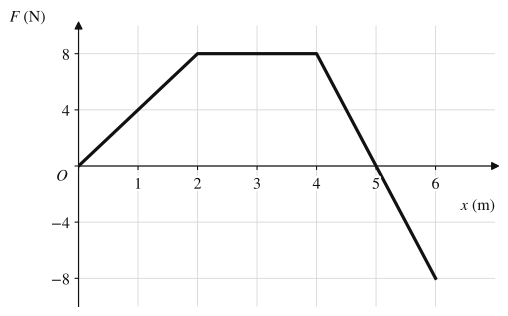
(a) Find the net work done on the cart from to , and the cart's speed at .
(b) Find the cart's speed at .
(c) At what position is the cart's speed greatest? Justify your answer.
Show solution
(a) Work is the area under the curve, split into simple shapes: the triangle from 0 to 2 m, ; the rectangle from 2 to 4 m, ; the triangle from 4 to 5 m, . The net work is . The cart started with , so by the work-energy theorem and
(b) From 5 to 6 m the area is a triangle below the axis, . Now and .
(c) At . Up to there the force points in the direction of motion, so it does positive work and the kinetic energy keeps rising. Beyond it points backward and does negative work, so the kinetic energy falls. The maximum is where the force changes sign, not where the force is largest.
A block of mass starts from rest at on a horizontal surface with coefficient of kinetic friction . A horizontal force in the direction, , acts on the block for , where and are positive constants and .
(a) Derive an expression for the work done by as the block moves from to a position , where .
(b) Derive an expression for the block's speed at position .
(c) Derive the position at which the speed is greatest, and justify why it is a maximum.
(d) For , , , and , calculate and the maximum speed.
Show solution
(a) The force varies with position, so integrate. It points along the motion, so :
(b) Friction is constant, , and opposes the motion, so . Gravity and the normal force do no work. Apply the work-energy theorem with :
(c) The speed is greatest where is. Set :
is the net force. Before the push exceeds friction, so the net work on each step is positive and increases; after it, friction exceeds the push and decreases. So is a maximum, located where the net force is zero.
(d) , so . Then
On a derivation, writing as an integral with its limits, naming each force's work, and then applying each earn credit separately.
Where students lose points
Check yourself
Question 1
A satellite moves in a circular orbit around Earth at constant speed. How much work does Earth's gravitational force do on it during half an orbit?
- A
Zero, because the force is always perpendicular to the satellite's velocity
- B
Zero, because the satellite's displacement over half an orbit is zero
- C
A positive amount, because gravity is the only force on the satellite
- D
A negative amount, because gravity points opposite the satellite's displacement
Show answer
A
Gravity points toward Earth's center, perpendicular to the velocity at every instant, so along the whole path; the speed, and so the kinetic energy, never changes. B gives the right number for the wrong reason: after half an orbit the displacement is a full diameter, not zero.
- A
Question 2
A force acts on an object as it moves along the -axis from to . How much work does the force do?
Show answer
The force varies, so integrate: . Using the force at either end times would give or .
Question 3
A box is pushed up a rough ramp and then slides back down to its starting point. For the whole round trip, which forces do a nonzero total amount of work on the box?
- A
Gravity only
- B
Friction only
- C
Both gravity and friction
- D
Neither gravity nor friction
Show answer
B
Gravity is conservative: it does going up and coming down, a total of zero. Friction opposes the motion on both legs, so its work is negative on each and the total is negative. (The normal force is perpendicular to the ramp and does no work on either leg.)
- A
Question 4
An elevator car rises at constant speed. Which describes the work done on it by the cable, by gravity, and the net work, in that order?
- A
Positive, negative, zero
- B
Positive, negative, positive
- C
Positive, zero, positive
- D
Zero, negative, negative
Show answer
A
The cable pulls up along the upward motion (positive work) and gravity pulls down against it (negative work). The speed is constant, so and by the work-energy theorem the net work is zero: the two works are equal in size. B forgets that net work must match the change in kinetic energy.
- A